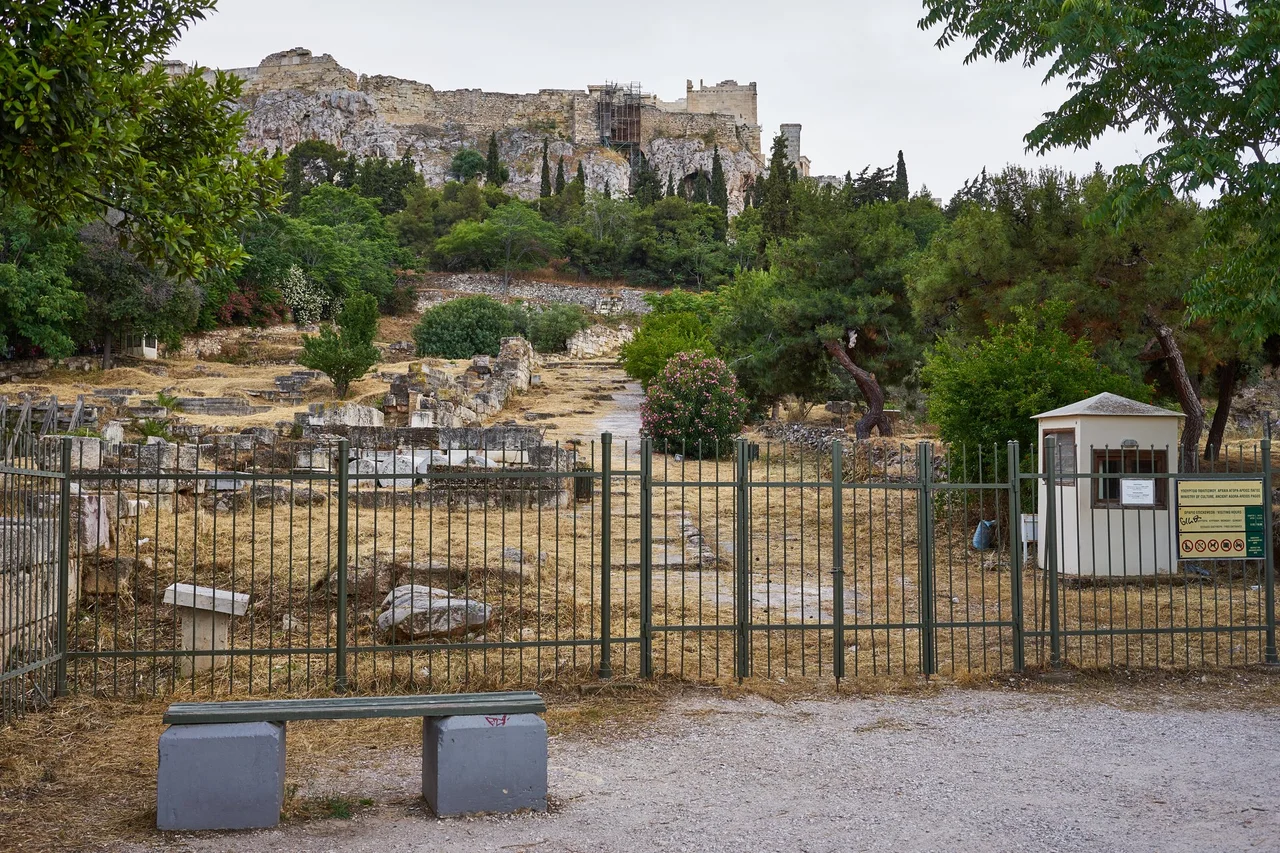

Eleusinion
Pausanias, the ancient world's most thorough travel writer, came to this sanctuary in the second century AD ready to describe everything he saw. Then he stopped. A dream, he wrote, had forbidden him to record what lay inside. He would say nothing about the temple of Demeter and Kore. This was the City Eleusinion, the Athens end of the most famous secret in the Greek world, and even a man who catalogued half of Greece would not break its silence.
Where the Secrets Were Kept
The sanctuary clung to the lower north slope of the Acropolis, just south of the bustling Agora and hard against the Panathenaic Way. It was dedicated to Demeter, goddess of grain, and her daughter Kore, whom most knew as Persephone, queen of the dead. Every autumn, before the Eleusinian Mysteries began, young men called ephebes carried sacred objects the fifteen miles from Eleusis into the city and stored them here for the festival's first five days. No one outside the cult knew what these objects were. To reveal them was a capital crime. The Eleusinion was the threshold of that secret, the place where the holy things rested in the heart of Athens before the rite reached its climax.
The Procession to Eleusis
The Mysteries promised something no other Greek cult offered: a happier fate in the afterlife. Those who wished to be initiated gathered at the Eleusinion to undergo the myesis, the pre-initiation, guided by members of the two ancient clans who controlled the rite, the Eumolpidae and the Kerykes. For five days the initiates prepared in the city. Then, on the sixth, a vast procession set out along the Sacred Way, carrying the holy objects back to Eleusis, where the deepest secrets were finally revealed by torchlight. When it was over, the Council of Five Hundred convened in the Eleusinion to review how the festival had been run. The state took these rites seriously enough to audit them.
A Temple for the First Farmer
Only the western edge of the sanctuary has ever been dug, a narrow strip clinging to the slope; the holiest core still lies buried under modern Athens. What archaeologists found centers on a small temple to Triptolemus, the mythical first human to receive the gift of farming from Demeter and to ride the world in a winged chariot teaching others to sow grain. Begun around 500 BC, his temple was interrupted by the Persian invasion that sacked Athens in 479 BC and finished only a generation later. Margaret Miles, who reconstructed it, found it echoed the elegant Ionic design of the Temple of Athena Nike on the Acropolis above. A bronze bull once stood before its doors, the standard sacrifice owed to the god of the harvest.
The Priestess Who Would Not Curse
In 414 BC, Athens was gripped by scandal. The brilliant, reckless general Alcibiades and others stood convicted of mocking the Mysteries and smashing the sacred Herms. Their property was seized, auctioned, and the records inscribed on ten stone slabs set up here in the Eleusinion. Every Eleusinian official was ordered to pronounce a public curse on the convicted men. One refused. Theano, priestess of Demeter and Kore, declared that she was "a praying priestess, not a cursing priestess." In a city consumed by fear and retribution, her quiet line of dissent survived the centuries, a small act of conscience preserved alongside the inventories of confiscated furniture.
The Long Twilight
The cult was extraordinarily durable. When the Heruli sacked Athens in AD 267 and a new wall was thrown up that left most of the city, even the Agora, outside its protection, the builders made a point of enclosing the Eleusinion. Unlike nearly everything around it, the sanctuary was not torn apart for stone, a measure of how much it still meant. The Mysteries ran for well over a thousand years, fading only under the anti-pagan laws of Theodosius I near the end of the fourth century. Houses, a Byzantine laundry, churches, and quarries later rose over the sacred ground. Today a quiet strip of foundations on the Acropolis slope is all that marks the spot where Athens kept its greatest secret.
From the Air
The Eleusinion lies on the north slope of the Acropolis at roughly 37.97°N, 23.72°E, within the fenced Ancient Agora archaeological site in central Athens. From the air it is a small terraced patch immediately below and north of the Parthenon-crowned rock, hard to single out among the ruins but framed by the unmistakable Acropolis itself. Nearest airport is Athens International (LGAV), about 33 km to the east-southeast. The dry, clear skies of the Attic summer give the best views over the historic center and out toward the Saronic Gulf and the route to Eleusis (modern Elefsina) to the west-northwest.
Nearby Stories
- Great Sand Beach 5 km away
- Battle of Delium 7.7 km away
- Tower of Aliartos 9 km away
- HMHS Britannic 10 km away
- Saronic Gulf 15 km away
- Sousaki Volcano 17 km away
- Sanctuary of Apollo Maleatas 24 km away
- Skyros 66 km away