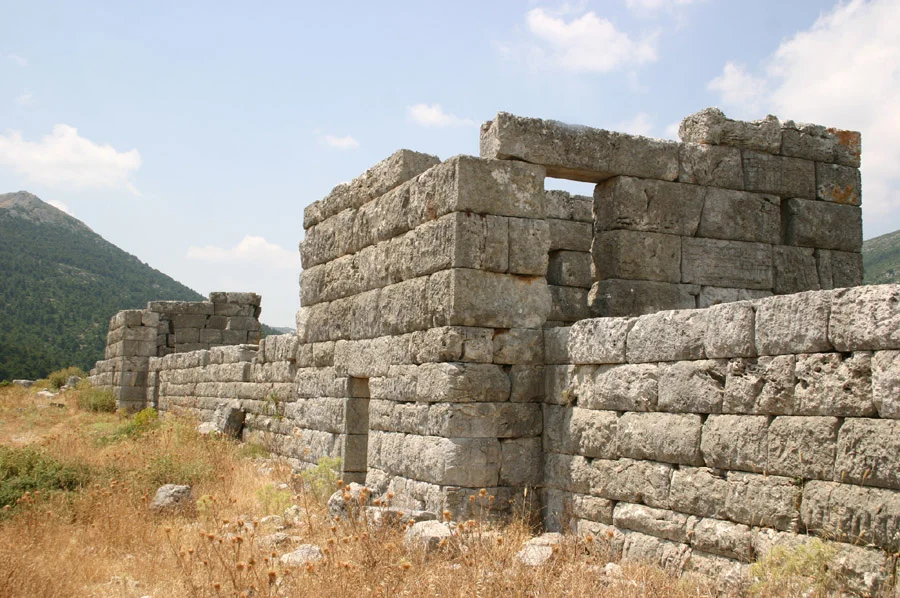

Eleutherae
A town that chose to be conquered. That is the strange truth at the heart of Eleutherae, a small polis perched on the rocky frontier where Attica gives way to Boeotia. According to the traveler Pausanias, who passed through in the 2nd century AD, the Eleuthereans did not surrender to Athens because an army defeated them. They volunteered. Worn down by the constant aggression of nearby Thebes, they handed their independence to the Athenians in exchange for citizenship and protection. In doing so, this obscure border settlement gave Athens a gift that would outlast every wall and treaty: the god Dionysus, the festival in his honor, and the seed of Western theatre itself.
The Liberator's Gift
In myth, Eleutherae was founded by Eleuther, a son of Apollo. Its real legacy is the cult of Dionysus Eleuthereus, "Dionysus the Liberator," whose old wooden image the town carried south to Athens. The Athenians, the story goes, first rejected the god and were struck by plague for the insult. Only after they honored him with a procession did the city recover. From that reconciliation grew the Dionysia, originally an Eleutherean festival celebrating the new wine. At the Theatre of Dionysus beneath the Acropolis, the priest of Dionysus Eleuthereus sat in the place of highest honor, his ornate marble throne planted dead center in the front row. It was at these festivals that tragedy and comedy were first performed as public competitions. A small town's local wine god became the patron of an entirely new art form.
Walls of Fine Masonry
What survives at Eleutherae today is not a temple but a fortress, and it is one of the finest of its kind anywhere in the Greek world. Built between roughly 370 and 360 BC, its walls of carefully fitted masonry average 2.6 meters thick. The circuit runs about 860 meters around an irregular enclosure roughly 113 by 290 meters across. Six towers still stand along the northern edge, preserved to heights of four to six meters, with the foundations of others marking the rest of the line. You can still trace the large double gate on the west, a smaller gate to the southeast, and two narrow sally-ports cut into the north wall for quick sorties. Scholars connect its construction to Thebes, which dominated the region in the years after its victory at Leuctra in 371 BC.
A Hometown of Sculptors
Eleutherae produced more than a god. It was the birthplace of Myron, one of the most celebrated sculptors of the classical age, remembered above all for the Discobolus, the discus thrower frozen at the instant before release. No original survives; we know the work only through Roman marble copies, yet it remains one of the most recognizable images of Greek athletic ideals. Myron's son Lycius became a respected sculptor in his own right. That a frontier town of modest size should give the ancient world both the festival that birthed drama and the artist who defined the moving body in stone is a reminder that influence rarely keeps to the size of a place on the map.
The Frontier Now
Eleutherae sat on a boundary that mattered. For generations it marked the edge of Boeotia toward Attica, until its defection pushed that border north to Mount Cithaeron. Today the fortress stands above the modern road between Athens and Thebes, its tawny towers catching the light against the dry mountain slopes. Visitors walk where defenders once watched for Theban columns and where a community once weighed its freedom and chose neighbors over independence. The choice unsettles modern instincts. But for a small people caught between larger powers, citizenship in Athens was not surrender. It was survival, and the price of being remembered at all.
From the Air
Eleutherae lies at 38.177 N, 23.382 E, on the mountainous border between Attica and Boeotia, roughly 40 km northwest of Athens. The fortress sits above the old Athens-Thebes route near Mount Cithaeron. Best viewed from about 2,500-4,000 ft AGL in clear conditions, picking out the tawny stone towers against dry hillsides. Nearest major airport: Athens International (LGAV), about 55 km southeast. Summer haze is common; spring and autumn offer the clearest light.
Nearby Stories
- Spata 1.1 km away
- Helios Airways Flight 522 5.7 km away
- Anthedon (Boeotia) 6.1 km away
- Euboea 8.2 km away
- Salamis Island 9.9 km away
- Davleia 11 km away
- Corinthia 11 km away
- Mount Helicon 14 km away