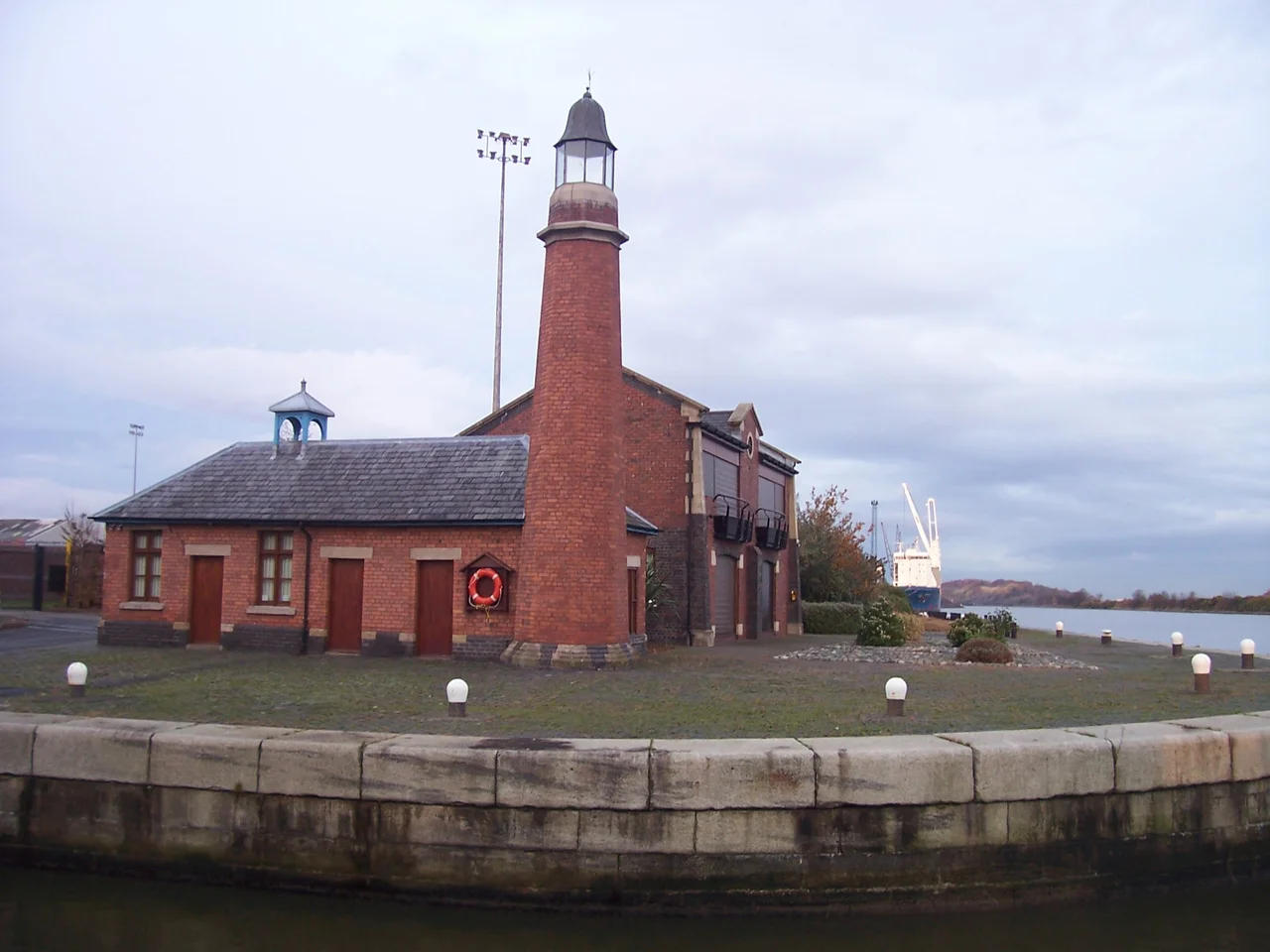

Ellesmere Port
Ellesmere Port was supposed to be a different town entirely. It was named for Ellesmere in Shropshire, the upstream destination of a canal that never made it that far. William Jessop and Thomas Telford designed the Ellesmere Canal in the 1790s as part of an ambitious scheme to connect the rivers Severn, Mersey, and Dee. The Mersey section opened in 1795, joining the river at a place the act called "at or near Netherpool". Then the money ran out, the economics shifted, and the canal stopped well short of the Severn. The settlement at the canal's mouth kept the name of the town it was meant to reach but never did. Today around 65,000 people live in a town whose name commemorates a piece of unfinished engineering.
Stanlow on the Mersey
The defining industrial feature of Ellesmere Port is the Stanlow oil refinery, opened in 1924 and now one of the largest in Britain. Stanlow occupies a stretch of land where the Manchester Ship Canal joins the Mersey estuary, and from any altitude its tanks, towers, and flare stacks dominate the south bank. The refinery handles roughly a sixth of the UK's road fuel, with crude arriving by tanker at Tranmere and travelling overland by pipeline. The complex has changed hands several times, most recently passing to Essar Oil. For most of the twentieth century, Stanlow defined what Ellesmere Port was: an industrial town where the smell of petroleum hung over the houses on warm summer evenings. Many of those houses were built by Shell for its workers, in tight rows close to the plant gates.
Sixty Years of Vauxhalls
The other defining employer is the Vauxhall car plant, which opened in 1962 as a components factory feeding the Luton works. Passenger car production began in 1964 with the Vauxhall Viva. The plant became Britain's most prolific car factory through the 1970s and 1980s, with the Astra rolling off the lines by the millions. When Luton stopped making cars in 2004, Ellesmere Port became Vauxhall's only car factory in Britain, employing around 2,500 people on two shifts. The site has survived multiple ownership changes (General Motors, PSA, and now Stellantis) and in 2022 began the transition to producing electric Vauxhall and Opel vans. The Astra has gone. The site has not. Many of the people who work there are the children and grandchildren of workers from 1964, families that have spent three generations on the same factory floor.
The National Waterways Museum
Where the canal first reached the Mersey, the docks survive as the National Waterways Museum, holding the largest collection of canal boats in the world. The museum sits at the head of the original Shropshire Union Canal, with the basin lined by Victorian warehouses converted into galleries. Visitors can walk through engine houses, climb aboard restored narrowboats, and watch the lock gates worked by hand. The collection includes working examples of every major canal-boat type, from the iron-bowed flyboats of the early nineteenth century to the diesel-powered narrowboats that kept the British canals alive into the 1960s. Children can ride the tugs around the basin in summer. The museum's brick warehouses are listed buildings; the boats themselves are part of the National Historic Fleet.
John Prescott Went to School Here
Ellesmere Port has produced a striking number of national figures. John Prescott, who became Deputy Prime Minister under Tony Blair, attended Grange Secondary Modern School here in 1948. Joe Mercer, born in Ellesmere Port in 1914, became one of the great managers of English football, leading Manchester City to the 1968 First Division title and to wins in the 1969 FA Cup, the 1970 League Cup, and the 1970 European Cup Winners' Cup. Stan Cullis, born here two years later, captained and then managed Wolverhampton Wanderers through their golden years. More recently the town has produced footballer Rob Jones, who played for Liverpool; the comedian Russ Abbot; and the electronic producer Joshua Leary, who records as Evian Christ. The town also has the second-largest Marks & Spencer store in the United Kingdom, after Marble Arch, on a retail park near the Cheshire Oaks outlet village.
Where the Mersey Bends
Ellesmere Port sits on the south-eastern edge of the Wirral Peninsula, although the town has steadfastly refused to be administratively part of Wirral or of Merseyside, sitting instead in Cheshire West and Chester. The geography is more telling than the boundary lines. From the air the town shows as a long industrial smear along the Mersey, with the refinery to the east, the docks at its centre, and the housing estates and motor plant spreading inland toward the M53 and M56 interchange. The Manchester Ship Canal runs along the river's edge. The Shropshire Union Canal ends at the museum. The Mersey itself bends sharply here as it approaches the open estuary, and on a clear day from the canal-side you can see the white tanks of Stanlow on one horizon and the Welsh hills on the other. It is a town that was made by water, and that still arranges itself around its banks.
From the Air
Ellesmere Port sits at the south-eastern end of the Wirral Peninsula at 53.28°N, 2.90°W, on the south bank of the Mersey estuary about 6 miles north of Chester. The Stanlow oil refinery is immediately east of the town; the Vauxhall plant is south of the town centre. Best viewed from 2,000-4,000 ft. Hawarden (EGNR) is 7 nm south-southwest; Liverpool John Lennon (EGGP) is 8 nm north-northeast. Look for the refinery tank farm and flare stacks on the riverbank, with the M53 and M56 motorway interchange just to the south of the urban area.
Nearby Stories
- RAF Wrexham 3.3 km away
- Birkdale Palace Hotel 3.7 km away
- Turton Tower 4.1 km away
- Tatton Park 5.6 km away
- Abergele Rail Disaster 9.6 km away
- Diglake Colliery Disaster 13 km away
- Ysbyty Ifan 16 km away
- Celtic Array 62 km away