
Elstow
The Moot Hall sits at one end of the village green at Elstow, two miles south of Bedford, and it has been sitting there since the middle of the 15th century. It is a long, low, timber-framed building - oak posts and beams pegged together without nails, jettied upper storey overhanging the lower, the kind of medieval craftsmanship that takes longer to fall down than most things take to be built. The hall was raised by the Abbess of Elstow around 1440-1450 to serve as the village's market house: ground floor for trade, upper floor for whatever the abbey needed an upstairs room for. The abbey is gone, dissolved by Henry VIII in 1539. The market is gone too. But the Moot Hall is still here, now an Ancient Monument and a small museum of 17th-century life, and inside it you can stand on the same boards where the boyhood John Bunyan stood when he came up from his family's cottage at Harrowden to the May Day fairs that the village has been holding, on and off, for at least a thousand years.
Countess Judith's Nunnery
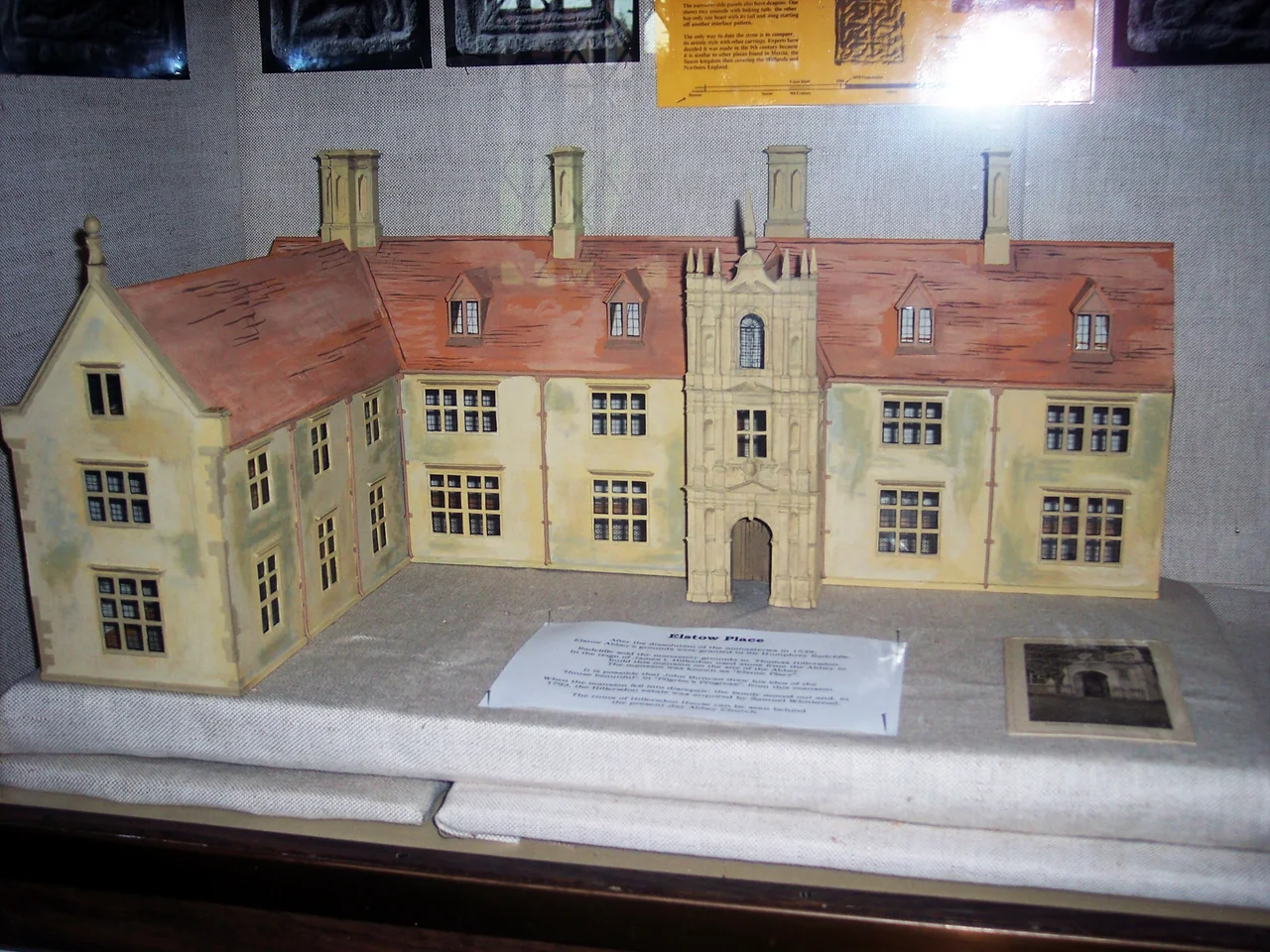
Elstow Abbey was founded in 1078 by Countess Judith of Lens - niece of William the Conqueror, daughter of Lambert II of Lens and Adelaide of Normandy - as a Benedictine nunnery. Judith had her own complicated history with the Norman Conquest. Married off to the English nobleman Waltheof, Earl of Northumbria, she had been complicit in his execution in 1076 for rebellion against the king. The founding of Elstow has been read by some historians as an act of contrition, though the documentary evidence is thin. Whatever her motivation, the nunnery she established grew rapidly. By 1538, when the dissolution of the monasteries reached Elstow, the abbey was being valued as the eighth richest convent in England - a remarkable status for a foundation in a small Bedfordshire village. So significant was it that in the 16th century, Bishop Stephen Gardiner of Winchester sponsored a bill in Parliament to make Elstow Abbey the cathedral church for a new diocese of Bedfordshire. The bill never received royal assent. On 26 August 1539, the abbess surrendered the abbey, the manor of Elstow and all the abbey's properties across England to King Henry VIII. The buildings were demolished and quarried. What survives is the parish church of St Mary and St Helena, originally the nave of the abbey church, and a detached medieval bell tower.
John Bunyan's Cottage and the Boy on the Green
John Bunyan was born in the parish of Elstow in November 1628, in the hamlet of Harrowden just south-east of the village. His father was a brazier and tinker - a travelling craftsman who repaired pots and pans - and the family was poor by the standards of even a poor Bedfordshire village. The cottage where Bunyan was born no longer stands, but the site is marked, and the church where he was baptised on 30 November 1628 is the same St Mary and St Helena that grew out of the abbey ruins. As a young man, Bunyan came regularly to the village green at Elstow to play tip-cat - a children's game with a stick - and to take part in the village dances on Sundays after church. It was during one of those Sunday games, around 1650, that Bunyan later said he heard a voice from heaven asking 'Wilt thou leave thy sins, and go to heaven? Or have thy sins, and go to hell?' The crisis of conscience that followed eventually drove him into the radical Baptist congregation in Bedford, into nonconformist preaching, into prison, and ultimately into the writing of The Pilgrim's Progress. He came back to Elstow to preach. The Moot Hall, from 1810 to 1910, was used as a chapel and Sunday school for the local congregation of the Bunyan Meeting church - the spiritual descendants of his ministry.
The May Festivals
May Day festivals are thought to have taken place at Elstow from long before the nunnery was founded - possibly stretching back to the pre-Christian celebrations that often clustered around the cross-quarter day of Beltane. The Norman abbey absorbed them; the village continued them; they survived the Reformation in a slightly tamer form. In Bunyan's lifetime, the Elstow May Day was the kind of village riot - dancing, drinking, sports, sexual licence - that the godly party of the Civil War detested. Bunyan himself, in his later writings, looked back on Elstow's May games as part of the worldly life he had renounced. The festival was abandoned around 1889, in an era when traditional rural revels were dying out across England. In 1925, the local headmaster Bob Wadsworth revived it as a more decorous schoolchildren's event, and it ran in that form for forty-three years before being discontinued again in 1968. The current revival dates from 2006, when the Reverend Jeremy Crocker, rector of Elstow Abbey, reinstated the festival once more. It runs on the village green, in the shadow of the Moot Hall, on the same ground where a thousand years of Elstow children have danced around variants of the same poles.
The Munitions Factory
Between 1942 and 1946, on a site just south of the village, the Royal Ordnance Factory at Elstow filled artillery shells and bombs for the British war effort. ROF Elstow employed thousands of workers, most of them women, in conditions that were dangerous, exhausting and almost completely undocumented at the time. The novelist H. E. Bates - then working as a writer for the Air Ministry - visited the factory and turned what he saw into a 1946 book, The Tinkers of Elstow, named partly in homage to Bunyan's tinker father. Bates's portrait was sympathetic and detailed: the long shifts, the careful handling of explosives, the wartime camaraderie. After the war the factory closed, and the site was eventually redeveloped. The village green, the Moot Hall and the medieval church survived intact, on the inside of Bedford's southern bypass, with the hamlet of Harrowden tucked just beyond the road. Elstow today is a conservation area of perhaps 1,500 people, with many of its historic buildings still in residential use, looking - depending on the angle - like a piece of medieval Bedfordshire that the 21st century quietly agreed to leave alone.
From the Air
Elstow sits at 52.1070°N, 0.4649°W just south of Bedford, immediately inside the A421 southern bypass. From the air, the village reads as a small cluster of historic buildings around the green, with the medieval church and detached bell tower visible to the south of the green and the timber Moot Hall on its north side. Cranfield Airport (EGTC) lies about 6nm west; Luton (EGGW) is roughly 16nm south. Best viewed at 1,500-3,500 ft AGL in clear conditions, with the larger sprawl of Bedford 2nm north.
Nearby Stories
- Fowlmere Airfield 6 km away
- Canons Ashby House 7.9 km away
- Berkhamsted Castle 10 km away
- Boughton House 11 km away
- Pitt Rivers Museum 18 km away
- King's Ely 18 km away
- North Weald Airfield 18 km away
- Wigston 23 km away