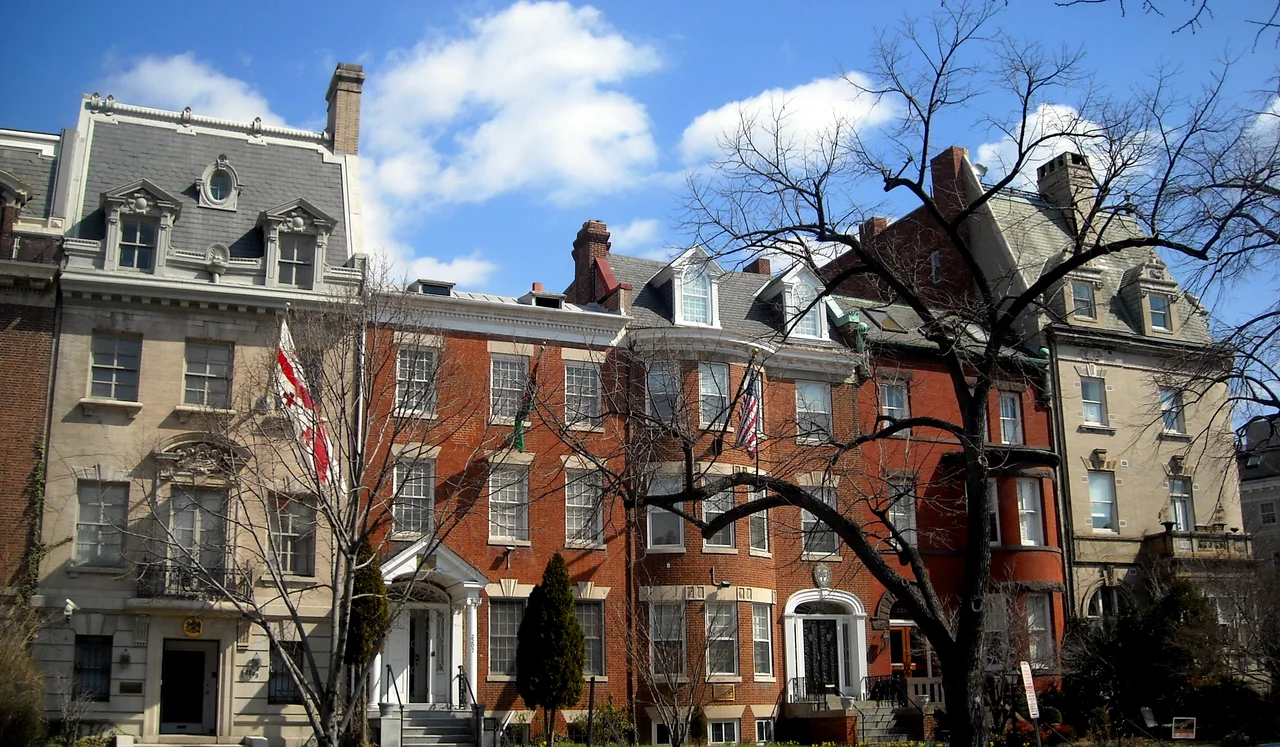

Embassy Row
Larz Anderson built a mansion at 2118 Massachusetts Avenue in 1905 because he could. He was a diplomat, an heir to a Cincinnati shipping fortune, and one of the founders of the American hereditary patriotic society called the Society of the Cincinnati. The house his architects Arthur Little and Herbert Browne designed for him had a marble-paneled great hall, a Tiffany-lit dining room, a grand staircase, and a courtyard with a fountain. When Larz died in 1937, his widow Isabel gave the entire house to the Society of the Cincinnati, which still operates it as a museum today. Larz Anderson House is exactly one of about a hundred buildings along Massachusetts Avenue NW that tell the same story in different versions: a Gilded Age mansion bought, bequeathed, or rented by a government that needed Washington property to plant its flag. They are the spine of Embassy Row.
Millionaires Before Diplomats
The stretch of Massachusetts Avenue between Scott Circle and Sheridan Circle, about a mile and a quarter, was the Millionaires' Row of Washington in the decades around 1900. New money from Pittsburgh, Chicago, the West, and the Gilded Age industries arrived in the capital, hired the best architects, and built. Stanford White designed the Patterson House at 15 Dupont Circle. Carrere and Hastings designed the Townsend House, now the Cosmos Club. Jules Henri de Sibour, a French-born Beaux-Arts specialist, designed seven separate buildings along this stretch, including the Clarence Moore House (now the Embassy of Uzbekistan), the Ingalls House, the McCormick Apartments, and the Alexander Stewart House (now the Embassy of Luxembourg). These were houses meant to project status in a city that had relatively few opportunities to do so. The income tax, the Depression, and the suburbanization of American wealth between 1913 and 1945 made most of them economically impossible to maintain as private residences.
The Switch to Embassies
Between the wars, foreign governments started buying. An empty mansion with grand reception rooms, conveniently located on a major avenue close to the State Department and the White House, was exactly what an embassy needed. The British had built their own purpose-designed embassy on Massachusetts Avenue earlier than most, but the postwar boom in diplomatic missions in Washington meant that nearly every available mansion eventually found a buyer. The Walsh-McLean House at 2020 Massachusetts (Embassy of Indonesia), the Joseph Beale House at 2012 Massachusetts (Embassy of Portugal), the Halliday House at 2234 Massachusetts (Embassy of Ireland), the Brodhead-Bell-Morton Mansion at 1500 Rhode Island Avenue (Embassy of Hungary), the T. Morris Murray House at 2107 Massachusetts (Embassy of India). The mansions that had been built to show off old families were repurposed to show off newer countries.
Saved by a Demolition
The change of use did not always go smoothly. In the early 1970s a developer announced plans to tear down the historic townhouses at 1722 through 1728 Massachusetts Avenue and replace them with an office tower. The fight that followed produced the Massachusetts Avenue Historic District in 1974, which formally protected most of the corridor between 17th Street and Observatory Circle from further demolition. The district preserved not only the mansions still in use as embassies but also the surviving rowhouses, apartment buildings, and commercial structures from the era. Other landmarks along the row include the Phillips Collection at 1600 21st Street (founded by Duncan Phillips in 1921 as the first museum of modern art in America), the Cosmos Club at 2121 Massachusetts, and the Sulgrave Club at 1801 Massachusetts.
Observatory Circle
The northern end of Embassy Row culminates at Observatory Circle, where the United States Naval Observatory sits on seventy-two wooded acres. The Vice President's official residence, Number One Observatory Circle, is here. Built in 1893 as the home of the superintendent of the Observatory, the house was the official residence of the Chief of Naval Operations from 1923 to 1974, when Congress designated it the Vice President's residence. Walter Mondale was the first vice president to live there full-time. Nelson Rockefeller had been offered it and refused, finding it too modest. Embassy Row's western end also includes the South African embassy at 3051 Massachusetts (the site of a famous 1984 anti-apartheid protest by Randall Robinson and others that helped trigger the Comprehensive Anti-Apartheid Act), the Embassy of the Vatican (the Apostolic Nunciature at 3339 Massachusetts), and the British Embassy at 3100 Massachusetts. The Edwin Lutyens-designed British embassy, opened in 1930, is one of the few purpose-built embassies on the row and remains one of the largest.
Two Days a Year
Most days the embassies are closed to the public. Twice a year, that changes. Passport DC, an initiative launched by the European Union embassies in 2007 and extended to other countries in 2008, opens the doors of dozens of embassies on a single weekend each May. Lines stretch around blocks. People who have lived in Washington for decades use the chance to walk through buildings they had only ever passed on the sidewalk. The Embassy Series, organized separately since 1994, hosts classical music concerts in embassy reception rooms throughout the year. Three blocks south, between Scott and Dupont Circles, the buildings that were once mansions have been repurposed again, this time as the headquarters of major Washington think tanks: Brookings at 1775, Carnegie Endowment at 1779, the American Enterprise Institute in the old McCormick Apartments at 1789. Some Washingtonians have started calling that segment Think Tank Row. The buildings remember being mansions. The mansions remember being houses. The houses remember the people who built them.
From the Air
Embassy Row runs along Massachusetts Avenue NW from Scott Circle at 38.9078 degrees north, 77.0358 degrees west, northwest to Observatory Circle at 38.9216 degrees north, 77.0676 degrees west. Best viewed at 1,500 to 2,500 feet AGL, with the diagonal sweep of Massachusetts Avenue clearly visible. Reagan National (KDCA) is four to six nautical miles south. The site lies inside the P-56 prohibited area and within the Naval Observatory restricted airspace; overflight requires authorization and viewing is from authorized riverside approaches.
Nearby Stories
- Gunston Hall 1.1 km away
- 2023 Baltimore Shooting 4.9 km away
- Battle of Middleburg 6.6 km away
- Crownsville Hospital Center 10 km away
- Battle of Loudoun Heights 13 km away
- First Battle of Rappahannock Station 20 km away
- Howard County, Maryland 21 km away
- Harriet Tubman Underground Railroad 50 km away