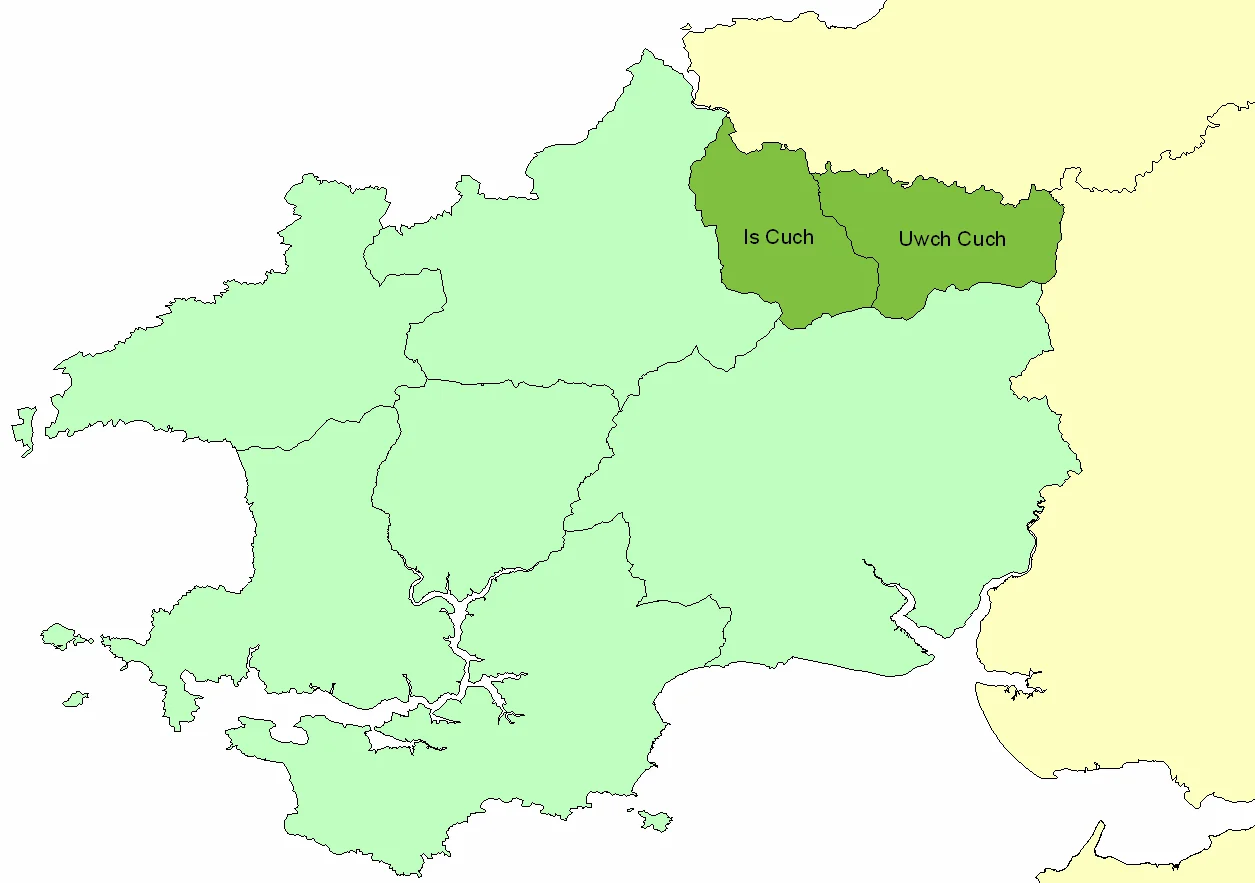

Emlyn
Long before counties, parishes, or post codes, the land between the Preseli Hills and the Cambrian Mountains had its own name. Emlyn meant the country on both sides of the valley, am-glyn in old Welsh, and the valley in question was the Cuch, the small wooded river that runs north into the Teifi at Abercych. Emlyn was one of the seven cantrefi of Dyfed, the ancient Welsh kingdom that filled the south-western corner of Wales. It became part of Deheubarth around 950. The Normans took it in 1093. It was split in 1240, abolished as a unit in 1535, and yet its name still survives, attached to a small Carmarthenshire town and to the valley that gave the cantref its identity in the first place.
Cantref and Commote
A cantref in medieval Welsh law was an administrative district, literally a hundred farms or hundred townships, though in practice the numbers varied. Each cantref was usually divided into two or three commotes, smaller units used for justice and tax. Emlyn covered about 84 square miles of the northern strip of Dyfed, bordered to the south by the ridge of hills separating the Teifi from the Tâf and Tywi valleys. The River Cuch divided it into two commotes: Emlyn Is Cuch to the west, the lower commote whose civil headquarters was at Cilgerran; and Emlyn Uwch Cuch to the east, the upper commote whose centre would eventually be at Newcastle Emlyn. The ecclesiastical centre of the cantref was the church of St Llawddog at Cenarth, an old religious site that in the Age of the Saints may even have been the seat of a bishop.
The Norman Crash
Following the Norman Conquest of England in 1066, the ruler of Deheubarth was Rhys ap Tewdwr, who accepted the overlordship of William the Conqueror. When William died in 1087, Rhys took the view that his vassalage had been personal to William, not hereditary, and joined other British magnates in attacking Worcester. He was killed in battle at Brecon in 1093. His lands, in Norman theory now forfeit, were immediately seized by various opportunistic magnates. Arnulf de Montgomery swept south from Ceredigion, took Emlyn, passed through it, and conquered western Dyfed beyond, establishing the Marcher Lordship of Pembroke. He appointed Gerald of Windsor as castellan, and around 1100 Gerald built Cilgerran Castle to control Emlyn and to face down challenges from Ceredigion across the Teifi.
The Welsh Push Back
Arnulf de Montgomery did not enjoy his new lands long. In 1102, he joined his elder brother Robert of Belleme in an unsuccessful rebellion against Henry I in favour of Robert Curthose's claim to the English throne. As a rebel against his suzerain, Arnulf's lands were forfeit. Through the 12th and 13th centuries, Emlyn changed hands repeatedly between Welsh and Norman lords. The native Welsh princes of Deheubarth pushed back when they could, especially under the Lord Rhys in the later 12th century. Llywelyn Fawr, prince of Gwynedd, established his hegemony over the Welsh princes in the early 13th century, and Henry III of England was for some time unable to resist. After Llywelyn's death in 1240, the Treaty of Gloucester reorganised the Welsh lands, and the princes of Deheubarth became mere barons holding their lands as honours from the king.
Maredudd and the New Castle
In 1241, Maredudd ap Rhys Gryg married Isobel, the illegitimate daughter of the late William Marshal, 2nd Earl of Pembroke. The marriage was probably pre-arranged as part of the political settlement; Maredudd effectively acquired Emlyn Uwch Cuch as a dowry. To control his half of Emlyn, Maredudd built a new castle on a rocky bend in the Teifi, displacing the older centre of administration. The fortification was called, simply, the New Castle of Emlyn. The town that grew up around it took the same name. Newcastle Emlyn castle still stands in ruins above the Teifi, its great gatehouse a reminder that this was once one of the few castles in Wales actually built by a Welsh prince rather than by a Norman conqueror.
Statute and Survival
In 1282 the Statute of Rhuddlan formalised the conquest of Wales by Edward I, converting the king's Welsh lands into counties. Emlyn Uwch Cuch became part of the new Carmarthenshire, falling within the Elvet Hundred. Maredudd's son Rhys ap Maredudd inherited the family baronies, now within Carmarthenshire; he committed treason in 1287, attempted a rebellion, and was eventually captured and hanged. The western half of Emlyn, Emlyn Is Cuch, remained in the Marcher Lordship of Pembroke. That lordship passed through a succession of holders over the next two centuries, including Duke Humphrey of Gloucester, William de la Pole, Jasper Tudor, and finally, as a Marquessate granted just before his marriage to Anne Boleyn, Henry VIII himself. The 1535 Laws in Wales Act abolished the Marcher Lordships and converted them into ordinary counties; Emlyn Is Cuch became Pembrokeshire's Cilgerran Hundred. The cantref of Emlyn, as a unit, ceased to exist. The name persisted in the town, in the valley, and in the long memory of west Wales.
From the Air
The historic cantref of Emlyn covered roughly the area centred on 52.03 degrees north, 4.43 degrees west, between the Preseli Hills to the south and the Cambrian foothills to the north, with the Teifi as its northern boundary and the Cuch as its central axis. Cruise altitude 3,000-5,000 feet gives a clear view of the valley system. Newcastle Emlyn Castle is the focal landmark. The MoD Aberporth danger area lies to the west; check NOTAMs. Nearest civil airport is Haverfordwest (EGFE).
Nearby Stories
- RAF Haverfordwest 3.7 km away
- Great Western Railway in West Wales 7.7 km away
- West Wales 9.9 km away
- Fishguard Lifeboat Station 13 km away
- Battle of Mynydd Hyddgen 15 km away
- Strata Florida Abbey 18 km away
- Neath and Tennant Canal 21 km away
- HMS Tyler 44 km away