.jpg)
Engineer's Office of the Former Pumping Station
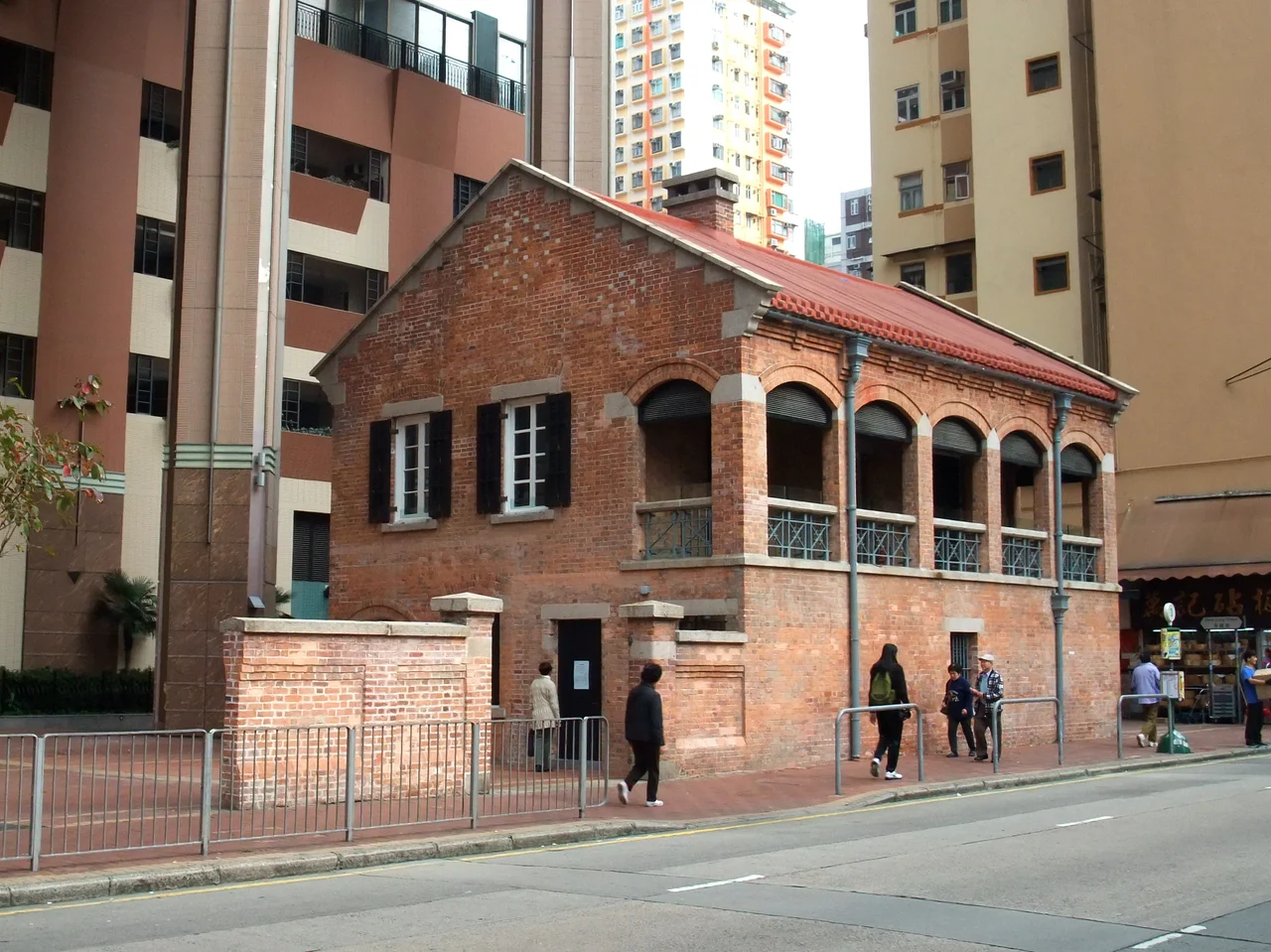
By the late 1990s, almost no one in Hong Kong could say what the small red-brick building at 344 Shanghai Street had originally been. The Salvation Army was using it as a shelter for people sleeping on the street — a good purpose, certainly, but not one that invited historical inquiry. When a developer drew plans for a 36-storey twin-tower residential complex on the site, demolition looked like the obvious next step. The building had no remembered identity. It did have a past, though — a past that reached back to 1895 and the very foundations of Kowloon's water supply.
The Station That Watered Kowloon
In 1890, Osbert Chadwick, a consulting engineer working for the Crown Agents, proposed a water supply system for Kowloon based on collecting subterranean water through underground mud barriers. His specific proposal was not immediately adopted, but it planted the idea — and the pumping station at what would become Shanghai Street was constructed in 1895, making it the oldest pumping station in Hong Kong, predating the Tai Tam Tuk Pumping Station by more than two decades. The original complex comprised three two-storey buildings and a tall chimney. Steam-driven pumps, imported from England, extracted an estimated 400,000 gallons of water daily from three nearby wells. That water supply was not merely convenient: it enabled commercial activity and settled daily life to take hold in the Kowloon Peninsula, and the population grew by 33 percent — from about 23,000 in 1891 to 34,782 by 1897.
Layers of Use, Layers of Forgetting
The pumping station's original purpose was already giving way to other needs within a generation of its construction. The chimney came down first. The engine house and boiler house became a post office, serving Yau Ma Tei through the 1910s and 1920s. On the lane beside it, in the pre-war and early post-war years, as many as 37 professional letter writers set up stalls in Yunnan Lane, earning a living from the literacy gap in the neighborhood — a vivid street economy that gradually dissolved as education spread. The post office itself closed in 1967 when the Kowloon Central Post Office opened nearby. The building then passed to the Salvation Army, which operated it as a Street Sleepers' Shelter until the shelter relocated across the road at the end of the 1990s. By then the building's original identity had been thoroughly overwritten.
The Drawings That Changed Everything
When the Land Development Corporation and Sun Hung Kai Properties began preparing for their 36-storey development, the red-brick building was slated for clearance. During the required study process, two heritage specialists from the University of Hong Kong — Dr. Lee Ho Yin and Dr. Lynne DiStefano — raised questions about what the anonymous structure had originally been. The answer came from an unexpected source: an old British engineer at the Water Supplies Department who still had the original architectural drawings. The drawings established, unambiguously, that this was the engineer's office of the former pumping station — not just any old building but the sole surviving structure of Hong Kong's oldest water supply facility.
Preservation Against the Odds
The Antiquities Advisory Board awarded the building Grade I Historical Building status in 2000, the highest category of protection available in Hong Kong short of declared monument status. Grade I means the building cannot be demolished. The developers had to adjust their entire scheme — the 36-storey tower was redesigned to accommodate the engineer's office on the same site without touching it. That outcome, a glass-and-concrete tower rising beside a 19th-century red-brick survivor, is now a familiar Hong Kong juxtaposition: old fabric preserved not because it was always valued, but because someone looked closely enough to ask the right question at the last possible moment.
From the Air
The Engineer's Office of the Former Pumping Station stands at approximately 22.3123°N, 114.1696°E on Shanghai Street in Yau Ma Tei, on the Kowloon Peninsula. From the air, Kowloon presents as a dense rectilinear grid north of Victoria Harbour; Yau Ma Tei sits roughly in the centre of the peninsula. The nearest major airport is Hong Kong International Airport (VHHH) on Lantau Island, approximately 25km to the southwest. At approach altitudes over Kowloon, the contrast between the low 19th-century structure and the adjacent modern towers is visible as a gap in the building heights. Recommended viewing altitude: 1,500–2,500 feet.
Nearby Stories
- Lok Ma Chau Loop 2.3 km away
- Portas do Cerco 2.3 km away
- Kweilin Incident 17 km away
- Wanshan Archipelago Campaign 34 km away
- Nanxiong Formation 115 km away
- Battle of Nanpeng Island 148 km away
- Heyuan 169 km away
- Cape Maobitou 632 km away