
Eurovision Song Contest 2006
The stage at the Olympic Indoor Hall in Athens was designed to look like an ancient Greek amphitheatre, which made what happened on it in May 2006 all the more surreal. Six performers in elaborate monster costumes walked out, delivered a song called "Hard Rock Hallelujah", and won the Eurovision Song Contest. Finland's Lordi, the band that had spent years being dismissed as too extreme for a mainstream audience, received 292 points — the highest score in the contest's history at that point — and ended Finland's 45-year wait for a first victory.
The Olympic Indoor Hall, Repurposed for Europe
The Olympic Indoor Hall — Olymbiakó Indóor Hall, also known as the Athens Olympic Indoor Hall — sits in the Marousi district, part of the Olympic Sports Complex built to anchor the 1996 Games (which Athens did not host) and dramatically expanded for 2004. The venue hosted gymnastics and basketball during those Games and has since become one of the largest and most technically sophisticated arenas in Greece. When Greece won Eurovision 2005 with Helena Paparizou's "My Number One", the right to host the following year fell to Athens. ERT, the Hellenic Broadcasting Corporation, chose the Olympic Indoor Hall — capacity well above ten thousand — as the venue, and the stage designer Elias Ledakis built a set modelled on a classical Greek amphitheatre. The juxtaposition of ancient forms and contemporary pop spectacle was deliberate: Greece was presenting itself as the living heir to a deep cultural inheritance while hosting the continent's most exuberant popular event.
The Night Finland Won
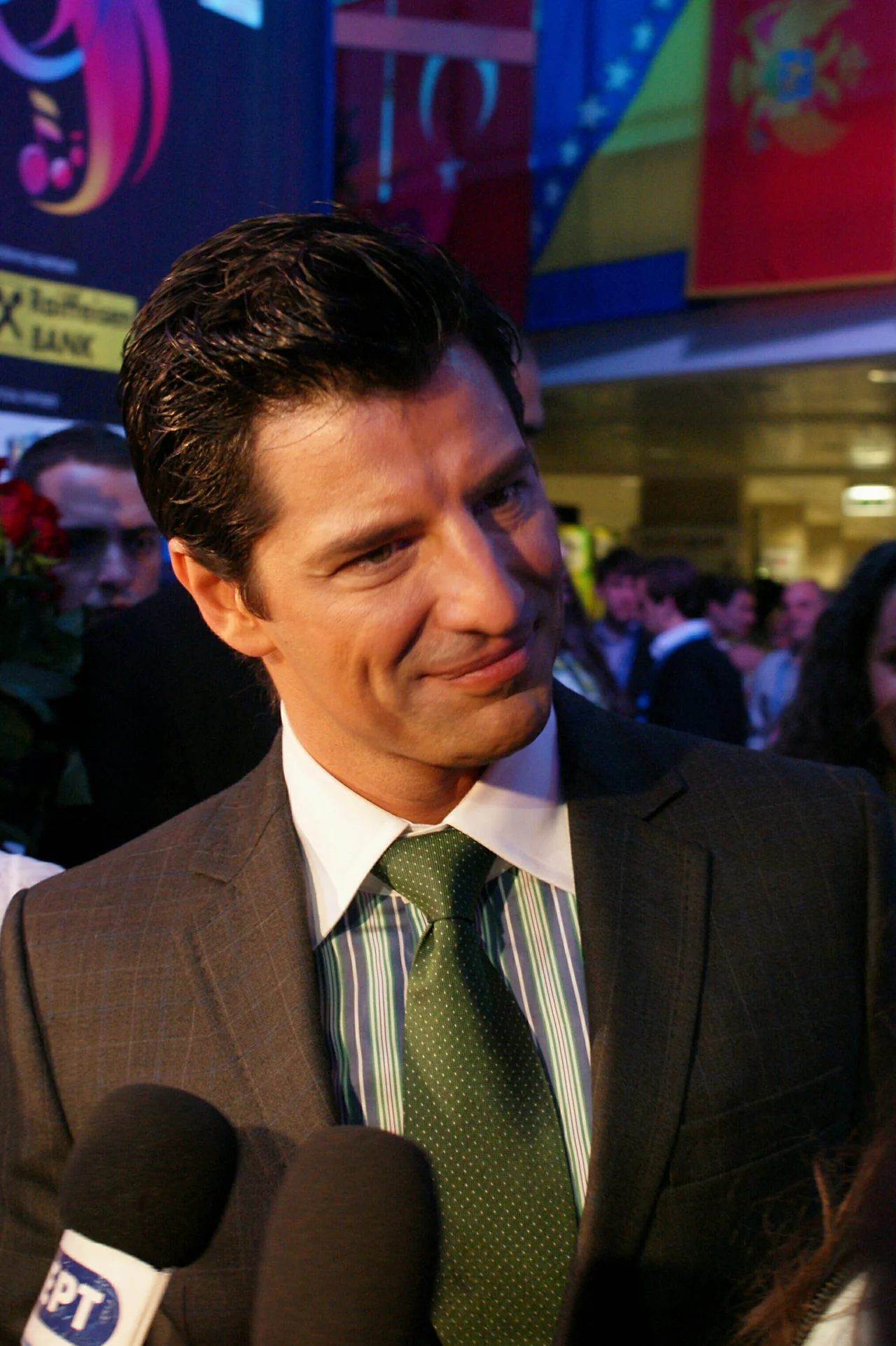
The semi-final took place on 18 May 2006, the final on 20 May. Thirty-seven countries participated across both shows. The hosts for the contest were Maria Menounos, the Greek-American television personality, and Sakis Rouvas, who had represented Greece at Eurovision 2004. The semi-final opened with a theatrical medley in which performers dressed as Greek gods — Zeus, Poseidon, Athena, Aphrodite, and others — performed former Eurovision winners, a sequence that underscored the contest's own sense of its accumulated mythology.
In the final, Lordi performed seventeenth. Finland had never placed in the top five in 45 years of participation — the longest drought of any country at that point. When the votes were tallied, Lordi had scored 292 points, winning comfortably. Russia's Dima Bilan finished second with 248 points, Bosnia and Herzegovina third with 229 — an order suggesting the scoreboard had not distributed votes in the way bloc-voting critics might have expected. Finland's win remains one of the contest's most striking upsets: a hard rock band, first ever of the genre to win, beating a field of balladeers and pop acts on the most mainstream stage in European music.
What Greece Put Into It
ERT invested heavily in presenting Athens to Europe. The 37 postcards shown before each competing entry — brief films introducing the performing countries — were themed around Greece's historical significance and contemporary appeal. ERT spent €3 million on their production alone. The logo for the 2006 contest, designed by the company Karamela, was inspired by the Phaistos Disc, an archaeological artefact discovered in Crete and one of the more enigmatic objects of the ancient Aegean world. ERT described it as "inspired by the wind and the sea, the golden sunlight and the glow of the sand" — a phrase that captures the self-image Greece was projecting.
The stage itself was built by the British company Stage One, which had also designed the Opening and Closing ceremony stages for the 2004 Olympics. The theme music was composed by Nikko Patrelakis and conducted by Andreas Pylarinos, with the ERT Symphony Orchestra recording all music used during the shows. The production was enormous. The revenues ERT recovered from the event — €3.63 million from national sponsors, €2.2 million from tickets, and €1.45 million from international sponsorship and other sources — covered a fraction of what it cost to stage.
The 1,000th Song and Other Landmarks
The 2006 contest was the 51st edition of Eurovision and contained several milestones beyond Finland's win. When Brian Kennedy performed "Every Song Is a Cry for Love" for Ireland in the semi-final, it was the 1,000th song to be performed in the contest's history. The shows were broadcast in widescreen 16:9 standard-definition to all participating countries; they were also filmed, though not broadcast, in high-definition as part of a research experiment by the EBU and several broadcasters. The first Eurovision contest actually produced and broadcast in high-definition came the following year, in 2007.
Voting in the final was modified to save time: points 1 through 7 were displayed automatically, and spokespersons only announced 8, 10, and 12. The experiment drew criticism — the suspense of the traditional announcement was diminished — and created its own chaos when the Dutch spokesperson Paul de Leeuw gave his phone number to host Rouvas during the Dutch results, slowing everything down. Eurovision had always managed the boundary between ceremony and entertainment imperfectly. That night in Athens, it found a new way to make the tension real.
After the Hallelujah
Lordi's victory at the Olympic Indoor Hall permanently changed perceptions of what Eurovision could accommodate. The argument that the contest rewarded only safe, glossy pop was harder to sustain when a group of Finnish people in monster costumes had won by the widest margin in recent memory. The band went on to achieve mainstream commercial success in Finland and beyond. Greece's hosting — the city, the venue, the production — was widely judged a success: lavish without being ostentatious, rooted in the specific character of Athens while serving the pan-European purpose of the event. The Phaistos Disc logo and the amphitheatre stage were exactly the kind of choices that make a host country's edition recognizable decades later.
From the Air
The Olympic Indoor Hall sits at approximately 38.04°N, 23.78°E in the Marousi district of northern Athens, within the Athens Olympic Sports Complex (OAKA). Approaching Athens International Airport (LGAV) from the north or west, the Olympic complex — the distinctive OAKA campus with its Santiago Calatrava roof structures — is visible to the northwest of central Athens at 3,000–6,000 feet. LGAV is 22 km to the east-southeast. The Acropolis is visible 12 km to the south.
Nearby Stories
- Parnitha 3.4 km away
- Kea (island) 7.3 km away
- Sanctuary of Apollo Maleatas 11 km away
- Sousaki Volcano 12 km away
- Battle of Leuctra 14 km away
- Great Sand Beach 18 km away
- Agios Georgios (island) 23 km away
- Skyros 84 km away