
Eurovision Young Musicians 2016
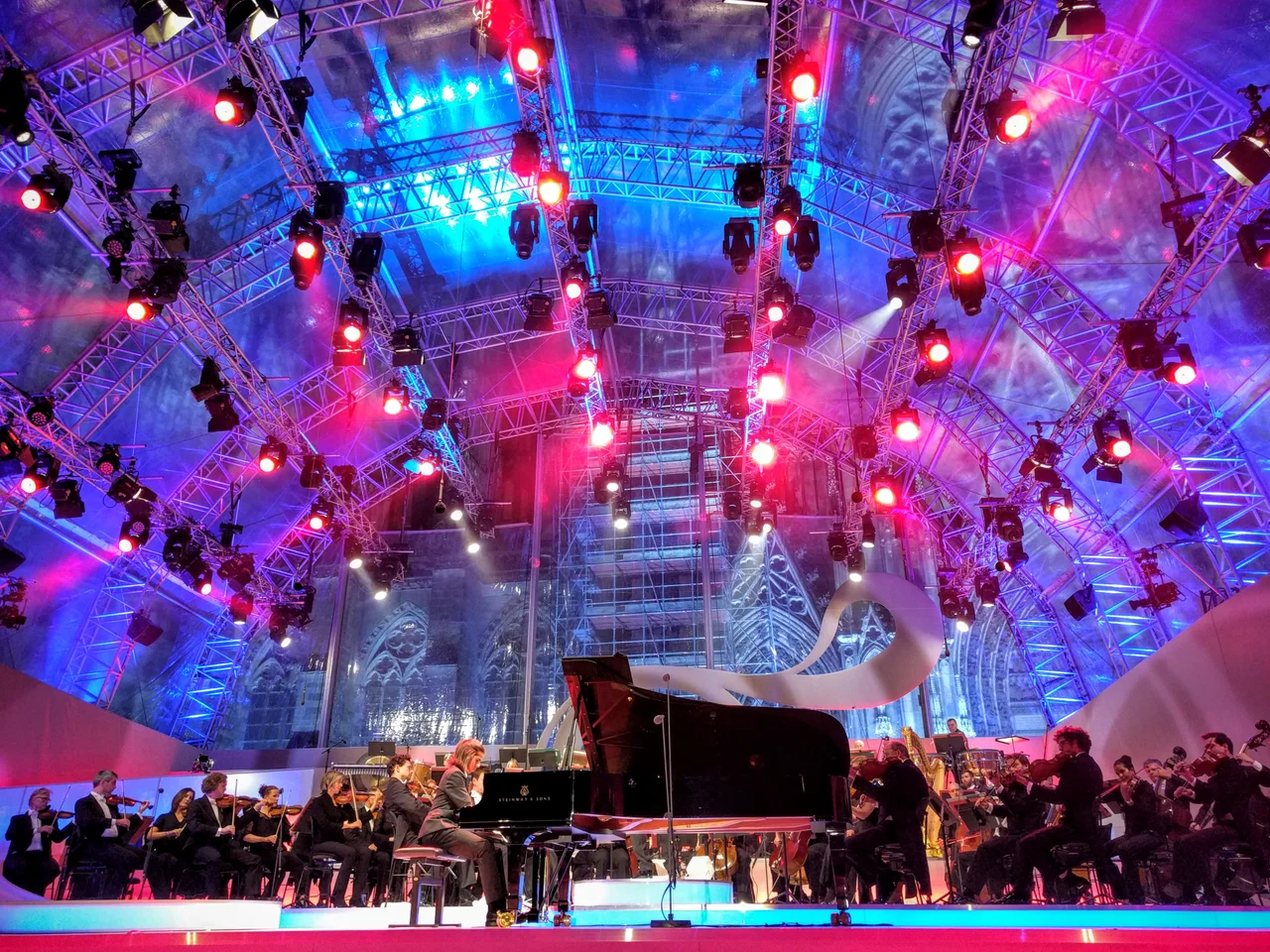
Picture an open-air stage built directly against the south façade of Cologne Cathedral, the Gothic spires rising 157 metres into a darkening September sky. Now picture an alto saxophone. The two do not obviously belong together. But on the evening of 3 September 2016, an eighteen-year-old from Poland named Łukasz Dyczko stepped onto that stage, lifted a saxophone to his lips, and played André Waignein's Rhapsody pour Saxophone alto. The WDR Symphony Orchestra Cologne, under conductor Clemens Schuldt, played beneath him. A five-person jury - including Austrian violinist Julian Rachlin, who had himself won this contest in 1988 - listened. When the points were tallied, Dyczko had beaten ten of Europe's most promising young classical instrumentalists. He took home ten thousand euros, a solo concert with the WDR Symphony, and the trophy for the eighteenth Eurovision Young Musicians.
The Cathedral as Concert Hall
Cologne had narrowly outbid Budapest for hosting rights, and the decision turned out to be a kind of architectural showmanship. This was only the sixth time in the contest's history that the final had been staged outdoors, and German broadcaster WDR made the most of it. Performances unfolded on the Roncalliplatz, the cathedral plaza, with the medieval west façade looming behind every musician. Cameras caught the contrast between an eighteen-year-old hunched over a cello and eight hundred years of carved sandstone above them. For musicians more accustomed to the dry acoustics of conservatory halls, the open air was both blessing and curse. Sound vanished upward into the evening rather than ringing back from walls. Every note had to be played with conviction or it would simply disappear into the Rhineland sky.
Eleven Countries, Eleven Instruments
The programme was a tour through the strangeness of what classical music can be. Marko Martinović of Croatia played Massenet's Meditation from Thaïs on a tamburica, a long-necked Balkan folk lute rarely heard in symphonic settings. Dominik Wagner of Austria coaxed Koussevitzky's double bass concerto out of an instrument the size of a small wardrobe, taking third place. Robert Bílý of the Czech Republic played Samuel Barber's brittle, prickly Piano Concerto and finished second. There were horns and violins and cellos, a saxophone and a Slovenian playing Tchaikovsky. Each performer had six minutes. Six minutes to prove that years of practice in a parental living room had produced something worth flying to Cologne for.
The Saxophone and the Cathedral
Dyczko's win mattered partly because of what he played. The saxophone is barely 180 years old - invented by Adolphe Sax in the 1840s, a comparative newcomer in classical music that still struggles for repertoire and respect on concert programmes. To win Europe's most prestigious youth classical competition on an alto saxophone, on a stage facing a building begun in 1248, was its own quiet argument. Old and new could share the same square. Daniel Hope, the British-German violinist who co-hosted the broadcast with WDR journalist Tamina Kallert, would have understood the symbolism. So would the jury. Tine Thing Helseth had been runner-up here as a teenage trumpeter in 2006; Alice Sara Ott had won Echo Klassik's Young Artist prize in 2010. They knew what it took to stand on that stage and what it meant to win.
Cologne's Open-Air Tradition
This was Germany's third turn as host, after Berlin in 2002 and Cologne in 2014. Each time the contest landed in this Rhineland city, it gathered around the cathedral - the unmissable anchor of the old town, a building visible from almost every approach to the river. The crowd that September evening was small by Eurovision standards. Young Musicians is the quieter cousin of the famous Song Contest, broadcast to classical-music audiences across the EBU network rather than the hundreds of millions who watch the pop version. But for the eleven competitors and the listeners who tuned in, it was a glimpse of who might be playing the world's great concert halls in twenty years. Some of them, surely, already are.
From the Air
The contest was staged on the Roncalliplatz directly against the south side of Cologne Cathedral, at 50.9413° N, 6.9583° E - the geographic heart of Cologne's old town. From cruising altitude the cathedral's twin spires are the unmistakable landmark on the west bank of the Rhine. Nearest major airport is Cologne Bonn (EDDK / CGN), about 14 km southeast. Düsseldorf (EDDL / DUS) sits 40 km north.
Nearby Stories
- Diamond Interchange: How a Simple Idea Reshapes Towns Like Julich 2.8 km away
- Dusseldorf-Unterbach 6.1 km away
- Baumwollspinnerei Ermen & Engels 11 km away
- RAF Bruggen 15 km away
- Hagen Open-air Museum 21 km away
- Belgium 130 km away
- Marcinelle Mining Disaster 173 km away
- Zwingenberg Castle 178 km away