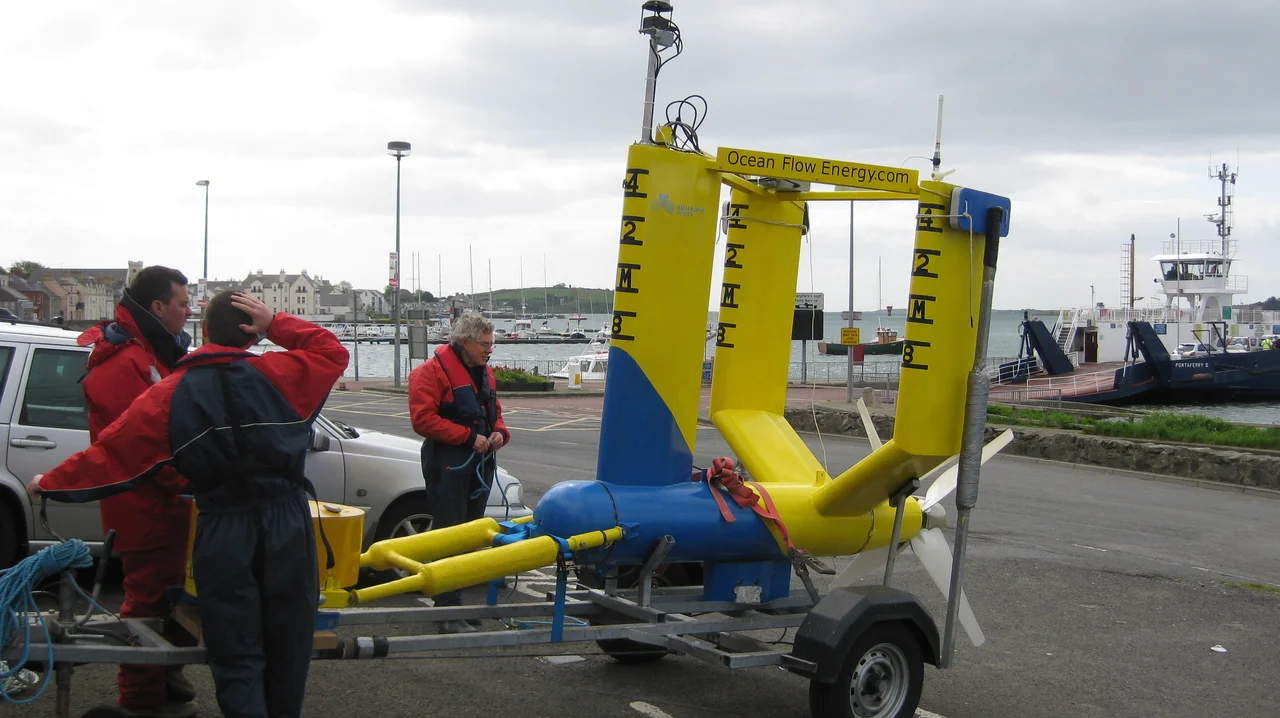

Evopod
The Strangford Narrows squeeze 150 square kilometres of sea inlet through a kilometre-wide gap four times a day. The current that comes out of this bottleneck is one of the strongest tidal flows in the British Isles, and from 2008 onwards there was something rather strange floating in it. A blue and white pod, ten metres long, with three vertical struts piercing the water and a turbine hidden in its submerged hull. The pod weathervaned around its midwater mooring buoy, always pointing into the flow, generating electricity on both the flood and the ebb. This was Evopod, a one-tenth-scale tidal energy prototype from a small company in North Shields, and the Strangford Narrows were its proving ground.
The Idea of a Floating Turbine
Most tidal energy schemes put their turbines on the seabed, like underwater windmills. Evopod inverted the logic. The fastest tidal flow is near the surface, where the water is not slowed by friction against the bottom, and the power available rises with the cube of the velocity. A 10% increase in flow speed yields a 33% increase in power per unit of turbine area. A surface-tethered turbine catches the fast water at the top of the column, can be towed in and out for maintenance, carries its own navigation lights, and avoids the static pressures that wear out seabed seals. The trade-off is that surface devices have to ride waves. Evopod's answer was a semi-submerged hull on the SWATH catamaran principle, with most of its volume well below the surface and only three narrow struts breaking the waterline. The hull pierces almost nothing of the wave field above, so waves passing over the top do little to disturb the turbine below.
The Rotating Buoy
The mooring was the unusual part. A single midwater buoy, anchored to the seabed by four spread mooring lines, but with a twist: the buoy itself was built in two pieces. A fixed part, geo-locked by the anchor lines, and a rotating part linked to Evopod by a rigid yoke. The turbine's drag was transmitted through a bearing system between the two halves, and a slip-ring power swivel let the cable carrying the generated electricity feed down through the centre without ever twisting. As the tide turned, the rotating part of the buoy turned with it, and Evopod weathervaned to face the new direction of flow. The result was a tidal generator that worked roughly twenty hours per lunar day, on both the flood and the ebb, instead of giving up its generating time to the slack water between tides. Evopod's engineers patented the hull form and the rotating buoy together, and the design has its origins in the same hydrodynamic thinking that underlies SWATH research ships and large floating wind platforms.
Strangford Narrows, 2008
In 2008 the one-tenth-scale Evopod was installed in the Strangford Narrows near Portaferry, under the umbrella of the Supergen Marine Energy Research Programme and in collaboration with Queen's University Belfast. For two years it sat in the flow and recorded data without being connected to the grid, while the engineering team learned how a tethered turbine behaved in a flow that could exceed five knots on a spring tide. In 2011 a power export cable was added, and the generated electricity was fed onshore into the mains circuit of the Queen's Marine Laboratory at Portaferry. This was not a giant installation. It was the kind of patient, instrumented, well-documented prototype work that wins very little press attention and quietly answers the questions that the next-generation devices need answered. The Narrows had earlier hosted the much larger SeaGen project, the first commercial tidal turbine in the world, and Evopod was working in the same demanding water.
Sanda Sound and After
From Strangford, Oceanflow Energy moved up in scale. A 35-kilowatt grid-connected E35 turbine, developed with Siemens and carrying a 4.5-metre-diameter rotor, was deployed at Sanda Sound in South Kintyre under a Scottish WATERS grant. The E35 ran from August 2014 until September 2015 before being lifted for maintenance. The plan was to redeploy and feed power ashore via a subsea transformer and cable to Southend. The Sanda programme was wound up in March 2017. That same year, the original one-kilowatt E1 Evopod went to the Faro-Olhão Inlet in the Ria Formosa, in southern Portugal, as part of the SCORE project on sustainability of using estuary currents for renewable energy. It worked from June to November and then came home. The history of tidal energy in the British Isles is full of these patient, instrumented, eventually-paused prototypes. Each one teaches the next one how to be slightly less impossible. Strangford Narrows, for a few years, was where one of those lessons was learned.
From the Air
The Evopod test site sat in the Strangford Narrows near Portaferry, at approximately 54.388°N, 5.566°W, in the strongest tidal flow of Strangford Lough. From the air look for the narrow channel between Portaferry and Strangford village, the ferry crossing, and the strong tide line where the lough water meets the Irish Sea. Recommended viewing altitude 1,500–3,000 feet for the Narrows and the surrounding lough. Tidal flow is best observed near spring tides, when the colour change between the inflowing and outflowing water is visible from altitude. Nearest airports: Newtownards (EGAD) 13 nm north, Belfast City (EGAC) 22 nm north-northwest, Belfast International (EGAA) 33 nm northwest. The Narrows themselves can develop standing waves at peak ebb, a striking feature in glancing sunlight.
Nearby Stories
- Silent Valley Reservoir 1.7 km away
- Drummore 3 km away
- Copeland Islands 5.2 km away
- Castle Upton 8.4 km away
- Hillsborough Castle 9.5 km away
- Bradda Head 11 km away
- Pasages (steam trawler) 20 km away
- Chicken Rock Lighthouse 41 km away