.jpg)
Ewloe Castle
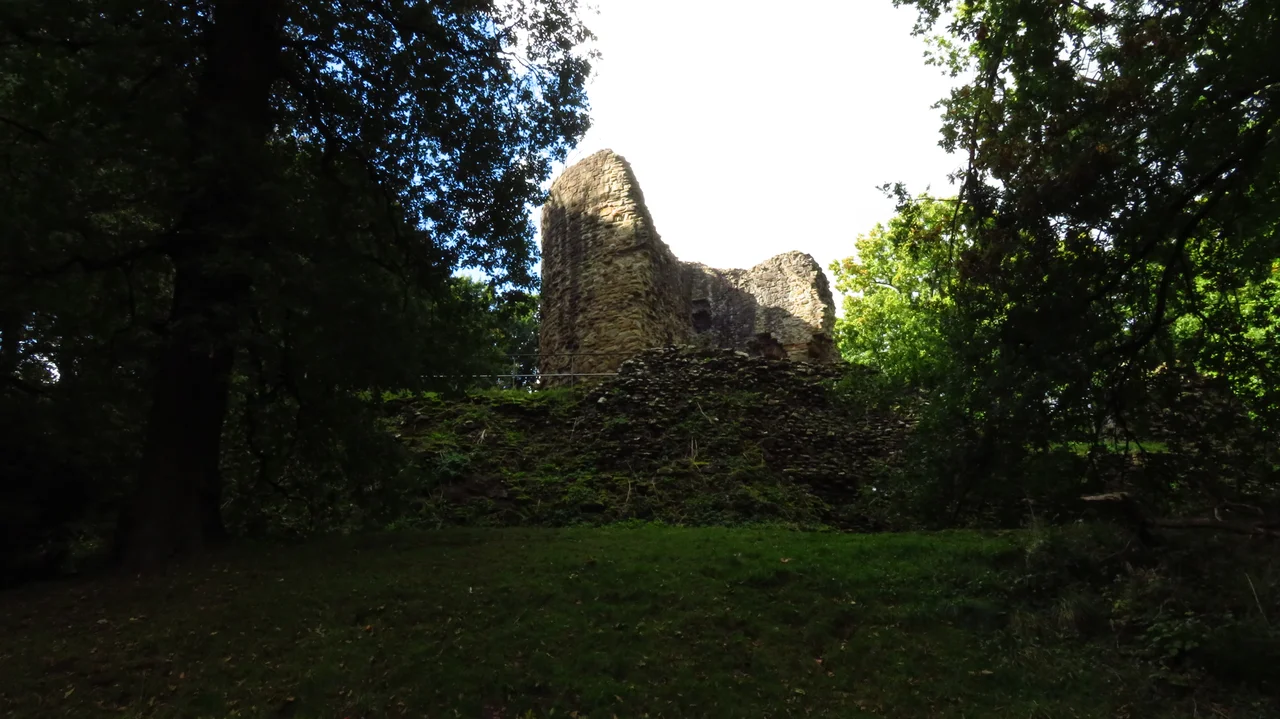
Walk down through Wepre Woods on a damp Welsh morning and you may not realise you have arrived until the stonework rises in front of you. The Welsh Keep sits on a knuckle of rock in a steep little valley, the D-shaped tower half-shrouded in moss and ivy, with no signage and no entry fee. Ewloe Castle is one of the last things the native princes of Wales built before Edward I came for them, and it has the air of a place hiding from history rather than presiding over it.
A Princely Hideaway
Ewloe was sited in Tegeingl, a cantref of north-east Wales, on high ground near the road from Chester. Its position is unusual for a serious fortress. Most castles command views from a hilltop; Ewloe sits inside a forested valley on a steeply sloped promontory, looking out only as far as the junction of two streams. The chosen location speaks to a different kind of military thinking. The castle was not meant to dominate a landscape. It was meant to control a wooded back door into the Welsh interior, watching the border with England without being easily watched in return.
The Welsh Keep
Within the upper triangular ward stands the D-shaped tower the builders called the Welsh Keep. It rests on a stone outcrop that acts as a motte, with a basic stone revetment, or chemise, wrapped around its base. The shape is the giveaway. D-shaped towers usually project from a wall or gatehouse to flank an approach, but at Ewloe the tower stands alone on its mound, encircled by its own curtain wall. Llywelyn the Great had built something similar at Castell y Bere in the 1220s, and the design at Ewloe almost certainly echoes that earlier princely project. The flat side of the keep faces outward and is pierced by a Romanesque window. The curved sides carry arrowslits. A first-floor hall sat above a ground-floor chamber; the roof was pitched, and the parapets were built up high enough to protect it from projectiles.
Llywelyn's Strongroom
Older accounts gave the castle to Llywelyn ap Gruffudd, who supposedly built it in 1257. Recent scholarship, particularly the 2022 study Princely Ambition, pushes the date back. Construction probably began under Llywelyn ab Iorwerth, the grandfather, perhaps as early as the 1210s or 1220s. An earlier fortification may have already stood here, dating from Owain Gwynedd's victory over Henry II at the Battle of Ewloe in 1157. The work continued in fits and starts; the castle may never have been finished. In the 1240s, Llywelyn's son Dafydd ap Llywelyn used Ewloe as a base for failed negotiations with the officials of Henry III, talks that collapsed into war between 1244 and 1246. The Welsh lost. Ewloe sat empty until Llywelyn ap Gruffudd reconquered the Perfeddwlad in 1256-57 and refurbished it. He used the castle again for talks with the English in 1259 and 1260.
Edward's Long Shadow
In 1276, Edward I marched out of Chester Castle and up the west bank of the Dee estuary, beginning the first Welsh War. He built Flint Castle at his forward base, a day's ride from Chester, and then Rhuddlan, both designed to be supplied by sea. Ewloe is not mentioned in the war chronicles of 1276-77, though earthworks outside the castle may indicate a brief siege. The reason for the silence is simple: Ewloe had no military value to Edward. His new coastal castles handled everything Ewloe had been built for, and they did it with the long supply lines of an empire rather than the cautious provisioning of a Welsh prince. The English Crown took the site, found it useless, and let it slip into ruin.
Wepre Woods
By the later medieval period, much of Ewloe's dressed sandstone had been carted off to build houses around Mold and Connah's Quay. The walls were the soft kind of stone the Welsh princes could find locally, and they served the practical hunger of nearby towns. A 1311 report from the Justice of Chester to Edward II notes that by 1257 Llywelyn ap Gruffudd had reclaimed Ewloe and strengthened the castle in the wood; at the time of the report, much of it was still standing. Today the castle is a Grade I listed building under the care of Cadw, the heritage agency of Wales. It sits inside Wepre Park, free to enter, reached by footpaths through Wepre Woods. In November 2009 Flintshire County Council put the surrounding land up for auction; an anonymous farmer bought it, with the castle itself permanently protected, for one hundred and twenty-two thousand pounds. The Welsh Keep is still there, lichen-dappled and silent, waiting for the next walker to round the bend.
From the Air
Located at 53.200N, 3.067W in Wepre Park between Ewloe village and Connah's Quay, Flintshire. From altitude the castle ruins are barely visible as they sit in a wooded valley below the surrounding ridgelines; the surrounding forest of Wepre Woods is the most recognisable feature. The Dee estuary lies just to the north, with Flint Castle visible on the coast about 4nm northwest. Nearest airports: Hawarden (EGNR, 2nm southeast) and Liverpool John Lennon (EGGP, 11nm northeast).
Nearby Stories
- Goodison Park 1.5 km away
- First Battle of Middlewich 2.4 km away
- Whittington Castle 4.2 km away
- Worsley 9.5 km away
- Gwrych Castle 14 km away
- Lilleshall Abbey 22 km away
- Cymer Abbey 31 km away
- Celtic Array 70 km away