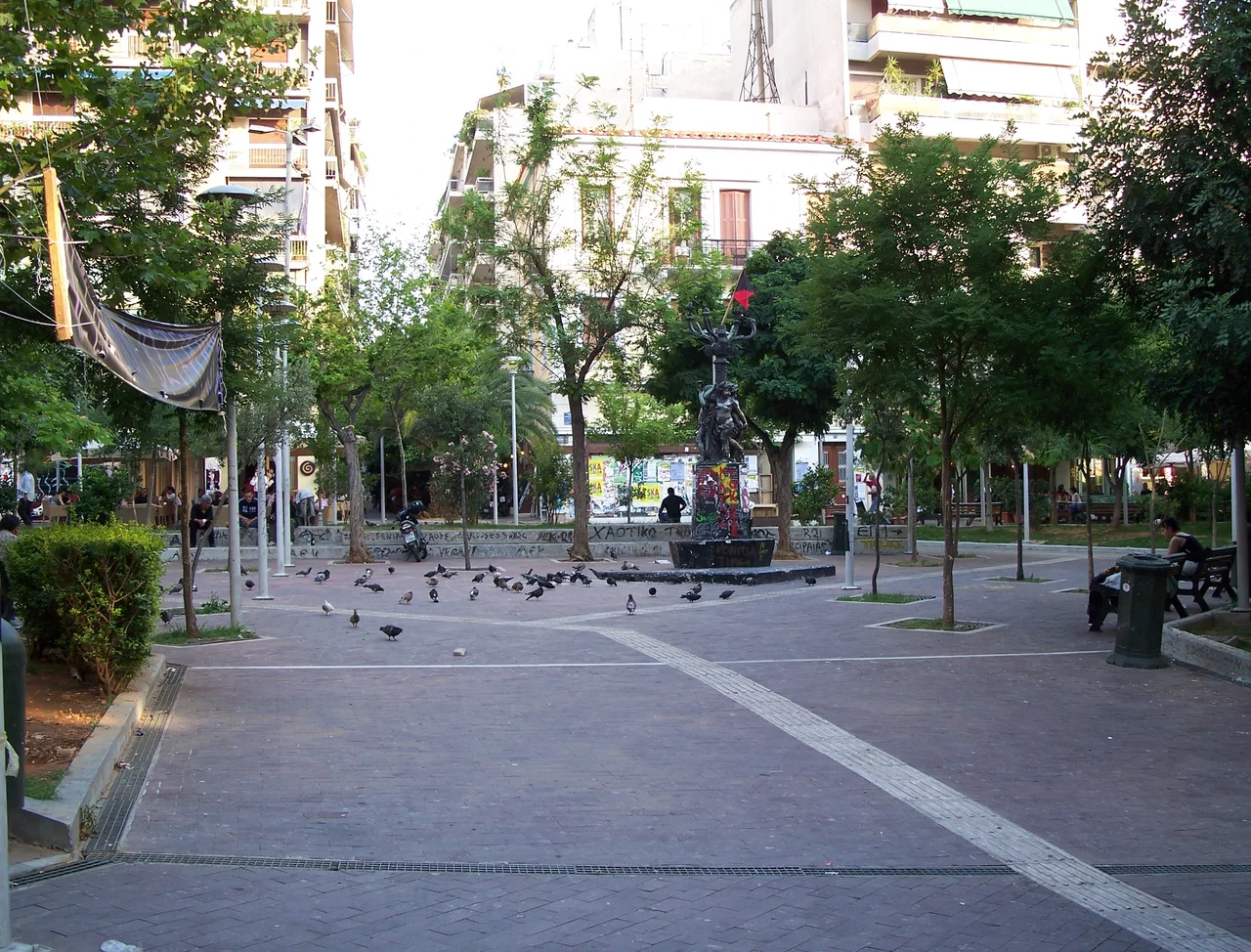

Exarcheia
The graffiti tells you where you are before the street signs do. Stencils of clenched fists, slogans in Greek and English, faded posters layered over older posters over older ones still. This is Exarcheia, a few square blocks in central Athens that punch far above their size in the history of modern Greece. The name comes from something ordinary: a 19th-century businessman named Exarchos who opened a large general store here when the area was first laid out, between 1870 and 1880, at what was then the edge of the city. The store is long gone. What remains is a neighborhood that has spent a century and a half arguing about how people should live together.
A Day in the Square
By day, Exarcheia looks less like a battleground than a working neighborhood that happens to read a lot of books. The central square fills with cafe tables and the smell of strong coffee. Stournari Street hums with computer shops, so many that locals call it the Greek Silicon Valley. Bookstores, comic shops, fair-trade stores, and organic groceries cluster nearby, a reflection of the place's intellectual and political character. The Vox, one of the oldest open-air summer cinemas in Athens, still flickers to life on warm nights. Nearby stands the National Archaeological Museum, holding the treasures of ancient Greece a short walk from a square covered in the slogans of the modern one. Just up the slope, Strefi Hill offers a quiet green vantage over the rooftops.
The Polytechnic and the Tank
Exarcheia sits beside the historic building of the National Technical University of Athens, the Polytechnic, and that proximity shaped everything. In November 1973, students occupied the campus to protest the military dictatorship then ruling Greece. On 17 November, the junta sent a tank crashing through the university gates. Civilians were killed in the crackdown, the exact number still debated decades later, and the brutality helped turn public opinion against the regime, which fell the following year. From the uprising came the Academic Asylum Law, which barred police and military from university campuses. That law made the Polytechnic both a symbol of resistance and a practical sanctuary, and it is one reason protest has gathered in these streets ever since.
December 2008
On the evening of 6 December 2008, a police special guard shot and killed Alexandros Grigoropoulos, a 15-year-old boy, within blocks of the Polytechnic. He was someone's son, a schoolkid out in his own neighborhood. The news detonated. Protests began in Exarcheia and spread across the country, the largest unrest Greece had seen since the dictatorship ended in 1974. The anger was about a death, but it was also about a generation's sense that the future had been foreclosed. In the months that followed, residents turned a parking lot into the self-built Navarinou Park, with free film screenings and gatherings. Collectives experimented with cooperative kitchens, recycling and sharing networks, and solidarity trade. Whatever one makes of the politics, people were trying to build something out of grief.
Sanctuary and Crackdown
When the European refugee crisis brought hundreds of thousands of people to Greece, many found themselves stranded in camps short of housing and basic sanitation. In Exarcheia, activists opened squats that doubled as housing, clinics, and social centers. The City Plaza, an occupied hotel, sheltered Afghans, Iraqis, Iranians, Syrians, Kurds, Palestinians, and Pakistanis under one roof, trying to give displaced families some version of home. These spaces were never universally welcomed. Far-right groups attacked some of them, and successive governments moved to clear them. After 2019, evictions accelerated under a national pledge to impose order on the neighborhood. When the deadline for one squat ultimatum fell on 5 December, the eve of the anniversary of Grigoropoulos's death, no one in Exarcheia missed the symbolism.
The Argument That Won't End
Exarcheia is easy to caricature and hard to summarize, because the people who live and pass through it span the political spectrum, from dispossessed young Greeks and migrants to anti-authoritarians, anarchists, and ordinary citizens with ordinary lives. The latest flashpoint is mundane and enormous at once: a planned metro station for Line 4 in the square, opposed by residents who fear it will erase the place they know. A government Christmas tree once raised here was burned within hours; a replacement lasted not much longer. Walk these blocks and you feel a neighborhood that refuses to be settled, by police, by developers, or by anyone's tidy story about what it means.
From the Air
Exarcheia sits in central Athens at roughly 37.99 degrees N, 23.73 degrees E, immediately northeast of Omonoia Square and bordered by Patission, Panepistimiou, and Alexandras avenues, with green Strefi Hill at its northern edge. The dense low-rise grid abuts the National Archaeological Museum and the Polytechnic campus. Athens International Airport (LGAV) lies about 30 km east-southeast; the city center offers easy visual reference from the Acropolis and Lycabettus Hill. Best viewed in the clear, dry light typical of Attic summers.
Nearby Stories
- Great Sand Beach 5 km away
- Battle of Delium 7.7 km away
- Tower of Aliartos 9 km away
- HMHS Britannic 10 km away
- Saronic Gulf 15 km away
- Sousaki Volcano 17 km away
- Sanctuary of Apollo Maleatas 24 km away
- Skyros 66 km away