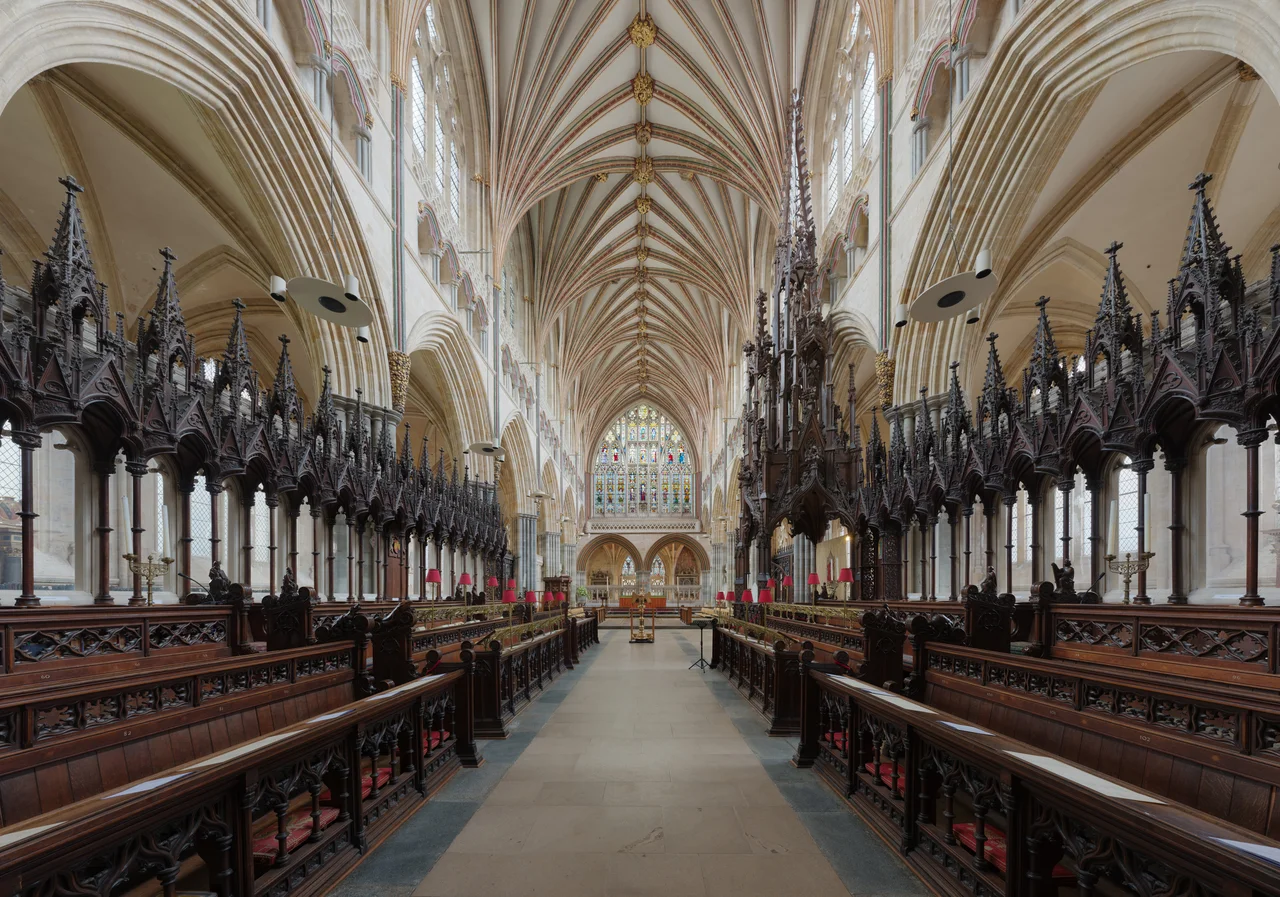

Exeter Cathedral
Walk into Exeter Cathedral and look up. The ribbed stone vault above the nave runs for roughly 96 metres without a break, the longest uninterrupted medieval stone vault anywhere on Earth. Bishop John Grandisson finished it in the 14th century, and the geometry has not faltered since. Below that ceiling sits a library that began in 1050 with sixty-six books, one of which still survives in the building where it was first shelved nearly a thousand years ago.
Leofric's books
When Leofric became the first Bishop of Exeter in 1050, he gave the cathedral sixty-six books. Sixty-five are gone or scattered to other libraries. The one that stayed, Exeter Cathedral Library MS 3501, is known today as the Exeter Book, the largest surviving collection of Anglo-Saxon poetry. It has lived here for almost a millennium. Sixteen other Leofric volumes survive in the British Library, the Bodleian, and Cambridge. The cathedral kept inventorying its collection across centuries. By 1327 Sub-Dean William de Braileghe counted 230 titles, with a dismissive note at the end mentioning many books in French, English, and Latin that the compiler considered worthless. In 1412 two carpenters spent forty weeks building a new lectrinum, the reading lectern desks, and damaged books were repaired or chained in place. By 1506 the library held over 530 titles across eleven desks.
How the books survived the Commonwealth
In 1657, under Oliver Cromwell's Commonwealth, the cathedral was stripped of several ancillary buildings, including the 1412 reading room. Books vanished into the chaos. Most of them might have followed, except Dr Robert Vilvaine intervened. He had the surviving volumes spirited to St John's Hospital for safekeeping, then later funded the conversion of the Lady chapel into a new library so the collection could come home. Vilvaine's quiet rescue saved what amounted to centuries of monastic and scholarly work. By 1752 the collection had grown to roughly 5,000 volumes, mostly through benefactions, and Dean Charles Lyttelton was already cataloguing manuscripts and tidying the muniments. The cathedral kept its books because one man refused to let them be lost.
The bells called Peter
The North Tower houses a single bourdon bell, named Peter, weighing roughly 80 long hundredweight, so heavy it no longer swings but only chimes. The South Tower carries something rarer: the second heaviest peal of 12 bells hung for change ringing anywhere in the world, beaten only by Liverpool Cathedral. Two extra semitone bells sit alongside, available for ringers who want chromatic options. When the full peal sounds across Exeter, you are hearing one of the heaviest concentrations of bell metal in the country. Inside the cathedral, the organ adds another rarity: one of only three trompette militaire stops in Britain, the others at Liverpool Cathedral and St Paul's in London. After a £1 million refurbishment by Harrison & Harrison completed in 2014, the pipes sit refreshed in the minstrels' gallery, ready for the choir's eight services each week.
Buried beneath the floor
Walking the cathedral floor is walking on bishops. Leofric himself is here, alongside Robert Warelwast, Bartholomew Iscanus, John the Chanter, and a long succession of Exeter prelates running through the centuries. Hugh Courtenay, 2nd Earl of Devon, lies beside his wife Margaret de Bohun, their tomb effigies still legible. Henry de Bracton, the great English jurist whose writings shaped common law, rests here. So does Edmund Lacey, Bishop from 1420 to 1455, whose tomb had once been a pilgrimage shrine before being walled over during the Reformation. Fragments of his shrine were uncovered after the Baedeker Blitz tore into the cathedral in 1942. Peter of Courtenay, sixth son of Louis VI of France, was buried here in 1183, a French prince in a Devon cathedral. Even outside the official burials, a memorial to Protestant martyrs Agnes Prest and Thomas Benet, executed in 1557, stands at Livery Dole.
The spider in the wall
The cathedral has one more resident worth mentioning. Segestria florentina, the tube web spider, lives in the cracks of the cathedral's outer walls. The walls are calcareous stone that slowly decays from acid pollution, opening crevices that invertebrates have made into homes. The spider's distinguishing feature is its fangs, which glow an iridescent shimmering green. They are not visible from a distance. You would have to lean close to the medieval stonework, find a likely crevice, and shine a light. Most visitors never know about her. She has been there longer than most of the marble effigies inside, doing what spiders do, indifferent to the music and the prayer above her. The cathedral has space for everyone.
From the Air
Exeter Cathedral sits at 50.7225N, 3.5297W in the centre of Exeter, Devon. The two transept towers rise to roughly 41 metres and dominate the central skyline from any approach. Best viewed from 1,000 to 2,000 feet AGL on clear days, when the long roofline of the world's longest medieval stone vault traces a line southwest to northeast. Exeter Airport (EGTE) lies 4 nm east, making this an ideal turn-from-base landmark. Dartmoor weather can roll in fast from the west.
Nearby Stories
- Manor of Orleigh 1.4 km away
- Berry Pomeroy Castle 3.9 km away
- 1890 Norton Fitzwarren Rail Crash 5 km away
- North Cornwall Railway 6.9 km away
- St Germans Priory 8.7 km away
- Siege of Lyme Regis 16 km away
- Exmoor 19 km away
- HMS Formidable (1898) 26 km away