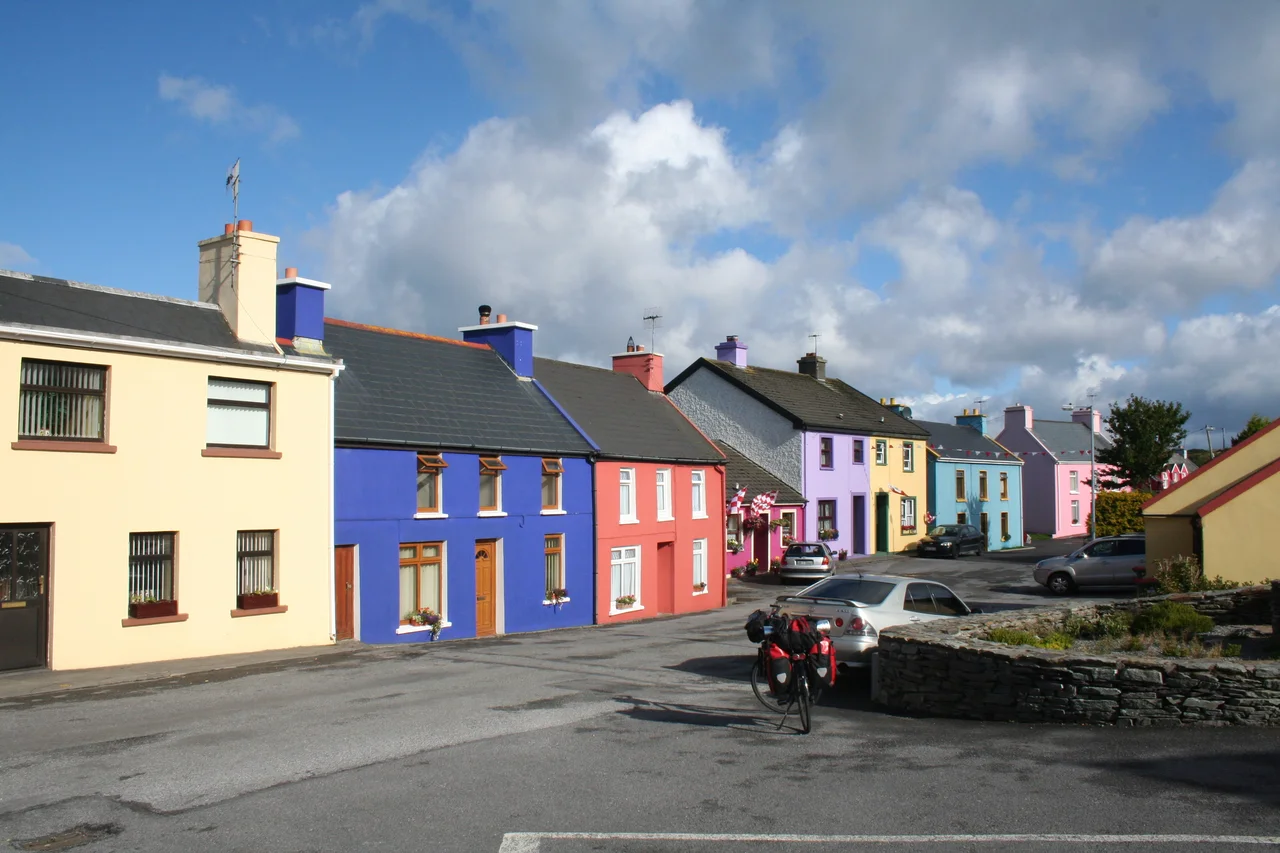

Eyeries
The houses are pink and yellow and tangerine and turquoise, the kind of colours you might paint a child's drawing if you had only the most cheerful crayons in the box. Eyeries sits on a bluff above Coulagh Bay on the Beara Peninsula, one of the most south-westerly villages in Ireland, and it does not apologise for being beautiful. In 2012 the all-island Best-Kept Places competition named it overall winner. The Tidy Towns judges have come back year after year with awards. The verdict, when you walk up the single curving street, is hard to dispute.
Where Cork Becomes the Atlantic
The Beara Peninsula is the middle finger of three peninsulas that point south-west from Ireland into the ocean - the Iveragh to its north across Kenmare Bay, the Mizen Head to its south. Eyeries lies roughly halfway along Beara's north coast, looking across Coulagh Bay toward the mouth of the Kenmare River. Behind the village rises Maulin, the tallest peak in the Slieve Miskish range at 2,044 feet. Below stretches the bay, often white with weather, sometimes flat enough to mirror the sky. The Atlantic does most of the deciding here. The Wild Atlantic Way driving route uses Eyeries as a stop, and on a fine afternoon you can see why - the village is a punctuation mark in 2,500 kilometres of coastline.
The Cheese That Started a Country
Just outside Eyeries, on a small farm at Milleens, Veronica Steele made the first wheel of modern Irish artisan cheese in the late 1970s. Until then, Ireland's dairies produced cheddar for the supermarkets and not much else. Steele - reportedly using a few gallons of her own cow's milk and a recipe she developed by trial and error - made a soft, washed-rind cheese with a pungent character closer to a French Munster than anything Ireland was selling at the time. Milleens cheese reached Declan Ryan's restaurant in Cork, then Sally Barnes's smokehouse, then the wider world. By the time Steele died in 2017, Ireland's farmhouse cheese movement had thousands of producers behind it. None of them got there first.
Stones and Stories
Two kilometres south-west of the village stands the Coulagh Stone Circle, ruined now but recognisable. To the north-east at Ardgroom are two more stone circles, one of them in fine condition. These rings of standing stones date from the Bronze Age, when the Beara Peninsula was apparently busy enough to merit ceremonial architecture. Eyeries itself is much younger as a settlement, but the older Irish name - Iries, written the way it sounds - records a pronunciation that goes back to a time before the spelling was standardised. The local GAA ground is called Pairc na hAorai, the field of the Aorai, after a sept that lived here. Layers on layers, in a place that looks at first glance like a single bright street.
A Refuge for Writers
Past the village, opposite the graveyard at Cappaneil, is the Anam Cara Writer's and Artist's Retreat. Since around 2000 it has hosted hundreds of writers and artists - novelists, poets, painters, screenwriters - who book a room for a week or a month and use the silence to finish something. The crime writer Alex Barclay lives nearby. So does Eoghan Daltun, who manages a patch of rewilded Atlantic rainforest just outside the village and has become one of Ireland's most articulate voices for ecological restoration. The village has played other supporting roles in the arts. In 1977 it stood in for a Connemara location in The Purple Taxi, a film starring Fred Astaire, Peter Ustinov and Charlotte Rampling. The 1998 television series Falling for a Dancer was shot here too. The houses, the bay, the light - they tend to photograph well.
What the Colours Say
The painted houses are not whimsy. In coastal Ireland the tradition runs deep: lime wash with pigment in it, refreshed each year, partly to keep the salt at bay and partly to give the village an identity visible from the sea. Eyeries leans into the tradition harder than most. The colours change subtly from year to year as residents repaint, but the overall effect stays - a small, defiant cluster of brightness on the cliff above a grey bay. You can see why the cheesemaker stayed. You can see why the writers come back. Some villages just decide what they are going to be.
From the Air
Eyeries sits at 51.683°N, 9.950°W on the north coast of the Beara Peninsula, perched above Coulagh Bay. From the air the painted houses are surprisingly visible - a fleck of pink, yellow and blue at the foot of Maulin (2,044 ft), which marks the highest point of the Slieve Miskish range immediately south of the village. Approach altitude 2,000-3,000 ft AGL gives good views of both the village and the bay opening toward Kenmare Sound. Nearest airfields: Cork (EICK) about 55 nm east, Kerry (EIKY) about 45 nm north-east. The Beara coast is exposed to Atlantic weather and can shift from clear to instrument conditions inside an hour - Valentia Observatory reports are essential.
Nearby Stories
- Farranfore–Valentia Harbour line 3.3 km away
- Heir Island 4.1 km away
- Inishvickillane 4.4 km away
- Kealkill stone circle 8.7 km away
- Headford Ambush 10 km away
- Dunlough Castle 13 km away
- SM U-68 27 km away
- Sao Miguel 1923 km away