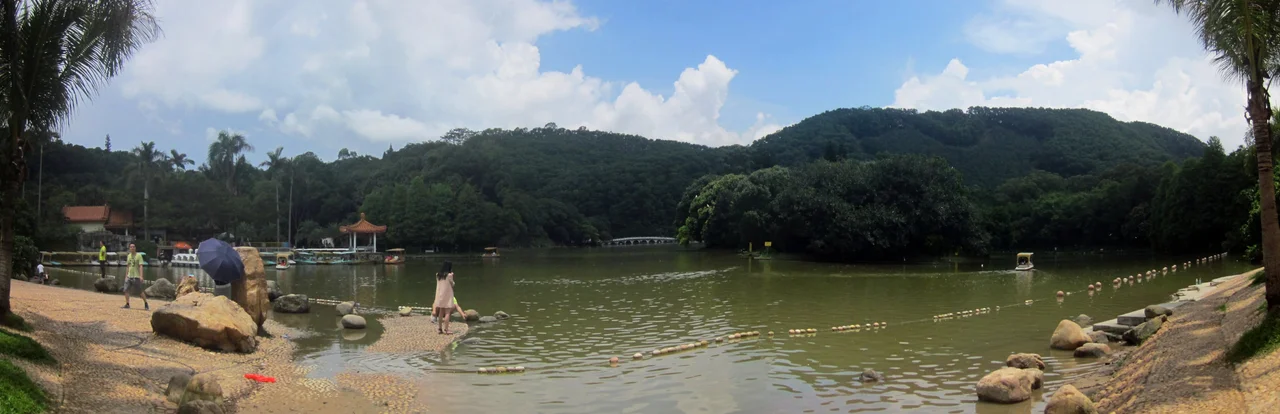

Fairy Lake Botanical Garden
Shenzhen is famous for speed — for fishing villages becoming skyscrapers in a single decade, for factories turning into tech campuses overnight. Yet tucked against the hills of Luohu District, Fairylake Botanical Garden has spent four decades doing something almost subversive: slowing down. Founded in 1983 and open to the public since 1988, it spreads across terrain that most Chinese cities would long ago have covered in concrete, offering a green counterweight to one of the most relentlessly urban landscapes on earth.
A Lake Called Xian
At the garden's heart sits Fairylake itself — Lake Xian in Chinese, a name that gestures toward the supernatural. The lake is man-made, shaped by engineers rather than geology, yet it carries itself with the quiet authority of something ancient. Arched bridges lead across its surface to small pagodas and open-sided halls where visitors pause, find shade, and watch egrets work the shallows. The surrounding hills reflect in the water on still mornings, and the effect is of a classical Chinese painting given depth and weight. For residents of Luohu, the lake serves as a kind of collective exhale — a place to arrive with nowhere urgent to be.
The Cycad Vault
If the lake is the garden's soul, the cycad collection is its claim to scientific significance. On December 18, 2012, the National Cycad Conservation Center was established here, bringing together specimens from 3 families, 10 genera, and 240 species — a breadth that ranks the collection second in the world. Cycads are often called living fossils: cone-bearing plants whose lineage predates the dinosaurs by tens of millions of years. Standing beside a mature specimen, trunk thick and bark roughened by millennia of evolutionary patience, it is easy to feel the garden's ambitions shift. This is not just a park. It is a refuge for botanical forms that outlasted most of the life on earth and now rely on institutions like this one to survive the next century. As of 2012, the garden as a whole maintained more than 8,000 plant species across 17 special-category living collections.
Hongfa Temple on the Hill
Few botanical gardens contain a working Buddhist temple, but Fairylake does. Hongfa Temple occupies a hillside terrace within the garden's grounds, its vermilion walls and upswept eaves visible from the paths below. Incense smoke drifts through the tree canopy on busy days, and the sound of wooden bells carries across the water. The temple is not a relic or a reconstruction — worshippers come here to pray, and monks move through the courtyards with the unhurried purpose of people who have never been in a particular rush. The juxtaposition of botanical science and living religious practice is distinctly Chinese: the two traditions share the same hillside without apparent contradiction, each finding in the other a kind of deep time that reinforces its own.
Science, Popularization, and the Open Gate
The garden's official mandate has always been threefold: scientific research, science popularization, and tourism. In practice, all three blend together on any given afternoon. Schoolchildren on field trips cluster around labeled specimen beds; retirees walk the shaded paths for exercise; visiting botanists consult the staff about seed-banking protocols. Weekend crowds are large and cheerful, drawn not by any single attraction but by the garden's unusual completeness — the sense that within its perimeter you can find a Buddhist temple, a prehistoric plant collection, a scenic lake, and a quiet hillside forest without ever needing to choose between them. Shenzhen built itself by tearing things down and starting over. Fairylake Botanical Garden is what it looks like when you decide, instead, to keep something and tend it.
From the Air
Fairylake Botanical Garden lies at approximately 22.571°N, 114.164°E in Shenzhen's Luohu District, roughly 8 kilometers east of central Shenzhen. From the air at 3,000–5,000 feet, the reservoir and lake system are visible as a dark-blue irregular shape set against green hillside terrain — conspicuously natural amid the surrounding urban grid. The nearest airport is ZGSZ (Shenzhen Bao'an International), approximately 35 kilometers to the west-northwest. Hongfa Temple's roofline is distinguishable on approach from the south or east in clear conditions. VHHH (Hong Kong International) lies roughly 50 kilometers to the southwest across Deep Bay.
Nearby Stories
- Hong Kong Disneyland 4.1 km away
- Mount Guanyin (Dongguan) 7 km away
- 2024 Lixinsha Bridge Collapse 7.4 km away
- Portas do Cerco 12 km away
- Lotus Hill 15 km away
- Nanxiong Formation 78 km away
- Heyuan 130 km away
- Checheng Fu'an Temple 629 km away