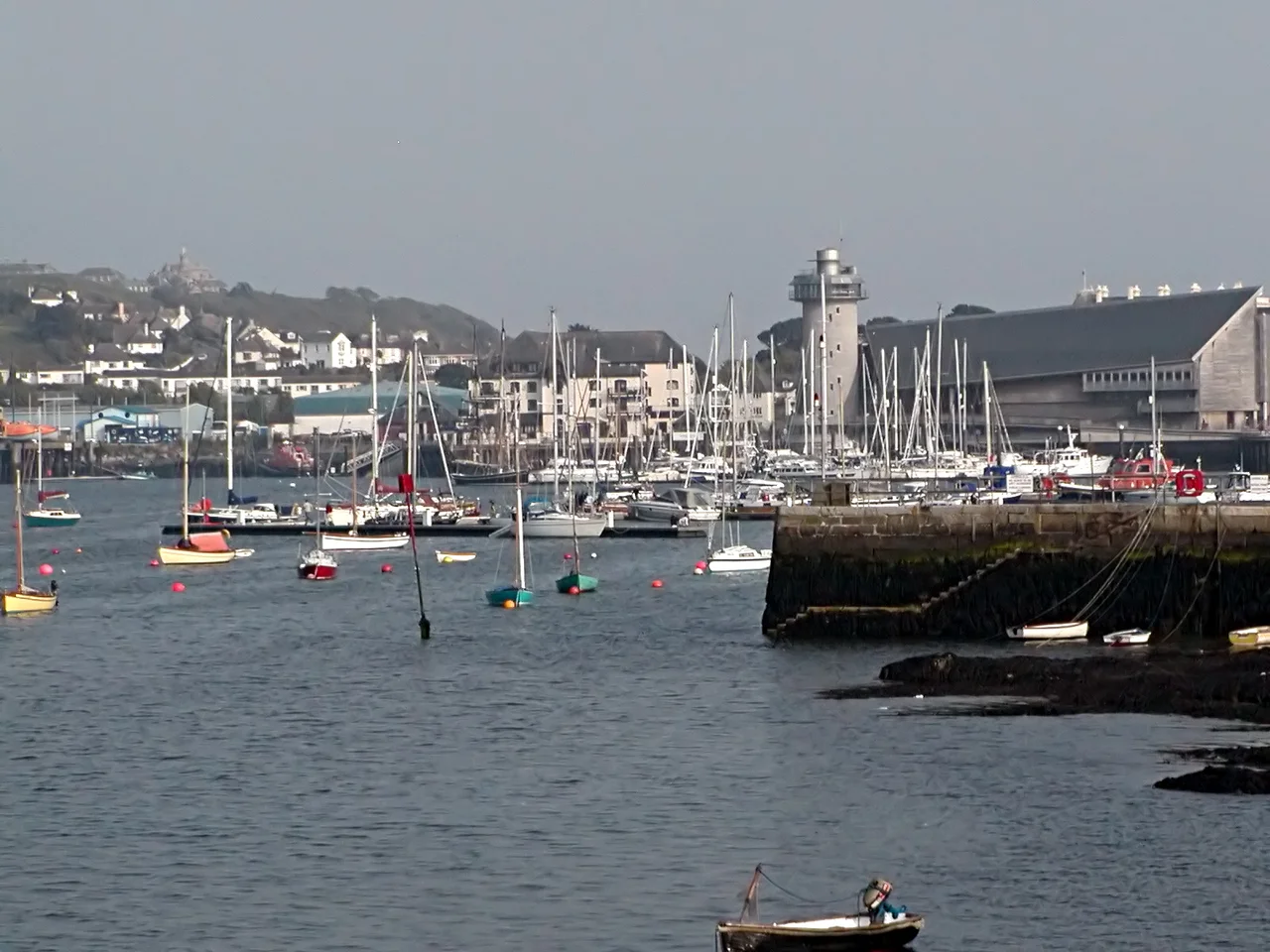

Falmouth, Cornwall
Falmouth is younger than most English towns, and that fact explains almost everything about it. Henry VIII built Pendennis Castle here in 1540 to guard the entrance to Carrick Roads, but he didn't build a town to go with it. The town came later, in 1613, when Sir John Killigrew of Arwenack Manor decided the natural harbour deserved a settlement of its own. The next two centuries turned it from a clutch of houses around Market Strand into the gateway port of the British Empire. Falmouth was where dispatches arrived from the Americas, where Darwin came ashore at the end of the Beagle voyage, where the mail packets sailed for the West Indies and the Mediterranean. The town has the deepest natural harbour in Western Europe and the third deepest anywhere on Earth, and almost everything that has ever happened here has been a consequence of that geological accident.
A Harbour Carved by Drowning
Carrick Roads is a ria, a river valley flooded by rising sea levels at the end of the last ice age. The River Fal once ran in a deeper channel through what is now the inland end of the estuary, and when the sea rose, it filled that channel to a depth that ocean-going vessels could still reach. The result is a sheltered, accessible anchorage of extraordinary scale, with deep water close inshore on both banks. Henry VIII recognised it immediately. In 1540 he built Pendennis Castle on the western headland and St Mawes Castle on the eastern, designed to provide overlapping cannon fire across the estuary's mouth. The two castles still stare at each other across the water today, with the wakes of cruise ships and cargo vessels passing between them.
The Killigrews Get Their Town
By the early 17th century, the existing town of Penryn at the inland end of the estuary had been overshadowed by maritime traffic at the harbour mouth. Sir John Killigrew founded the new town of Falmouth on his Arwenack lands around 1613. After the Civil War, his descendant Sir Peter Killigrew secured a royal charter from Charles II by, among other things, building a parish church and dedicating it to the executed Charles I. It was the kind of political theatre the Killigrews specialized in. The seal of the new town showed a double-headed eagle with a tower on each wing, based on the Killigrew arms, and the streets that grew up around Market Strand became the spine of the new port. Pennycomequick, the older name for the spot, is preserved in a street name; the new name took over.
The Falmouth Packet Service
From 1689 to 1851, Falmouth was the home of the Falmouth Packet Service: a fleet of small, fast, three-masted ships chartered by the Royal Mail to carry letters and parcels across the Atlantic. At the end of the 18th century, around forty packet ships were based here, each crewed by hand-picked sailors who frequently augmented their salaries with private contraband trade. As government ships they were exempt from customs searches, and a number of them got rich enough that whole streets in Falmouth are named for packet captains. The system gave Falmouth a strange demographic: a town of perhaps two or three thousand people, ferrying news to and from the entire British Empire. When the Beagle returned from her circumnavigation in 1836, she put in to Falmouth on 2 October, and Charles Darwin disembarked here to catch the mail coach to Shrewsbury, the journal of the voyage still in his head.
The Town That Wrote a Children's Book
In May 1907 a Scottish civil servant named Kenneth Grahame stayed at the Greenbank Hotel on the Falmouth waterfront. He was on holiday and missed his son, who was at home and recovering from illness. So Grahame wrote his son letters. The first two of those letters describe the riverbank, a mole, a rat, a toad. By the time Grahame got home the letters had become the basis of a book. The Wind in the Willows was published in 1908. Reproductions of those original Falmouth letters now hang on the walls of the Greenbank, which still operates as a hotel overlooking the harbour. Falmouth, the town that helped launch Darwin's findings to the world, also launched a children's classic from a hotel bedroom.
Total Eclipse, August 1999
On 11 August 1999, at 11:11 a.m. local time, the moon's shadow swept across southwest England. Falmouth lay close to the centre of the path of totality. The town saw a total eclipse of the sun that lasted just over two minutes, the longest duration of totality in the entire United Kingdom. The harbour fell silent. Thousands of spectators had crowded the cliffs around Pendennis and along the beaches at Gyllyngvase. For two minutes the gulls quieted, the temperature dropped, and the corona stood out against a sky the colour of inland twilight. Falmouth had been planned by a Tudor king for war, built by a Stuart courtier for politics, made rich by the mail trade. On that August morning, it was simply lucky.
Modern Falmouth
The town today has about 24,000 people and four engines under it: the working docks at the eastern end of the harbour, the National Maritime Museum Cornwall on Discovery Quay, the Falmouth University arts campus, and a tourism economy built around five beaches and a sheltered sailing harbour. The Tall Ships' Races have started or finished here in 1966, 1982, 1998, 2008, 2014 and 2023. Round-the-world solo records have begun and ended at the harbour mouth, most famously Robin Knox-Johnston's 1969 finish and Dame Ellen MacArthur's 2005 record. Cargo ships ride at anchor up the Fal waiting for charter orders, sometimes for months at a stretch. In 2016 Falmouth won the Great British High Street award in the coastal community category. The town that Henry VIII never quite built has, four centuries on, become almost everything its harbour promised.
From the Air
Falmouth sits at 50.15°N, 5.07°W on the western shore of Carrick Roads, the great natural harbour at the mouth of the River Fal. From cruising altitude the harbour is unmistakable: a wide, deep, irregularly branching inland sea opening through a narrow gap between Pendennis Point on the west and St Anthony Head on the east. The Maritime Line railway curves down from Truro along the western bank into three Falmouth stations. Newquay Cornwall Airport (EGHQ) is 19 nm north-northeast, the closest commercial field. Land's End (EGHC) lies 22 nm to the west-southwest. Perranporth (EGTP) is a closer GA option 14 nm north. The town and harbour read best from 2,000-3,000 feet on a clear day; the Carrick Roads anchorage often shows several large vessels at anchor, and Pendennis Castle stands prominent on the headland.
Nearby Stories
- Morvah 2.9 km away
- Carnewas and Bedruthan Steps 6.1 km away
- Liskeard 7.5 km away
- Battle off Lizard Point 14 km away
- Polperro 17 km away
- MV Cita 47 km away
- HMS Affray 86 km away
- 1979 Fastnet Race 96 km away