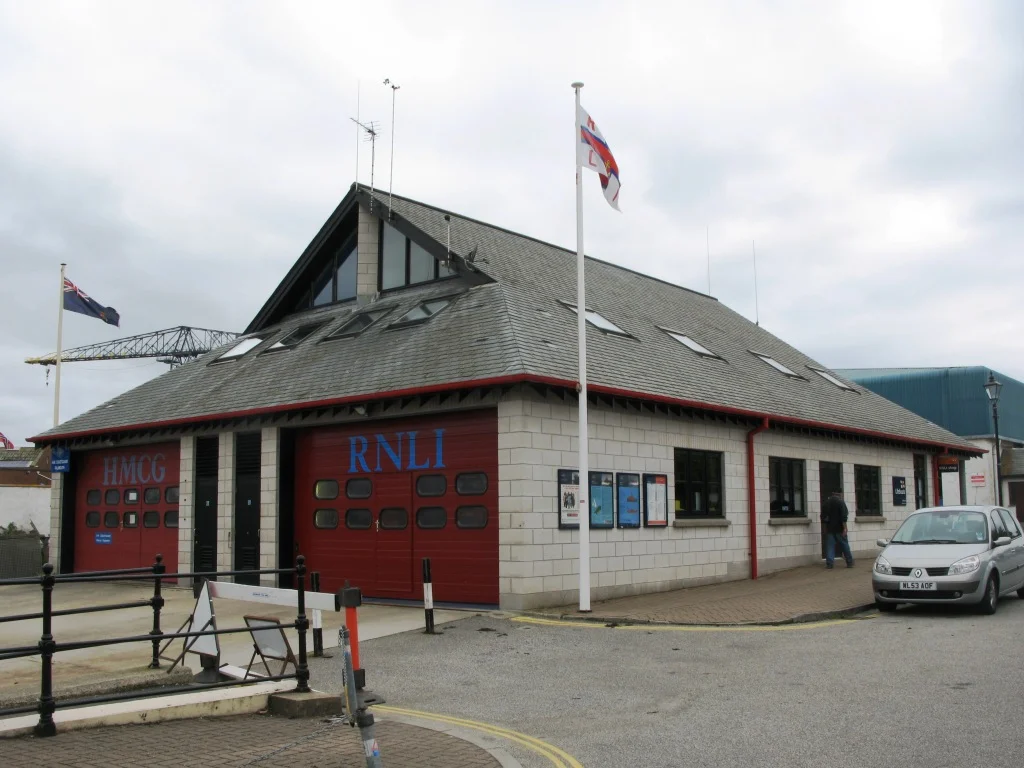

Falmouth Lifeboat Station
On 14 February 1838, Lieutenant William Field of the Royal Navy rowed into a Cornish gale and rescued two people from a barge. He did this before there was a lifeboat station in Falmouth, before the Royal National Lifeboat Institution had become what it is now, when saving lives at sea was a matter of who happened to be willing to put a boat in the water. He was awarded a medal. Two more gold medals had already been earned in Falmouth waters: William Broad in January 1828 for saving eleven from a vessel aground in a gale, and Lieutenant William James in 1830 for swimming through surf with a rope to rescue ten. The pattern of Falmouth and its lifeboat was set thirty years before the station opened.
City of Gloucester, 1867
A committee was formed in 1865 to ask the RNLI for a Falmouth lifeboat. The institution agreed. A wooden boathouse went up near the new commercial docks at a cost of £158, and a 10-oared pulling lifeboat was built in London for £280. It was funded entirely by donations raised in the city of Gloucester, which named it City of Gloucester on 9 April 1867 before sending it down to Cornwall. The boat reached Falmouth before the boathouse was finished, so the early launches were makeshift. A £98 carriage was added to wheel the lifeboat to the best launch point depending on the casualty. The wooden building opened formally on 28 August 1867. Falmouth was now part of a chain of stations that ringed the British coast.
The Storm That Never Ended
On 19 January 1940, six days after she was officially christened, the lifeboat Crawford and Constance Conybeare went to sea in a gale. The SS Kirkpool, a West Hartlepool steamer, was dragging her anchors and being driven onto the coast. The lifeboat managed to get a line between the ship and a tug, but it was not enough. The Kirkpool ran aground. A seaman in her engine room was badly injured. The lifeboat crew took him off, along with thirteen of his shipmates, landed them in Falmouth, and then turned around and went back. The remaining 21 crew were rescued in two further trips. Coxswain John Snell received the RNLI silver medal for his outstanding seamanship; his motor mechanic Charles Williams was awarded the bronze. Thirty-four people came home that day who otherwise would not have.
Fastnet, 1979
On 13 August 1979 an unforecast depression deepened explosively over the Western Approaches. The wind gusted to hurricane force 12. There were 303 yachts competing in the Fastnet Race when the storm hit. Fifteen sailors died. The rescue operation became the largest peacetime maritime emergency response in British history. Falmouth's brand-new Arun-class lifeboat went out on a search that first evening, returned, then was sent back out to join lifeboats from twelve other stations. The Falmouth boat took up a search area west of the Isles of Scilly, eight hours after leaving its moorings. The crew worked their search pattern for 32 hours straight before being given a break. They got home just after midnight in the early hours of 16 August. The RNLI chairman, the Duke of Atholl, sent every station involved a framed certificate. The Falmouth one still hangs on the wall.
Boats Through the Decades
The station's fleet history reads like a tour of British lifeboat design. The first motor lifeboat was the Watson-class The Brothers, transferred from Penlee in 1931. The B.A.S.P. arrived in 1934 from Yarmouth on the Isle of Wight; she is now preserved at the RNLI historic collection at Chatham. The prototype Thames-class Rotary Service left the station in 1976. Her replacement was the prototype Waveney 44-001, built in America in 1964 and capable of 14 knots, twice the speed of earlier displacement-hulled boats. Crews called her 'The Yank.' She is also at Chatham now. Severn-class The Will arrived as a stopgap in 1997, then the Richard Cox Scott, named by Queen Elizabeth II on a visit on 1 May 2002. In January 2025, Richard Cox Scott was withdrawn and a relief boat stood in. On 27 June 2025, the station's permanent new Shannon-class lifeboat Decibel Too arrived on station.
Two Boats, One Pontoon
The current station, built in 1993, sits in Tinners Walk close to Falmouth Docks. It is shared with HM Coastguard, an arrangement that gives the rescue services covered storage, a fundraising shop and direct access to the water. The all-weather lifeboat moors at a pontoon alongside the station. The inshore lifeboat, currently an Atlantic 85 named B-916 Robina Nixon Chard, launches from a slipway in front of the building. The neighbouring stations are Fowey to the east and The Lizard to the west, the three of them covering the south coast of Cornwall between them. A typical year sees the Falmouth boats called out fifty to seventy times, anything from fishing vessels in trouble off the Manacles to swimmers cut off by tide on Gyllyngvase beach. Some calls take an hour. Some, as 1979 proved, take days.
From the Air
Falmouth Lifeboat Station sits at 50.151°N, 5.059°W on the edge of Falmouth Docks, on the inner waterfront of Carrick Roads. From the air it is the small building at the eastern end of the Falmouth quay, with a lifeboat usually visible at the pontoon alongside. The wider docks complex is conspicuous and forms a useful orientation point: ship-repair cranes and a working drydock on the south side of the harbour entrance, just inside Pendennis Point. Newquay Cornwall Airport (EGHQ) is 19 nm north-northeast; Land's End (EGHC) is 23 nm west. Strong southwesterly winds funnel into the Channel Approaches and can build a substantial swell across the harbour mouth even with Pendennis Headland providing partial shelter; the lifeboats here regularly operate in conditions that ground recreational craft for days.
Nearby Stories
- Morvah 2.9 km away
- Carnewas and Bedruthan Steps 6.1 km away
- Liskeard 7.5 km away
- Battle off Lizard Point 14 km away
- Polperro 17 km away
- MV Cita 47 km away
- HMS Affray 86 km away
- 1979 Fastnet Race 96 km away