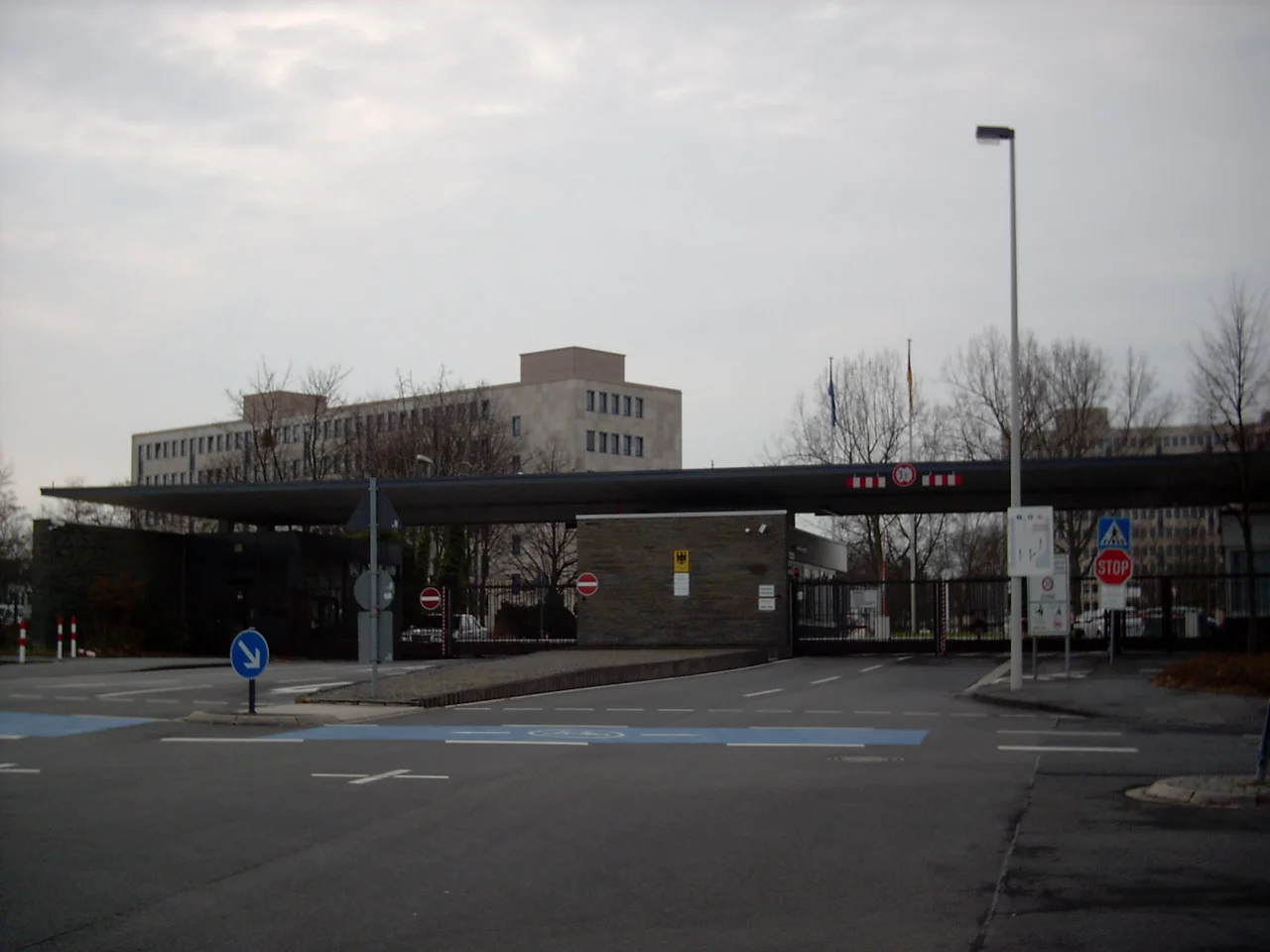

Federal Ministry of Defence (Germany)
On a forested hill called the Hardthöhe, above the Bonn district of Lengsdorf, sits one of the most consequential workplaces in postwar Europe — and the one its architects most wanted to be unremarkable. The Federal Ministry of Defence moved here in 1960 from the cramped Ermekeil barracks downtown, and ever since, this fence-lined cluster of low office blocks has set the policy that shapes the Bundeswehr, the German armed forces who together with their civilian colleagues number around 260,953 active personnel. The buildings are bureaucratic, the lawns trim, the access strictly controlled. From the air it could be a corporate campus. That is part of the design.
Amt Blank, in Secret
Germany was not supposed to have a Ministry of War again. In 1945 the institution had been disbanded, the Wehrmacht dissolved, and the country occupied. Then the Korean War broke out in 1950 and the United States began pressing Konrad Adenauer for a West German contribution to Western European defence. Adenauer agreed, but the public did not. Rearmament — Wiederbewaffnung — was hugely controversial and technically contradicted the Allied occupation statute. So the chancellor set up a special representative, Theodor Blank, with a quietly named bureau in Bonn that everyone called Amt Blank. Officially it did not exist. By 1955 it had over 1,300 employees. On 7 June 1955 the fiction ended and Amt Blank became the Bundesministerium für Verteidigung. The Bundeswehr was founded. Germany joined NATO the same year. Within a year, conscription was back.
Moving Up the Hill
The first home of the new ministry was the Ermekeil barracks, an old garrison building down in the city. By the late 1950s it was bursting. The decision was made to build a fresh complex on the Hardthöhe, the wooded hill on Bonn's western outskirts. The Hardthöhe blocks went up at the start of the 1960s and have grown by accretion ever since: more office buildings, an officers' mess, training rooms, a heliport, hardened communications facilities. About 2,000 people work in the ministerial offices alone, with thousands more across the wider Hardthöhe site. The complex is, by the standards of German defence ministries, deliberately understated — no soaring atrium, no monument. The Bonn Republic's instinct, as elsewhere, was to make the institutions of military power look as much like accounting offices as possible.
Bendlerblock, the Other Address
After reunification the ministry acquired a second seat in Berlin: the Bendlerblock, on the Landwehrkanal in Tiergarten. The name has gravity. It was here that the Ministry of the Reichswehr sat from 1919, here that the Wehrmacht ran the war from 1935 to 1945, and here, on the night of 20 July 1944, that Claus von Stauffenberg and his fellow conspirators were arrested and shot in the courtyard after the failed plot to assassinate Hitler. Today there is a memorial in that courtyard and the building functions as the ministry's Berlin office — used so often by ministers that journalists still write 'the Bendlerblock' as a metonym for the whole institution. The arrangement is pure Bonn–Berlin compromise: the bulk of the bureaucracy stayed on the Hardthöhe, the public ceremony moved east.
What the Hill Decides
Article 65a of the Grundgesetz makes the Defence Minister the Commander-in-Chief of the Bundeswehr in peacetime; in a declared state of defence, command passes to the Chancellor. Since the 1990s the Hardthöhe has authored a steady widening of what the German military does. The Bundeswehr deployed to the Balkans, flew combat missions in the 1999 Kosovo War, and spent almost twenty years in Afghanistan with the International Security Assistance Force and the Resolute Support Mission before the last German soldiers withdrew on 29 June 2021. The decisions to send them, to fund them, to bring them home — all routed through these unassuming Cold War office blocks. There is no statue out front. There is a checkpoint, and a flag, and a steady stream of staff cars rolling up a hill in Bonn that quietly reshaped what postwar Germany was allowed to be.
From the Air
50.6992 N, 7.0403 E on the Hardthöhe ridge in western Bonn, about 4 km west of the Rhine. Cologne-Bonn (EDDK / CGN) is roughly 25 km north; Bonn-Hangelar (EDKB) is around 10 km northeast. The site sits in restricted airspace — overflight at low altitude is not advised. Best appreciated from 4,000 feet or higher to the south or west, where you can pick out the disciplined orthogonal grid of office blocks on the wooded plateau above the city.
Nearby Stories
- Marienstatt Abbey 5.7 km away
- Baumwollspinnerei Ermen & Engels 14 km away
- Düren-Neuss railway 15 km away
- Operation Chastise 15 km away
- Battle of Hurtgen Forest 22 km away
- Zwingenberg Castle 147 km away
- Basilica of Saint-Pierre-aux-Nonnains 153 km away
- Fort Jeanne d'Arc 169 km away