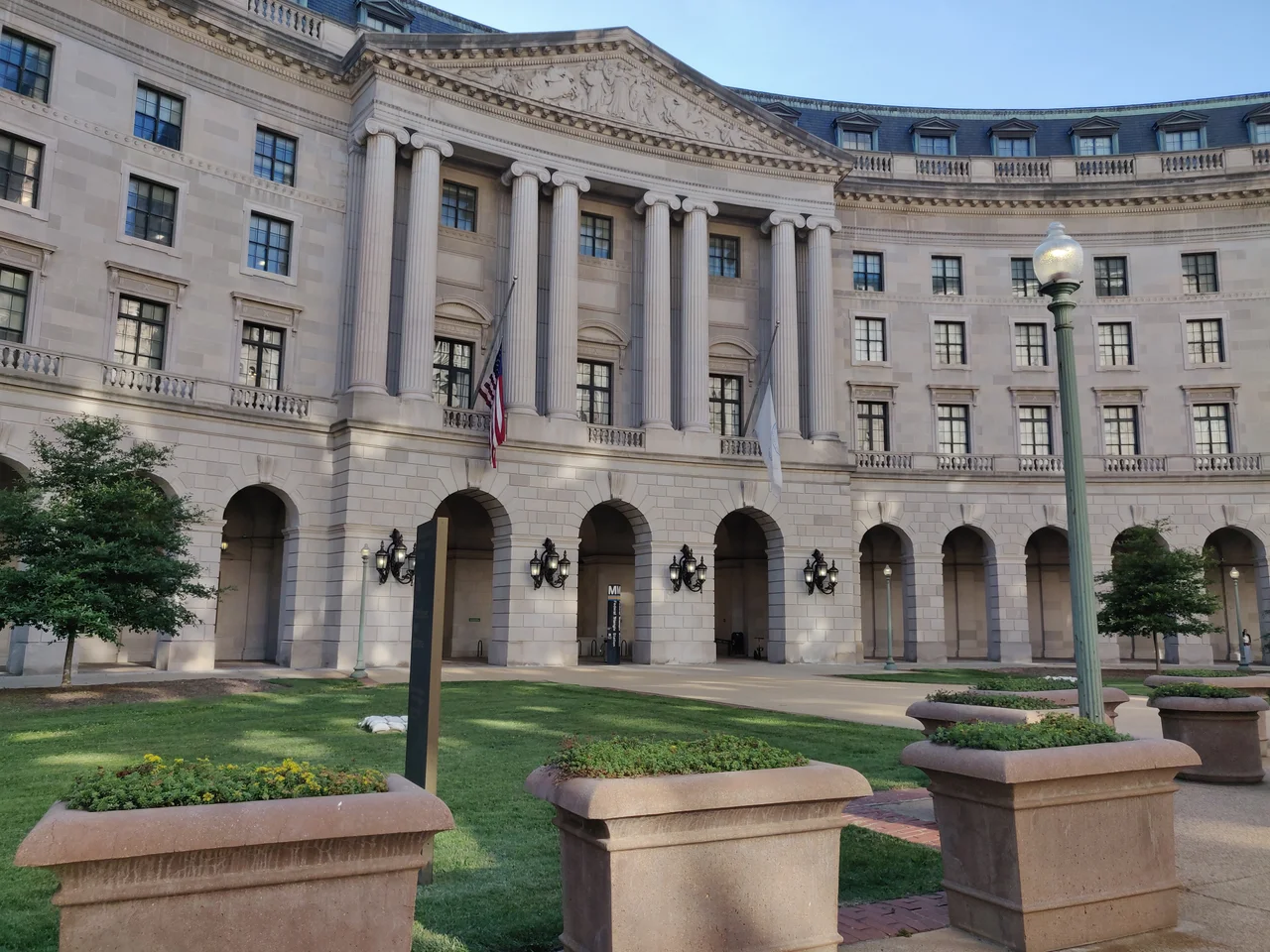

Federal Triangle
Before the limestone arrived, the place was called Murder Bay. The seventy acres between the White House and the Capitol that we now call Federal Triangle were, in the early twentieth century, a swampy floodplain along the buried Tiber Creek, almost completely unpaved, without functional sewers, malarial in summer, and dominated by what contemporary newspapers called Washington's underworld. There were brothels and saloons. There were gambling houses. There were tenements where the laborers and the longshoremen and the cooks who actually kept the federal government running lived without running water. Then between 1926 and 1938, the federal government bought it all, knocked it all down, and replaced it with seven enormous neoclassical office buildings faced in Indiana limestone, all designed by the same Board of Architectural Consultants, the largest single building project in Depression-era America.
The Public Buildings Act of 1926
The federal government's office space had been a problem for decades. Departments rented buildings ad hoc all over the city, with no coordination, while the McMillan Plan of 1902 imagined a more rational arrangement of executive offices that no Congress had been willing to fund. The Public Buildings Act of 1926, championed by Treasury Secretary Andrew Mellon, finally appropriated the money. The act authorized not only the Federal Triangle complex but the new Supreme Court Building, a major extension of the Government Printing Office, and the widening of B Street into what became Constitution Avenue. Treasury announced the first three buildings on June 5, 1926: a National Archives, an Internal Revenue building, and a Department of Commerce headquarters. The Board of Architectural Consultants, organized in 1927, eventually expanded the plan to seven major buildings designed by seven of the most prominent firms in American Beaux-Arts architecture: York and Sawyer for Commerce, Louis Simon for IRS, Pope for the National Archives, Medary for Justice, Brown for Labor, Delano for the Post Office, and Bennett for the Apex Building.
The Bonus Army and the Demolition
Clearing the land took until 1931. The Center Market, an enormous covered farmer's market that had stood on the future Archives site since 1872, was demolished. Railroad tracks that converged on the market site had to be lifted and rerouted. Hundreds of buildings were condemned and torn down. The vacant lots created by all this demolition became, in June 1932, the campsite for thousands of homeless World War I veterans who had marched on Washington as the Bonus Army to demand the early payment of their service bonus certificates. On July 28, 1932, President Hoover ordered Army Chief of Staff Douglas MacArthur to clear the Bonus Army from Federal Triangle. MacArthur went further than ordered and pursued the marchers across the Anacostia, burning their main camp at Anacostia Flats to the ground that same night. The political damage to Hoover, three months before the election that gave the presidency to Franklin Roosevelt, was lasting.
The Seven Buildings
The Internal Revenue Building, designed by Louis Simon, was the first finished. Treasury Secretary Andrew Mellon laid its cornerstone on May 25, 1929. It opened in June 1931, a year ahead of schedule. The Department of Commerce Building opened January 4, 1932, with 1.6 million square feet of floor space, then the largest office building in the world. The Post Office Department Building was dedicated on June 11, 1934. The Department of Justice Building on October 25, 1934. The Labor Building and the Interstate Commerce Commission Building, which share a common Departmental Auditorium, were dedicated together on February 26, 1935. The National Archives Building, designed by John Russell Pope (also the architect of the Jefferson Memorial), was occupied in 1937 and the records moved in during 1937. The last to finish was the Apex Building at the eastern tip of the triangle, originally the home of the Federal Trade Commission. Roosevelt laid its cornerstone in 1937 using the same trowel George Washington had used at the Capitol cornerstone in 1793.
The Style Wars
From the moment the first buildings opened, the architectural press was split. The Washington Post called the Internal Revenue Building's marble work some of the most beautiful in the United States. Younger architects called the whole complex elitist, pretentious, and anachronistic. The critic William Harlan Hale, writing in 1935, asked what was new or modern about trying to give Washington the character of Imperial Rome. By the 1940s critics drew uncomfortable parallels with Albert Speer's Berlin and the colossal classicism of Stalin's Moscow. The buildings stayed. They stayed because they worked as office buildings, and because they did exactly what their patron Andrew Mellon had wanted them to do: present the federal executive as permanent, dignified, and continuous with the Western tradition of state authority. The neoclassicism that made twentieth-century critics uneasy is the same neoclassicism that visitors from around the world still photograph today.
The Reagan Building
The original plan had called for an eighth building at the center of the complex, the Apex Building's opposite, but the project was abandoned during the Depression and the central block became a parking lot for decades. Daniel Patrick Moynihan, a New York senator who took a personal interest in the architecture of the federal city, championed completion of the unfinished Federal Triangle starting in the 1980s. The Federal Triangle Development Act passed Congress almost unanimously in August 1987, authorizing the Ronald Reagan Building and International Trade Center. Pei Cobb Freed and Partners won the design competition in October 1989. Cost overruns nearly killed the building. The George H.W. Bush administration cancelled construction in January 1992. The Clinton administration revived it in December 1993. The building finally opened in 1998 at a cost of $818 million, the second-largest building in Washington after the Pentagon. It carries the Woodrow Wilson Plaza along its eastern edge, a Martin Puryear minimalist tower called Bearing Witness, and the metro stop that opened in July 1977. Federal Triangle is at last finished, sixty years late.
From the Air
Federal Triangle is bounded by 15th Street NW on the west, Constitution Avenue NW on the south, Pennsylvania Avenue NW on the north, and 6th Street NW on the east, centered roughly at 38.8945 degrees north, 77.0269 degrees west. Best viewed at 1,500 to 2,500 feet AGL with the National Mall to the south and the Capitol clearly visible to the east. Reagan National (KDCA) is three nautical miles south. The site is inside the P-56 prohibited area; viewing is from authorized riverside approaches.
Nearby Stories
- Gunston Hall 1.1 km away
- 2023 Baltimore Shooting 4.9 km away
- Battle of Middleburg 6.6 km away
- Crownsville Hospital Center 10 km away
- Battle of Loudoun Heights 13 km away
- First Battle of Rappahannock Station 20 km away
- Howard County, Maryland 21 km away
- Harriet Tubman Underground Railroad 50 km away