
Felixstowe
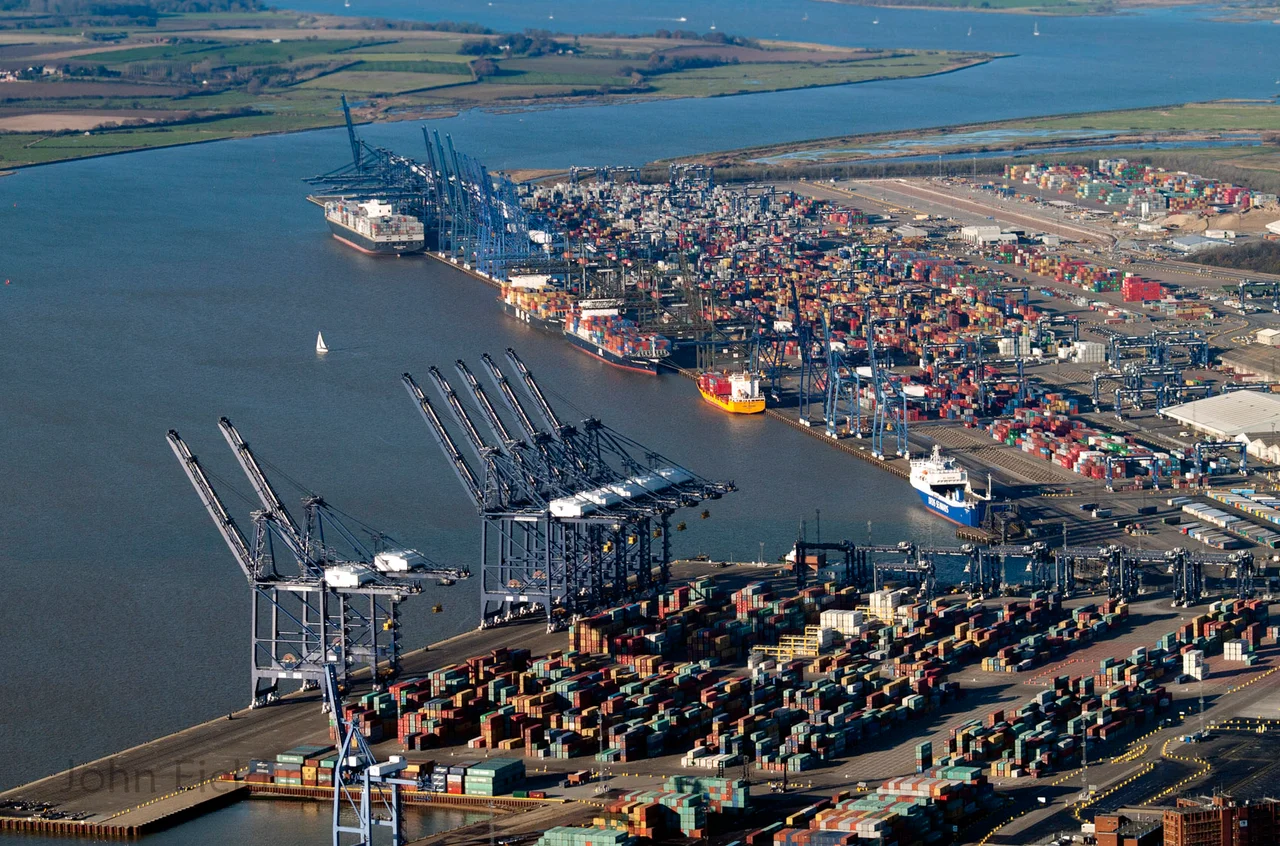
About 48 percent of all containers entering the United Kingdom come through one Suffolk town. Twenty-five ship-to-shore gantry cranes lift colored steel boxes off ultra-large container vessels along a continuous quay 2.4 kilometres long. The water alongside is dredged to 49 feet. The trains running out of the port carry the world's manufactured goods west to the Midlands. And yet, less than a mile from the cranes, you can stand on a Victorian promenade in front of the original British beach huts and look at the same coast Wallis Simpson briefly called home before she divorced her way into an abdication crisis.
Filicia's Place, or Felix's
There are two theories about the name. One says it honors Saint Felix of Burgundy, the first bishop of the East Angles in the 7th century. The other points to an Old English name Filicia plus stow, meaning Filicia's place. The earliest recorded forms - Filchestou in 1254, Filchestowe in 1291 - support the second theory. The reworking to Felixstowe may have been deliberate, to associate the place with the saint. Either way, the medieval settlement around the pub and church was a small thing compared to Walton, the larger neighbour on the River Orwell, which had been a Roman fort site (Walton Castle) since the 3rd century. Walton dominates the Domesday Book; Felixstowe does not appear at all.
Where British Beach Huts Began
Felixstowe rode the late-Victorian tourism boom. The pier opened in 1905. The Felixstowe Town railway station made the seafront reachable. The German imperial family visited in 1891. The Felix Hotel - the millionaires' hotel, now called Harvest House - was built in 1903. And around the spa area, sometime around 1895, Felixstowe became the first British town to install stationary beach huts as permanent structures rather than wheeled bathing machines. Photographic records go back to that date. Some of the huts in the conservation area at the spa are probably the originals. The town is, in beach-hut history, the source. The Floral Hall (now Spa Pavilion) opened in 1909. In April 1914, suffragettes burned down the Bath Hotel as part of their bombing and arson campaign.
The Wars
In the First World War, Felixstowe was an RNAS and RAF seaplane base. The Felixstowe Fury, a giant flying boat being prepared for an 8,000-mile flight to Cape Town, side-slipped and crashed offshore on 11 August 1919. Six passengers were rescued; the wireless operator, Lt MacLeod, died. Between the wars, the seaplane station became the RAF's experimental establishment for flying boats. In the Second World War the base became HMS Beehive, home to motor torpedo boats and motor gunboats that attacked German E-boats and coastal convoys under famous commanders including Hichens and Dickens. In 1944 the piers loaded troops, tanks, and vehicles into landing craft of Force L bound for Normandy. In 1945 German naval commanders sailed their E-boats from occupied Holland into Felixstowe Dock to surrender to the Royal Navy.
The Port
The Port of Felixstowe opened its dock basin in 1882 and its main port in 1886. Today it is operated by Hutchison Port Holdings, with additional land owned by Trinity College, Cambridge. The deep water can accommodate ultra-large post-Panamax vessels of any current generation. The port has its own police force, with jurisdiction over the surrounding area by arrangement with Suffolk Constabulary. It runs its own ambulance and fire services. The 1953 North Sea flood killed at least 48 people in the town. In 1993 a security van driver called Fast Eddie Maher walked off with 1.2 million pounds in cash from outside Lloyds Bank and went on the run for 19 years before being arrested in 2012. The town has absorbed multiple identities: spa town, military base, container port, ordinary Suffolk place.
Wallis, Edward, and an Abdication
In 1936 Wallis Simpson took residence in Felixstowe in order to claim local domicile for her divorce from Ernest Simpson, so that she would be free to marry the new king. The divorce, granted in October that year, triggered Edward VIII's abdication six weeks later. The hotel where she stayed is gone, but the link is genuine. Look at Felixstowe from the air today and you see the Victorian terraces of the spa running north along the seafront, the beach huts in a colored line along the promenade, and beyond them the great rectangle of the container port - thousands of stacked boxes, the cranes like giraffes drinking from the ships. A small town with an outsized influence on what arrives in Britain, and on who stays married to whom.
From the Air
Felixstowe sits at 51.95 N, 1.35 E at the mouth of the Orwell and Stour estuaries. The Port of Felixstowe dominates the southern end of the peninsula - look for stacked containers and gantry cranes. Landguard Point and Fort sit at the southernmost tip. Across the harbour to the south is Harwich. Nearest airports: RAF Wattisham (EGUW) 20 miles west, Stansted (EGSS) 55 miles southwest, Cambridge (EGSC) 65 miles west, Norwich (EGSH) 50 miles north. The town beach and seafront run north of the docks; the Felixstowe Ferry and golf course are to the northeast at the mouth of the Deben.
Nearby Stories
- Ickworth House 3.6 km away
- Framlingham 7.9 km away
- Castle Hedingham 8.6 km away
- Battle of Assandun 8.6 km away
- Margate Surfboat 33 km away
- 1382 Dover Straits Earthquake 41 km away
- Four Days' Battle 48 km away
- Battle of Lowestoft 85 km away