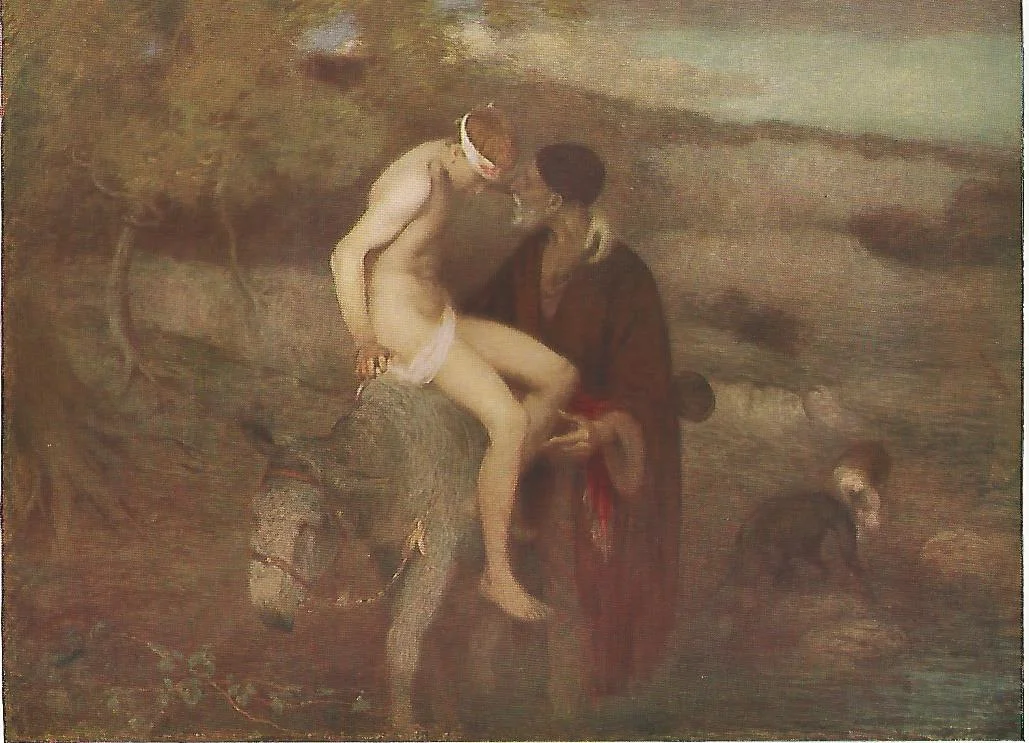
_81.6_x_106_cm,_Ferrens_Art_Gallery,_Hull.jpg)
Ferens Art Gallery
Thomas Ferens did not start out collecting paintings. He started out collecting soap. As a young Methodist accountant in Hull in the 1870s, he joined the firm that became Reckitt and Sons, eventually rising to chairman and Liberal MP for Hull East. By the time he died in 1930 he had given so much to his adopted city, including the entire site and building fund for an art gallery on Queen Victoria Square, that Hull simply named the gallery after him. The Ferens Art Gallery opened in 1927 and has been the city's flagship cultural institution ever since, the place that hosted the Turner Prize in 2017 and that bought a fourteenth-century Pietro Lorenzetti in 2013 because Hull deserved one.
The Frans Hals
The treasure of the permanent collection is a small, intense portrait of a young woman painted by Frans Hals between 1655 and 1660. The sitter is unknown, but the painter is one of the great masters of the Dutch Golden Age, the man who turned what could have been routine merchant portraits into psychological studies that anticipate modern photography. The Ferens Hals shows a young woman in dark clothing against a dark ground, a soft white collar catching the light, her gaze direct and slightly amused. It is the kind of small picture that rewards long looking. How a Hull gallery acquired a Hals at all is part of Thomas Ferens's legacy: his endowment fund continued buying art long after his death, and the gallery's professional curators have made shrewd acquisitions for nearly a century.
Lorenzetti, Found
In 2013, the Ferens acquired a small fourteenth-century tempera-on-panel painting of Christ Between Saints Paul and Peter, attributed to the Sienese master Pietro Lorenzetti. Lorenzetti was one of the great innovators of early Italian painting, killed by the Black Death in 1348 along with his brother Ambrogio after they had transformed the Sienese approach to space, narrative, and emotion. Lorenzettis on the open market are vanishingly rare. The Ferens funded the purchase jointly with the Heritage Lottery Fund and the Art Fund, an unusual coalition that allowed Hull to keep an internationally important painting in the public collection. The little panel now hangs alongside the Hals, two centuries of European art quietly redefining what a regional English gallery can hold.
Turner Prize, 2017
Hull was named UK City of Culture for 2017, and the Ferens was selected to host the Turner Prize, the country's most prestigious and most controversial contemporary art award. The gallery received a 4.5-million-pound refurbishment to prepare for the exhibition. New galleries were added, the entrance was reconfigured, and on 13 January 2017 the renovated building opened to the public. On 8 February, Prince Charles and Camilla, Duchess of Cornwall, came to view the work. By the end of 2017 the Ferens had received a record 519,000 visitors, a number that astonished a gallery that had quietly served a few thousand visitors a week for most of its existence. The winning Turner Prize that year went to Lubaina Himid, the first Black woman ever to take the award.
Victorians and Adelphi
Beyond the Hals and the Lorenzetti, the Ferens collection is strong on Victorian and Edwardian British painting. Frederic Leighton's Electra at the Tomb of Agamemnon hangs here, a 1869 study in classical grief. Elizabeth Thompson's The Return From Inkerman shows survivors of the Crimean War battle, painted by one of the few women to make a career as a military artist. Herbert James Draper's Ulysses and the Sirens captures the Homeric moment with operatic drama. The gallery also runs touring exhibitions that have featured Francis Bacon's papal portraits in 2017 and Ian McKeever's abstract paintings in 2019. In 2009 the Ferens hosted an exhibition and live performance celebrating the 25th anniversary of the New Adelphi Club, a tiny live music venue less than two miles north that has been called the best small venue in Britain. From medieval Sienese altar panels to indie rock posters, the Ferens collects everything Hull has cared about.
From the Air
Located at 53.74 degrees N, 0.34 degrees W on Queen Victoria Square in the centre of Kingston upon Hull. The gallery's classical-style stone facade fronts the main pedestrianised square, with the City Hall and Maritime Museum nearby. Nearest airports: Humberside (EGNJ) about 9 nautical miles south across the Humber estuary, Leeds Bradford (EGNM) about 50 nautical miles west. The Humber Bridge is visible to the southwest. Best viewed at low altitude when the city centre's clustered Victorian and Edwardian civic buildings stand out from the surrounding modern construction.
Nearby Stories
- Skipsea Castle 3.9 km away
- 2025 North Sea Ship Collision 4.8 km away
- Gainsborough, Lincolnshire 6.1 km away
- SM UC-47 9.7 km away
- Howden 12 km away
- Battle of Stamford Bridge 14 km away
- Battle of Winceby 28 km away
- HMS Cobra 50 km away