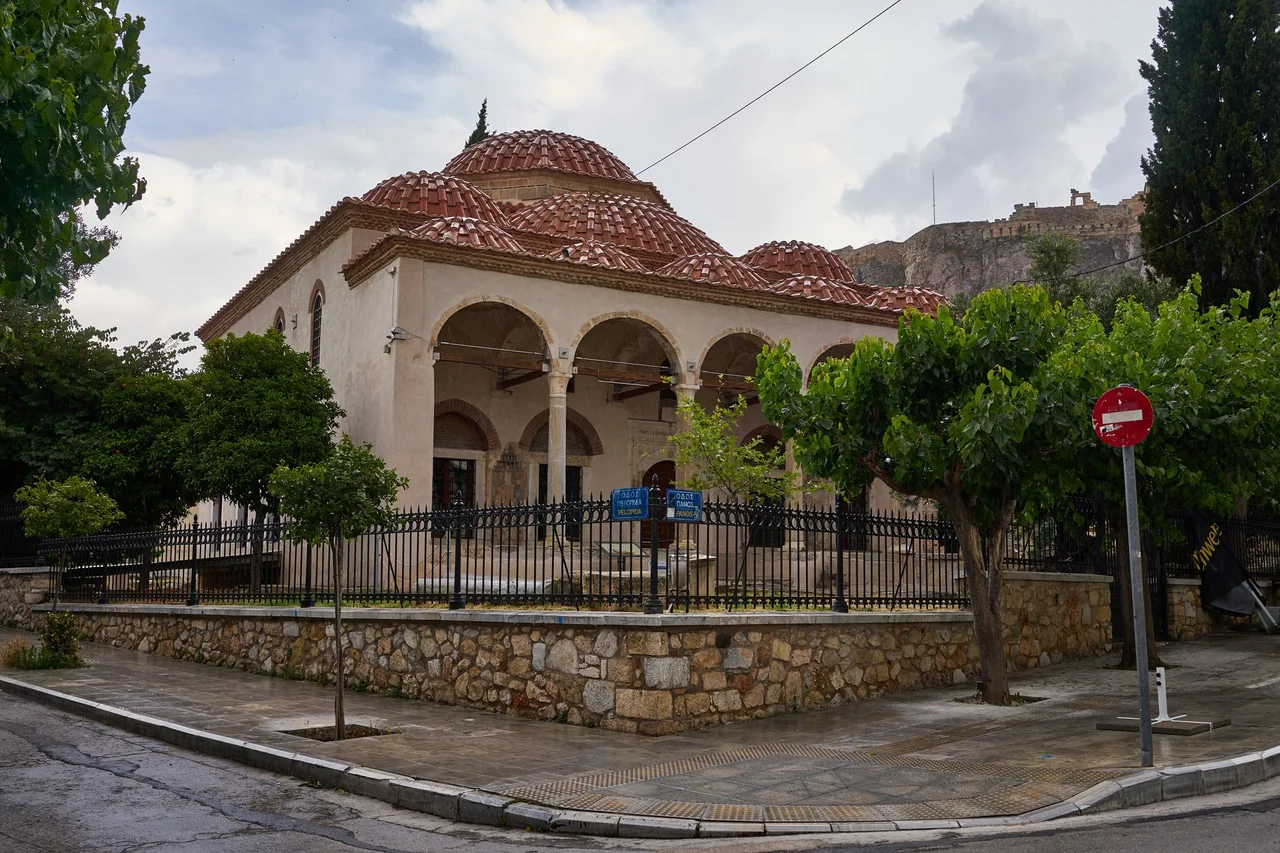

Fethiye Mosque (Athens)
Stand in the Roman Agora of Athens, the marketplace the city used after the classical Agora grew too small, and you will see a low domed building that does not quite match anything around it. It is not a temple and not a church, though both once stood near this very spot. It is the Fethiye Mosque, and its plain stone walls quietly record the layered story of Athens itself, a city conquered and reconquered, whose holy ground kept changing hands and changing names. Few buildings anywhere stack so much history into so modest a footprint.
Ground With a Memory
The mosque does not sit on empty earth. Beneath and before it stood a Christian basilica from the middle Byzantine period, the 8th or 9th century, when Athens was a provincial town in a Christian empire centered on Constantinople. That church marked the site as sacred long before any minaret rose here. The location matters, too. The Fethiye Mosque stands on the northern side of the ancient Roman Agora, steps from the Tower of the Winds, the elegant octagonal marble clock tower the ancient Greeks built to track time, season, and wind. To stand here is to stand inside three eras of Athens at once, with the classical, the Christian, and the Islamic city all within a few paces of one another.
The Conqueror's Mosque
In 1456 to 1458, soon after the Ottomans took the Duchy of Athens, the Byzantine church on this site was converted into a mosque. The timing was deliberate, meant to coincide with a visit to the city by Sultan Mehmed II, called Mehmed the Conqueror, the same ruler who had taken Constantinople in 1453. The name Fethiye means roughly "of the conquest," a word chosen to mark possession. Only a fragment of the mihrab, the niche that points worshippers toward Mecca, survives from that earliest mosque. The building visible today is later. Around 1668 to 1670, under Sultan Mehmed IV, the original structure was replaced by the present domed mosque, the one travelers see now in the Agora.
The Wheatmarket Mosque
To the Greeks who lived alongside it under Ottoman rule, the mosque carried a humbler, more local name. They called it the Wheatmarket Mosque, in Greek the Tzami tou Staropazarou, after the grain bazaar that bustled in the surrounding market. It is a small detail with a large meaning. Whatever the sultans intended by naming it for conquest, to ordinary Athenians it was simply the mosque by the place where you bought your wheat, a fixture of daily life woven into the rhythm of buying and selling, faith and bread sharing the same square.
Disrepair and Return
When Greece won its independence and Athens became the capital of a new state in 1834, the mosque lost the community it had served. Over the following century and more it was put to other uses and slowly fell into disrepair, a battered relic of a chapter many were eager to forget. Its survival was never guaranteed. In 2013, Greece's Central Archaeological Council sanctioned a restoration, and after careful work the building reopened to the public in 2017, not as a mosque but as a space for cultural events and exhibitions. The decision to preserve it rather than let it crumble is itself a kind of statement, an acknowledgment that the Ottoman centuries are as much a part of Athens as the marble columns nearby.
From the Air
The Fethiye Mosque lies in the Roman Agora of Athens at roughly 37.974 degrees N, 23.727 degrees E, on the north side of the ancient market beside the Tower of the Winds, just north of the Acropolis and the Plaka district. The Acropolis rock is the unmistakable visual landmark for orientation. Athens International Airport (LGAV) is about 30 km east-southeast. Clear Mediterranean light and low humidity make the compact old city easy to pick out from altitude.
Nearby Stories
- Great Sand Beach 5 km away
- Battle of Delium 7.7 km away
- Tower of Aliartos 9 km away
- HMHS Britannic 10 km away
- Saronic Gulf 15 km away
- Sousaki Volcano 17 km away
- Sanctuary of Apollo Maleatas 24 km away
- Skyros 66 km away