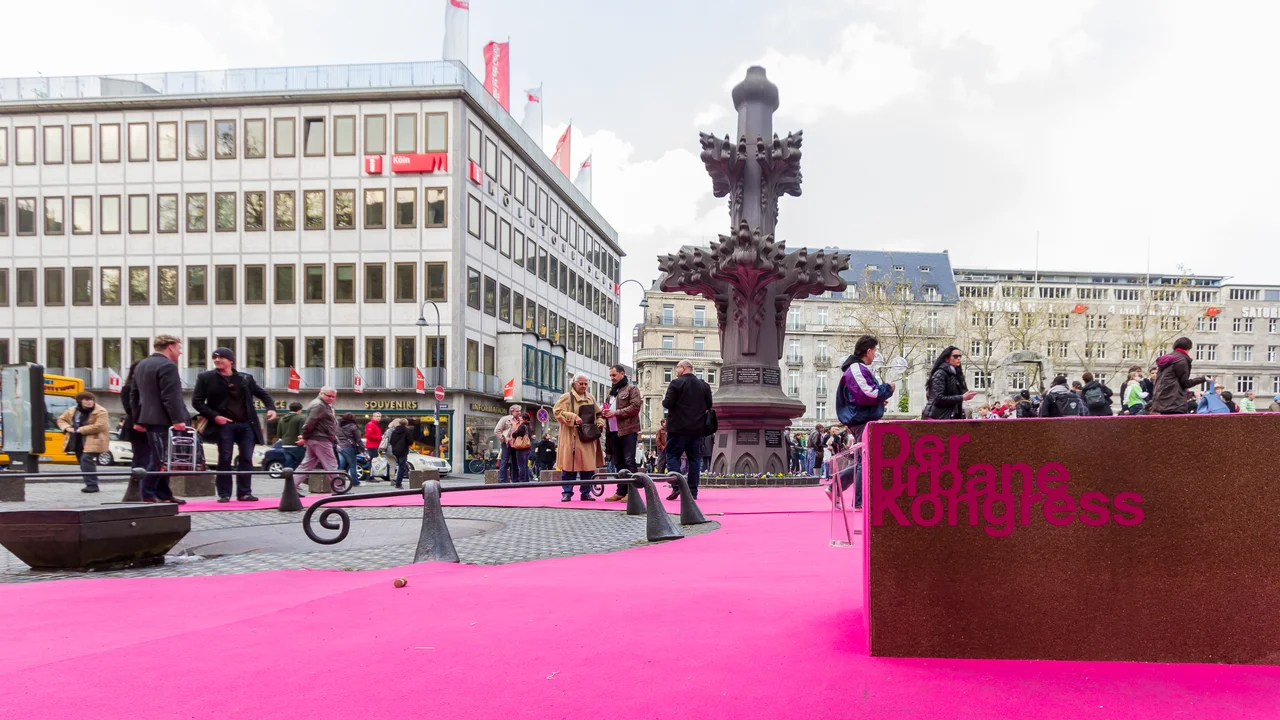

Finials of Cologne Cathedral
The crosses you see at the top of Cologne Cathedral's twin spires are not crosses at all. They are Kreuzblumen - finials, stone flowers, eight metres tall and 4.58 metres across at their lower leaf wreath. They sit at 149 and 157 metres above the cathedral square, almost half a kilometre above sea level once you factor in the pavement, and they are made of Obernkirchen sandstone from a quarry near Minden. Each finial is built from 24 individual stones, fitted together because no nineteenth-century freight lift could carry a one-piece leaf wreath weighing 17 tonnes to the top of the world's tallest church. Look up at the cathedral and you almost certainly do not see them as objects. They appear, from the square below, as decorative pinheads. They are, in fact, building-sized.
Master Builder's Compromise
The cathedral had been under construction for 632 years when, in 1880, the spires were finally crowned. The plans for the finials traced back to Ernst Friedrich Zwirner, the master builder who had revived work on Cologne Cathedral in the mid-nineteenth century. Zwirner died in 1861 and never saw his finials raised. He had specified a diameter of 5.20 metres, based on the medieval Plan F, the original Gothic façade drawing that survived from the 1300s. His successor wanted something slightly smaller - first 5.02 metres, then 4.75. In the end the Obernkirchen quarry made the decision for him. The largest blocks the masons could extract dictated a lower leaf wreath of 4.58 metres. Stone always has the final word.
Getting Them Up There
Moving thirty-seven cubic metres of carved sandstone to a height of 150 metres in 1880 was not a problem with an obvious solution. Scaffolding swayed. Rope hoists strained. The steam-powered freight lift on the cathedral building site could lift four tonnes at most. So the masons of the Dombauhütte, the cathedral building lodge, broke each finial into 24 stones small enough to lift, and as a precaution they replaced the hemp ropes on the lifting scaffold with steel cable before the raising began on 16 July 1880. Inside each finial, a wrought-iron rod ten centimetres thick and twenty-one metres long hangs downward into the spire like a pendulum, sheathed in copper, holding the whole composition together against the wind. Stone brackets support the leaves from below. A copper band wraps the shaft. Metal rods hold the leaves in place from above.
The Workers in the Wooden Boxes
The north finial was set on 23 July 1880. The south finial followed on 14 August. The keystone of the south spire - the symbolic completion of the entire cathedral - was placed during the formal ceremony on 15 October. And then the citizens of Cologne complained that the finials looked too bulky. Too compact. Too heavy against the sky. So in the winter of 1880-81, the building lodge mounted wooden housings around each finial, 150 metres in the air, and turned them into heated workspaces. Forty stonemasons climbed up and re-carved the leaf wreaths by hand, in the cold, until 12 February 1881. They were trying to make stone the size of small houses look filigree, and they were doing it in winter, on top of a cathedral, inside wooden sheds nailed to the spires. Almost nobody could see what they were doing. They did it anyway.
The Finial on the Square
If you stand on the Domplatte, the cathedral plaza, and look toward the west façade, you will see a third finial at ground level. It is a concrete copy of the originals at full size, installed on 11 October 1991 by the Cologne Tourist Office, replacing an earlier model that had been damaged in 1990 by storm Wiebke. Cathedral master builder Richard Voigtel had wanted exactly this - a third finial as a monument to the cathedral's completion - back in 1879. He never got his way. The 1991 copy lets you see what is up there: the leaves projecting 2.30 metres outward, the central shaft, the proportions that disappear when you crane your neck. In 2014 the city's district council voted to move the concrete finial somewhere else, and the argument that followed lasted years. An online petition gathered nearly 2,900 signatures to keep it where it was. In late 2015 the Lord Mayor Henriette Reker brokered a compromise: the finial stays for now.
From the Air
The cathedral and its finials sit at 50.9411° N, 6.9572° E, on the west bank of the Rhine in central Cologne. The twin spires reach 157 metres above ground level, making them one of the most recognisable landmarks on any approach to the city. Cologne Bonn airport (EDDK / CGN) is 14 km southeast. Düsseldorf (EDDL / DUS) is 40 km north. In clear weather the spires are visible from over 20 km away. VFR pilots should be aware that the cathedral exceeds 150 metres AGL and is lit at night.
Nearby Stories
- Diamond Interchange: How a Simple Idea Reshapes Towns Like Julich 2.8 km away
- Dusseldorf-Unterbach 6.1 km away
- Baumwollspinnerei Ermen & Engels 11 km away
- RAF Bruggen 15 km away
- Hagen Open-air Museum 21 km away
- Belgium 130 km away
- Marcinelle Mining Disaster 173 km away
- Zwingenberg Castle 178 km away