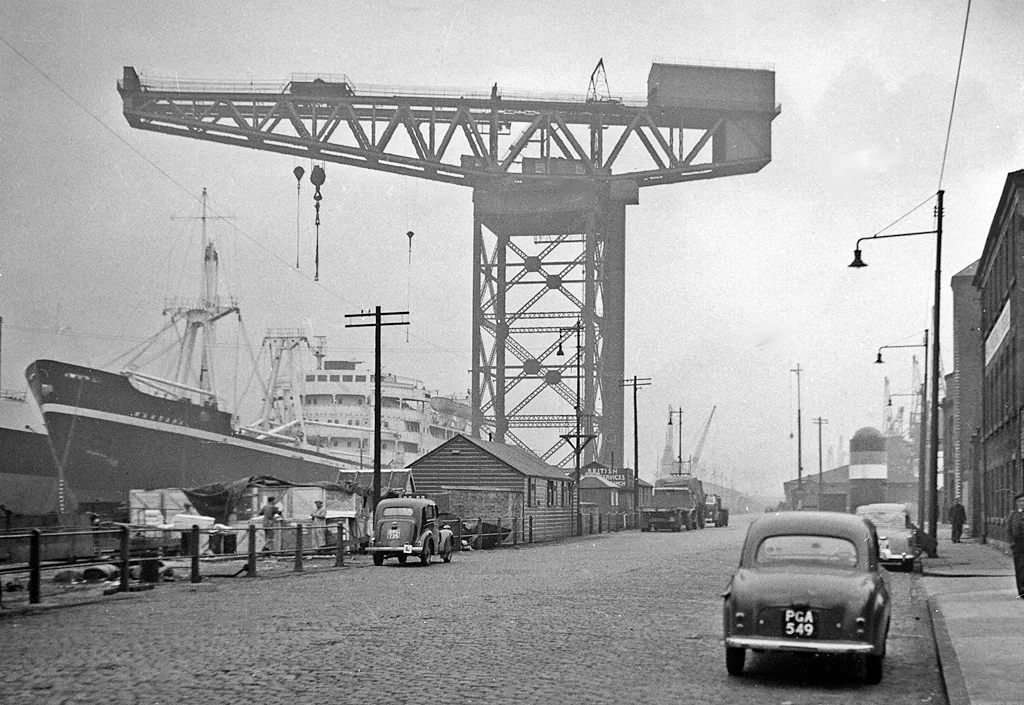

Finnieston Crane
Thirty thousand steam locomotives. That is the count, give or take, of the engines hauled through Glasgow's streets by Clydesdale horses, traction engines and diesel tractors, dragged from the works at Springburn down to the Stobcross Quay, where a giant cantilever lifted each one over the water and lowered it onto the deck of a waiting ship. The Finnieston Crane did that work. It is one of only eleven such giants left in the world, and one of four still standing on the Clyde. It no longer turns. But on the riverside it still does something else: it tells you, with one silent gesture, what this city used to be.
Built for the Empire
The present crane is the second machine to bear the name. An earlier Finnieston Crane was tested in April 1848 with thirty tons of pig-iron, then put to work loading machinery onto steam-vessels. By the late 1920s, a bigger replacement was needed for the bigger cargo of the industrial age. The Clyde Navigation Trust commissioned the new crane in June 1928, and it commenced operation in 1932. The tower was built by Cowans, Sheldon & Company of Carlisle. The cantilever jib came from the Cleveland Bridge & Engineering Company. The whole project cost £69,000, with the Trust paying eighty-five per cent. Daniel Fife, the Trust's mechanical engineer, supervised the build. The result was a giant: 175 feet tall, with a 152-foot cantilever jib, and the only personnel lift inside a crane of its kind anywhere in Britain.
The Last of Its Kind
The crane was built for one purpose: lifting the kind of cargo nothing else could lift. Tanks. Boilers. And above all, steam locomotives, bound for the British Empire. A short spur of the Stobcross Railway ran right to the quay, delivering machinery from the Hyde Park Works at Springburn. The crane lifted each locomotive over the river and set it down on a deck, where it would be lashed in place for the voyage. The docks the crane served closed in 1969 and were later filled in. The crane has been out of working order since at least 1988. It survives because Glasgow decided it should survive, retained as a monument to the city's engineering heritage. When the Fairfield Titan downriver was demolished in 2007, Finnieston joined an even smaller club: one of four such giants still standing on the Clyde.
The Crane as Canvas
Once it stopped working, the crane took on a second career as an unlikely art object. In 1987, as part of Glasgow's Mayfest, the sculptor George Wyllie hauled a full-size locomotive made of straw out to the quay and suspended it from the crane. The piece was then dragged back to Springburn and set on fire, burning away to reveal the metal frame beneath. After Wyllie's death in May 2012, a giant question mark was hung in his honour: a quiet nod to the way his work had always wrestled with what art was for. The following year, the American artist Bill Fontana attached microphones to the structure and recorded what it sounded like. The crane that once moved iron now also moved ideas. Glaswegians know it intimately enough that the comedian Brian Limond, as his character Dee Dee in Limmy's Show, once described a half-remembered dream of having a party at the top of 'that Finnieston Cran' with his sister and his da.
What the Skyline Says
A walk along the north bank of the Clyde brings the crane suddenly into view, framed against the steel rib-cage of the SEC Armadillo and the curve of the Hydro arena beside it. The old industry and the new entertainment city share the same patch of riverbank now. The crane is no longer the tallest thing on the skyline. The Glasgow Tower across the water beats it for height, and the new apartment blocks along Finnieston Street rise close around it. But it has a different kind of presence. It is the only structure on this bend of the river that does no useful work, has no commercial purpose, and is still preserved with great care. The city kept it because the city remembers what it was for.
From the Air
Located at 55.858 N, 4.285 W on the north bank of the River Clyde. Visible at low altitude as a distinctive grey cantilever silhouette against the river, just east of the SEC Armadillo and Hydro arena. Glasgow Airport (EGPF) sits about 8 nautical miles to the west, with the M8 motorway threading past to the south. Approach paths into EGPF runway 23 pass over the city; viewing altitude of 1,500 to 3,000 feet works best for clear sight of the crane and the Clyde waterfront together.
Nearby Stories
- Mauchline 3.6 km away
- Shotts 4.2 km away
- HMS Ulysses (1917) 7.7 km away
- Rothesay Castle 8.8 km away
- Inchcailloch 10 km away
- Strachur 14 km away
- Battle of Dollar 16 km away
- Crawford Castle 16 km away