.jpg)
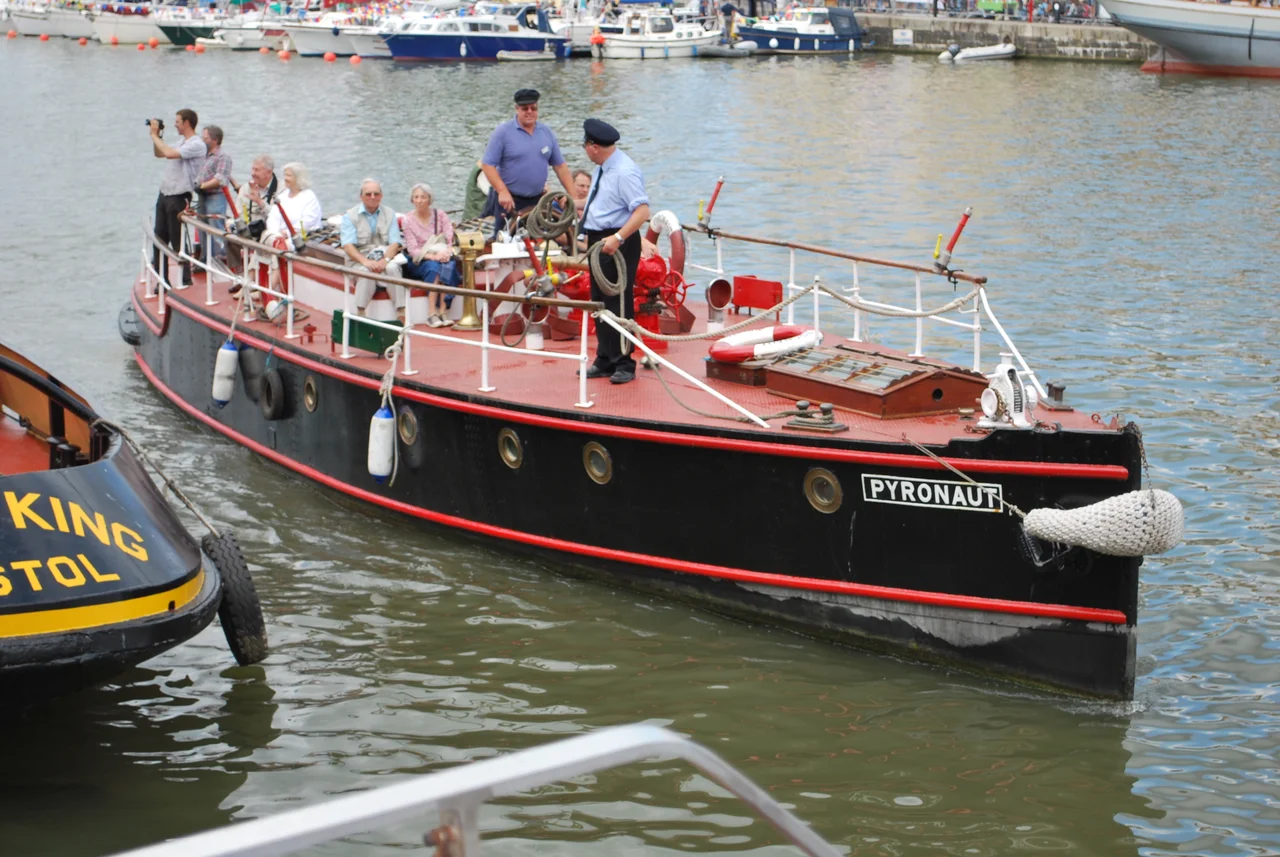
Fire-float Pyronaut
The helmsman had to lie flat. The fire-float was that low. To pass beneath Prince Street swing bridge, the lowest bridge in Bristol's Floating Harbour, Pyronaut had been built with an air-draught barely above the waterline, and her crew learned to flatten themselves against the deck plates as the underside of the bridge slid by inches above their heads. The bridge could open. But that took minutes, and minutes were what a fire-float never had. When the call came that a malthouse on Gas Ferry Road was burning in November 1938, Pyronaut needed to be there before the warehouses on either side caught too. So the helmsman lay down, took his bearings from a periscope view of the gantry overhead, and steered three crewmen and eight thousand pounds of pumping machinery under a bridge that nobody bothered to lift.
Why Bristol Built Fireboats
Bristol's Floating Harbour was an industrial inferno waiting to happen. Wooden ships loaded with valuable cargo lay packed alongside warehouses storing timber, sugar, tobacco, and tar. A single fire could leap from vessel to vessel, then up the ropes onto a quayside warehouse, and from there across an entire dock. Land-based fire engines could not reach the water side of a moored ship. So Bristol, like London before it, took to the water. The first recorded British fire-float was rowed out of London in 1765. James Hilhouse built Bristol its first in the 1780s. By 1884 the Fire Queen, built by Shand Mason of London, was steaming around the City Docks with a three-cylinder steam pump. The Salamander followed in 1905 at Avonmouth. Steam fire-floats were powerful, but slow to start: the Salamander once arrived at a fire at 8:36 a.m. for a 7:30 a.m. callout, having spent the intervening hour raising steam while the shore appliances did the work.
Built by Charles Hill, 1934
In 1931 the Bristol Fire Brigade decided steam was no longer good enough. Diesel engines started immediately, took no firemen to stoke them, and could be controlled remotely. Two new diesel fire-floats were ordered. Charles Hill & Sons of Albion Dockyard, Bristol, built both. The first, Bristol Phoenix II, was launched in 1934. She had two Petter Atomic diesels delivering 55 brake horsepower each, driving twin Merryweather reciprocating pumps that could throw 500 imperial gallons of water per minute. Her crew of three worked from a Prince Street Bridge river police station. The engineer stood below in the noisy engine room, taking telegraph orders from the wheel, controlling each engine's speed and direction by hand. In 1938 a second Bristol vessel was found to be called Phoenix, which was not allowed on the ship register, so the fire-float was renamed Pyronaut. The new name was thought up by the teenage son of the chairman of the Watch Committee.
The Bristol Blitz
Then came the war. Beginning in November 1940, Luftwaffe raids targeted Bristol relentlessly. The docks, the aircraft works at Filton, the city centre itself were repeatedly hit. The Bristol Blitz killed roughly 1,300 people and destroyed huge stretches of medieval Bristol. Pyronaut was manned twenty-four hours a day, working through the worst raids alongside two motor launches fitted with fire-fighting gear. The Floating Harbour burned in patches almost continuously. Warehouses collapsed. Bonded stores of spirits went up in white-hot pillars. Pyronaut pumped salt water from the harbour onto whatever the call directed her at, often returning to base soaked through and her crew exhausted, ready to be called out again before they had dried. She survived the war intact. Many of the buildings she protected did not.
Peacetime, Decline, and a Diamond Jubilee
Postwar work was less frequent but still serious. In February 1948, during pantomime season, the Bristol Hippodrome caught fire. Pyronaut pumped water from St Augustine's Reach while firefighters waded through the wreckage rescuing soaked costumes, including the comedian Sid Phasey's dress suit. A reporter described 'clusters of men soaked to the skin, their eyes red-rimmed with the smoke and fumes.' She fought oil fires at Avonmouth in 1951, pumping continuously for two days. By the late 1960s her equipment was obsolete and she was re-engined in 1968 with Ruston & Hornsby diesels and Coventry Climax centrifugal pumps that doubled her output. But Bristol City Docks closed to commercial traffic in 1975, and by then very few quayside buildings were beyond the reach of land-based engines. Pyronaut was sold in 1973. A private owner began converting her to a divers' boat, then a saloon for an Irish coastal cruise, before selling her back to Bristol City Museum in 1989. Restored by 1995, she now lives outside M Shed on Prince's Wharf, listed on the National Historic Fleet, performing at harbour events. In June 2012 she travelled to London by road to take part in Queen Elizabeth II's Diamond Jubilee Pageant on the Thames, alongside a thousand other historic vessels.
Flight Context
Pyronaut is normally moored outside M Shed at 51.4481°N, 2.5981°W on Prince's Wharf, on the south side of Bristol's Floating Harbour just east of Prince Street Bridge. From the air she is a small black-and-red vessel berthed alongside the museum's larger tugs Mayflower and John King and the replica caravel Matthew. Recommended viewing altitude 1,500-3,000 feet. Bristol Airport (EGGD/BRS) lies 7 nautical miles south. The Floating Harbour stretches west toward Hotwells and east toward Temple Meads station; the SS Great Britain lies a short distance west on the same harbour.
From the Air
Moored outside M Shed at 51.4481°N, 2.5981°W on Prince's Wharf, south side of Bristol Floating Harbour just east of Prince Street Bridge. Recommended viewing altitude 1,500-3,000 feet. Small black-and-red vessel berthed alongside the tugs Mayflower and John King and the replica caravel Matthew. Nearest airport: Bristol Airport (EGGD/BRS) 7 nm S. SS Great Britain lies a short distance W along the same harbour.
Nearby Stories
- Cosmeston Medieval Village 1.4 km away
- Glastonbury Festival 3.5 km away
- Tintern Abbey 3.6 km away
- Quantock Hills 4.8 km away
- Ebbw Vale Steelworks 10 km away
- New Wardour Castle 12 km away
- Windmill Hill, Avebury 16 km away
- Cotswolds 18 km away