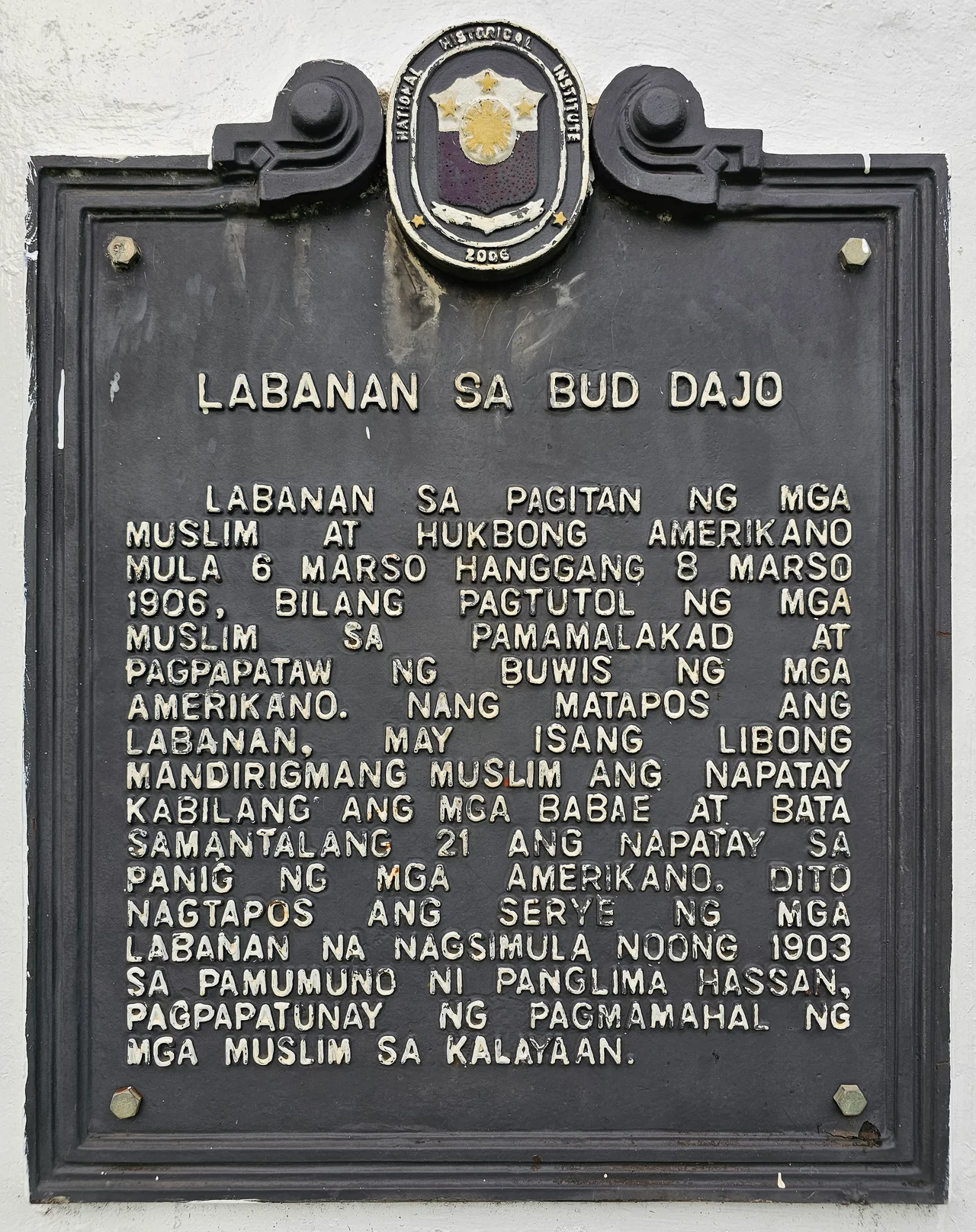

First Battle of Bud Dajo
Mark Twain did not mince words. "In what way was it a battle?" he wrote. "It has no resemblance to a battle. We cleaned up our four days' work and made it complete by butchering these helpless people." In March 1906, 750 American soldiers and Marines under Colonel Joseph Wilson Duncan assaulted the volcanic crater of Bud Dajo on the island of Jolo in the southwestern Philippines. Inside the crater were 800 to 1,000 Tausug villagers. When the fighting ended, only six Moro survived. The Americans lost between fifteen and twenty-one killed and seventy wounded. Whether called the First Battle of Bud Dajo or the Moro Crater Massacre, it remains one of the bloodiest and most controversial events of the American occupation of the Philippines.
Reforms That Lit the Fuse
The assault took place during the final days of General Leonard Wood's tenure as governor of the Moro Province, a period of sweeping reform that the Moro people experienced as oppression. Wood abolished slavery and imposed the cedula, a registration poll tax that the Moros interpreted as tribute demanded by foreign Christian occupiers. Moro participation in the cedula remained negligible even after thirty years of American rule. These reforms, layered on top of deep resentment toward foreign occupation, produced the heaviest fighting of the American period in Mindanao and Sulu. The immediate trigger was prosaic: a Moro named Pala ran amok in British Borneo, then evaded arrest near the city of Jolo when his datu resisted the colonial authorities. Wood led an expedition against Pala but was ambushed by Moros from the Bud Dajo area. The ambushers retreated to the volcanic crater, and Wood determined the position was too strong to assault with the forces at hand.
The Fortress in the Sky
Bud Dajo is an extinct volcano rising 2,100 feet above sea level, six miles from the city of Jolo. Its slopes are steep, thickly forested, and penetrated by only three main paths. The crater at the summit measures 1,800 yards in circumference, a natural fortress. Hidden trails known only to the Moros allowed resupply even when the main routes were blocked. District Governor Hugh Scott worried that attacking the crater would demonstrate how easily defended it was, inviting future standoffs. But the occupants had begun raiding nearby Moro settlements for women and cattle, and popular support for a general uprising was growing among Jolo's commoners. Something had to give. On March 2, 1906, Wood ordered Duncan to move.
Four Days on the Mountain
Three American columns advanced up the three main mountain paths under Major Omar Bundy, Captain Rivers, and Captain Lawton. On March 7, Bundy's detachment hit a barricade 500 feet below the summit. After snipers and rifle grenades softened the position, the Americans charged with bayonets. The Moro defenders fought back with kalises, the traditional wavy-edged swords of the Tausug, and spears. About 200 Moro died in this engagement alone, and Bundy's column took heavy casualties. Rivers' force encountered another barricade and fought for hours before Rivers was severely wounded by a spear. Lawton's detachment climbed a path so steep the soldiers went up on hands and knees, harassed by Moros hurling boulders and attacking with krises. Lawton eventually stormed the defensive trenches on the crater rim. Naval gunfire from offshore added overwhelming firepower to what was already a deeply asymmetric fight.
Ninety-Nine Percent
The numbers tell a story that resists any framing as a conventional battle. Of the 800 to 1,000 Moro in the crater, only six survived. Ninety-nine percent were killed, a higher rate than at Wounded Knee. Among the dead were women and children. The Moro who possessed weapons carried melee blades against troops armed with rifles, artillery, and naval guns. Major Scott recounted that many who fled to the crater had declared they had no intention of fighting, that they had run there in fright and had planted crops they wished to cultivate. Author Vic Hurley wrote plainly: "By no stretch of the imagination could Bud Dajo be termed a 'battle'." Wood defended the operation, arguing that the women had dressed as men and fought alongside them, and that men had used children as shields. He claimed a siege would have been impossible given the mountain's eleven-mile circumference, thick forest, and hidden paths. But when General Pershing faced the same problem at Bud Dajo in 1911, he succeeded in besieging the crater by cutting a lateral trail that encircled the mountain.
A Wound That Speaks
The press coverage of what newspapers called the Moro Crater Massacre landed on an American public already uneasy about the country's imperial role after the Spanish-American War and the atrocities of the Philippine-American War. Twain's condemnation was fierce and widely read. The incident has never fully receded from memory. In 2015, the Moro National Liberation Front published an open letter to President Obama demanding to know why America supported what they called Filipino colonialism and a war of genocide against the Moro people. In 2016, President Rodrigo Duterte raised the massacre in criticizing America and President Obama, leading to the cancellation of a planned meeting between the two leaders. Bud Dajo is considered a sacred site by the Tausug people. The crater where nearly a thousand people died remains a place of memory and grievance, a wound in the landscape that still speaks more than a century later.
From the Air
Coordinates: 6.01°N, 121.06°E, on the island of Jolo in Sulu Province, Philippines. Bud Dajo is an extinct volcanic cone rising 2,100 feet, visible from altitude as a distinctive steep, forested peak approximately 6 miles south of the town of Jolo. The crater at the summit is roughly 1,800 yards in circumference. Jolo Airport (RPVJ) is the nearest airfield. Zamboanga (RPMZ) is approximately 160 km to the northeast.
Nearby Stories
- Japanese Destroyer Tanikaze 49 km away
- Basilan 51 km away
- Isabela, Basilan 79 km away
- Tawi-Tawi 87 km away
- 2018 Lamitan Bombing 115 km away
- Sheikh Karimul Makhdum Mosque 153 km away
- Tubbataha Reef 303 km away
- November 2023 Mindanao Earthquake 378 km away