
First Cemetery of Athens
Walk to the end of Anapafseos Street — Eternal Rest Street — and the city noise softens. Cypress trees close overhead. The light turns green and filtered. You are in the First Cemetery of Athens, and it is less a graveyard than a compressed history of modern Greece, every decade of the nation's life represented in marble, carved into monuments whose craftsmanship would shame many museums. The cemetery opened in 1837, only six years after Athens became the capital of a newly independent country, and it has been filling with the people who built, governed, sang for, and sometimes betrayed that country ever since.
A Street Called Eternal Rest
The cemetery sits behind two of Athens's most famous ancient monuments — the Temple of Olympian Zeus and the Panathinaiko Stadium — but it belongs to a different era. This is nineteenth-century Athens, the neoclassical city that rose from near-ruin after independence. The avenues inside are wide and canopied with pines and cypresses, the air cool even in summer, scented with stone and resin. Three churches serve the grounds: Saint Theodores for the Orthodox majority, Saint Lazarus in a smaller chapel, and Saint Charles for Catholic visitors and residents, because Athens has always been a city where foreigners have left their mark. Protestant and Jewish sections exist as well, though the separations are not enforced. Walk any path long enough and you will pass a general of the War of Independence next to a singer of rebetiko, a Nobel Prize poet next to the archaeologist who dug up Troy.
Marble and Masterpiece
The most famous work of art in the cemetery is also the most intimate. Yannoulis Chalepas, born on the island of Tinos in 1851, carved a young woman lying in sleep — or death — with such tenderness that the sculpture became instantly famous. Known in Greek as *I Koimomeni*, The Sleeping Maiden, it marks the tomb of a young woman named Sofia Afentaki, who died in 1873 at age seventeen. Chalepas spent decades in mental illness and obscurity before a late-life recovery; he himself is now buried in this same cemetery, not far from the sculpture that made him immortal. The tomb of Heinrich Schliemann, the amateur archaeologist who excavated Troy and Mycenae, was designed by the architect Ernst Ziller — also buried here. The philanthropist Georgios Averoff, whose bequest funded, among other things, a warship that would change the Balkan Wars, lies here too. The cemetery is declared a historical monument, and walking it feels like reading a nation's biography in stone.
The Roll of the Nation
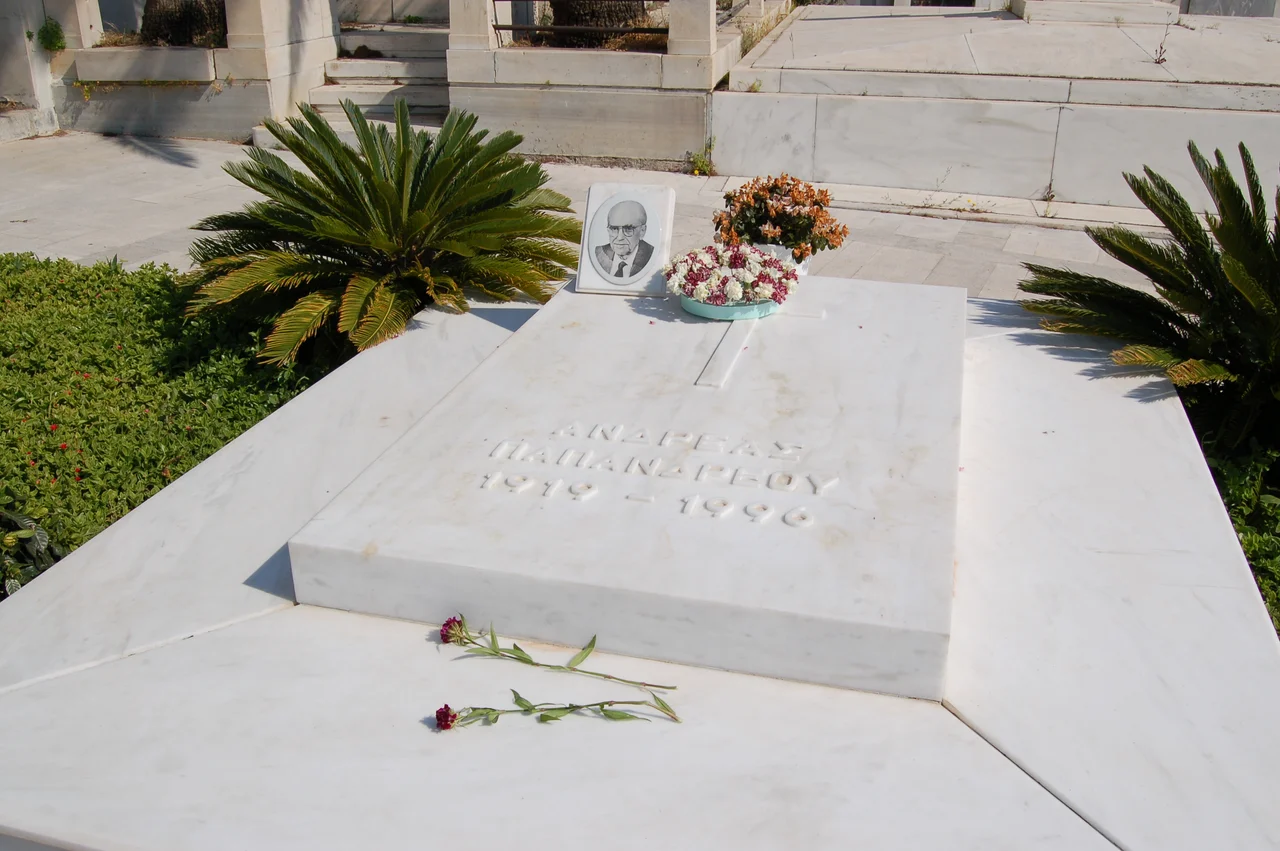
Theodoros Kolokotronis, the pre-eminent military leader of the Greek War of Independence, was a fighter of peasant origins who became a general and a symbol. He is here. So is Konstantinos Kanaris, the admiral who became a statesman. The poet Odysseas Elytis, who received the Nobel Prize in Literature in 1979, rests among cypress shade. Giorgos Seferis, another Nobel laureate in literature, is also here. The actress Melina Mercouri — who fought to have the Elgin Marbles returned to Greece and served as Minister of Culture — is buried in this ground. Kalliroi Parren, the pioneering feminist journalist who founded Greece's first feminist newspaper in 1887, has her grave here. Two Prime Ministers named Papandreou lie in the cemetery. The dictator Georgios Papadopoulos, who overthrew democracy in 1967, is also buried here — the same ground holds both the oppressor and those who resisted him. Death, at least, is democratic.
Foreigners in Greek Earth
Some of the graves belong to people who came from elsewhere and chose to remain. Richard Church, a British general who commanded Greek forces during the War of Independence, is here. George Polk, an American journalist murdered during the Greek Civil War in 1948 — a killing that was never fully resolved — is buried in this cemetery, far from home. Jules Dassin, the American director who was blacklisted in Hollywood, moved to Greece, made films with Melina Mercouri, and spent the rest of his life in Athens, is also interred here. T.H. White, author of *The Once and Future King*, who spent time in Greece, has a grave in this ground as well. The cemetery absorbed them all — the Greek War of Independence generals and the foreign artists who fell in love with this country and never quite left it.
A Living Memorial
The First Cemetery is not a closed archive. New burials still take place. Dionysis Savvopoulos, the beloved singer and songwriter, was buried here in late 2025. The cemetery is tended, visited, and mourned over, not just studied. On holidays and Sundays, Athenians come to leave flowers at graves that matter to them — not necessarily famous ones. The air smells of wax candles and stone. Swallows nest in the chapel eaves. The Sleeping Maiden still draws visitors who stand quietly in front of the marble, looking at the face of a young woman who died a century and a half ago, carved by a man who understood grief from the inside. In a city full of ancient ruins, this is the place where modern Greece buries what it loves.
From the Air
The First Cemetery of Athens is located at 37.963°N, 23.738°E, in central Athens just southeast of the Acropolis. From the air at 3,000–5,000 feet, look for the distinctive green canopy of cypress and pine trees immediately behind the marble columns of the Temple of Olympian Zeus and the distinctive horseshoe shape of the Panathinaiko Stadium. Athens International Airport Eleftherios Venizelos (LGAV) is approximately 25 km to the east-southeast. The cemetery's green rectangle is a rare patch of shade in the dense urban fabric of central Athens, visible clearly on approach from the east.
Nearby Stories
- Parnitha 3.4 km away
- Kea (island) 7.3 km away
- Sanctuary of Apollo Maleatas 11 km away
- Sousaki Volcano 12 km away
- Battle of Leuctra 14 km away
- Great Sand Beach 18 km away
- Agios Georgios (island) 23 km away
- Skyros 84 km away