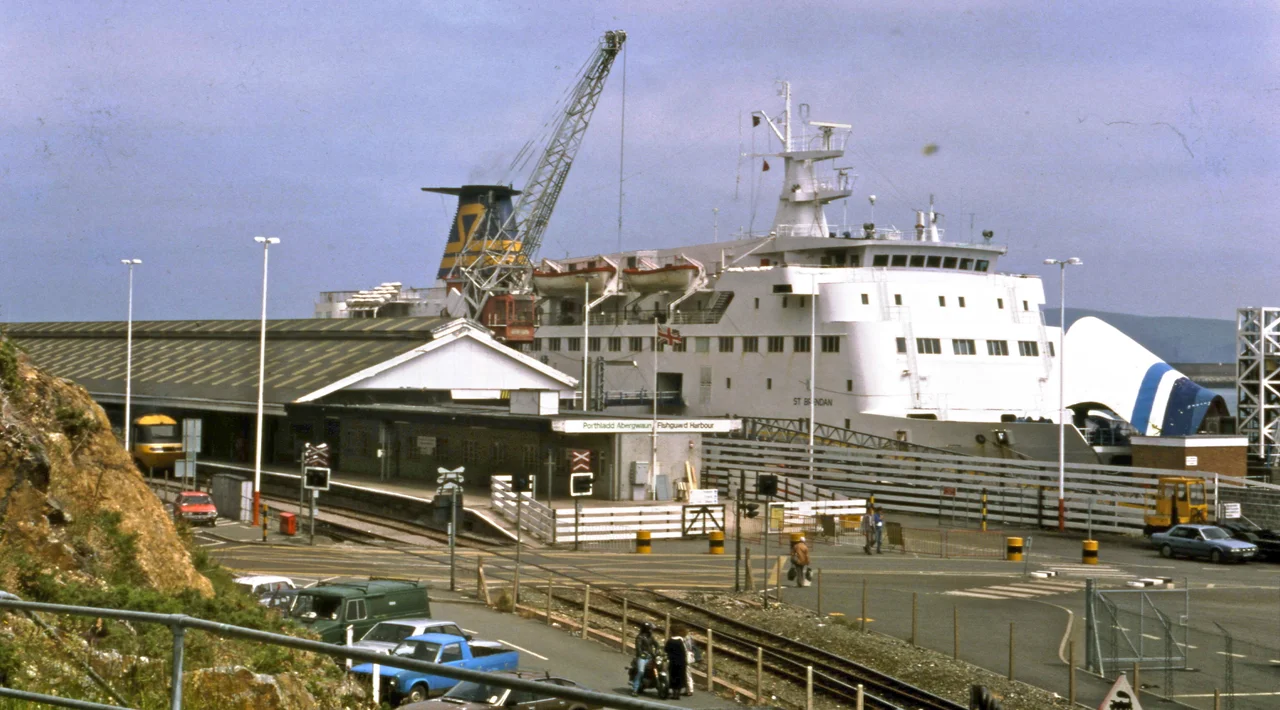

Fishguard Harbour Railway Station
For a few years in the early twenty-first century, Fishguard Harbour was the only railway station in the United Kingdom where you could still light a cigarette and stand on the platform with it. The smoking ban took effect in Wales in April 2007. Network Rail enforced it everywhere it owned track. But Network Rail did not own Fishguard Harbour. Stena Line did, because Stena Line still owns the whole port, and Stena Line decided the only place its passengers could safely smoke was the platform itself. The alternative was a busy level crossing. The exemption may still apply: it certainly did when it was first reported in 2007.
The Ocean Liner That Never Came
The Great Western Railway took over the North Pembrokeshire and Fishguard Railway in February 1898 with a specific dream: poach the trans-Atlantic passenger trade away from Plymouth and Southampton. Fishguard Bay sat closer to New York than either of those ports, and the GWR planned a purpose-built ocean liner terminal here. Work began on the East Breakwater in 1899, along with a new two-mile cutting and tunnels to bring the railway down to the proposed deep-water berths. Within two years, the engineers realised the harbour would silt up faster than dredging could clear it. The East Breakwater was abandoned half-finished. Two completed sections of new track were never used. So the GWR pivoted. It blasted the North Breakwater out of the headland at Goodwick instead, and the quarried-out hollow became the new quay.
Opening Day, 1906
Fishguard Harbour station opened on 30 August 1906, the day the Waterford and Cork ferry services arrived from their previous Welsh terminal. Three years later, on the exact anniversary of the opening, the Cunard liner RMS Mauretania called at Fishguard, the first of the great Atlantic ships to do so. It was also one of the last. The harbour was too shallow for the Mauretania to come properly alongside, so her passengers had to be ferried ashore by tender to catch the boat train to London. The GWR built a smaller inner breakwater, sometimes called the Mauretania Mole, hoping to coax larger ships in, but the silting only worsened. The ocean liner trade went elsewhere. Fishguard kept the Irish boat trains, and that is what it has remained: a ferry terminal with railway tracks running into it.
The Direct Train to London
For most of the twentieth century, Fishguard had through trains to London Paddington, an InterCity 125 service that ran by day and by night, connecting Wales to England's capital in a single straight shot. British Rail ran them, then First Great Western, then Wales and West, then Wales and Borders, then Arriva Trains Wales. In 2003 the last direct Paddington services were withdrawn, ending almost a century of continuous through running. The night service kept going, however, sometimes from London Waterloo connecting with Eurostar arrivals from Paris, sometimes empty stock running back to Carmarthen for storage. The day service ran via various routings, occasionally using the Carmarthen avoider line, occasionally the Swansea District Line, occasionally a route round the back of Landore depot known as the Swansea Avoiding Line. Railway timetables are how Britain talks to itself.
The Petition That Worked
By 2011 the Fishguard branch had been reduced to two boat trains a day, one at lunchtime and one in the small hours, both timed solely for ferry connections. Two teenagers from Moylegrove decided this was not enough. They gathered 1,440 signatures on a petition asking for proper local rail services, presented it to the Welsh Government, and were heard. From September 2011 the branch gained five extra trains each direction, the first non-ferry services to call at Fishguard Harbour since 1964. The Welsh Assembly funded the experiment to the tune of 1.4 million pounds a year. Services were trimmed back during the COVID-19 pandemic, but as of 2024 the branch runs six trains Monday to Saturday and three on Sundays, connecting to Carmarthen, Swansea, and Cardiff Central. The teenagers, now adults, may still be on the train.
From the Air
Fishguard Harbour station sits at 52.01 degrees north, 4.99 degrees west on the western side of Fishguard Bay. From altitude the station shows as a strip of railway track running along the inside of the North Breakwater, alongside the modern ferry terminal building. The harbour itself is enclosed by two breakwaters, with the unfinished East Breakwater visible as a shorter spur. Haverfordwest (EGFE) is fifteen miles south; Swansea (EGFH) fifty miles east. The North Breakwater is 900 metres long and the rock cliffs at Goodwick visible from the air are partly the legacy of the harbour's construction.
Nearby Stories
- RAF Angle 0.9 km away
- Cardigan Bay Special Area of Conservation 5.4 km away
- Abercych 11 km away
- Cantre'r Gwaelod 12 km away
- Burry Port Lifeboat Station 22 km away
- Johnstown Castle 61 km away
- Hook Lighthouse 92 km away
- 1979 Fastnet Race 157 km away