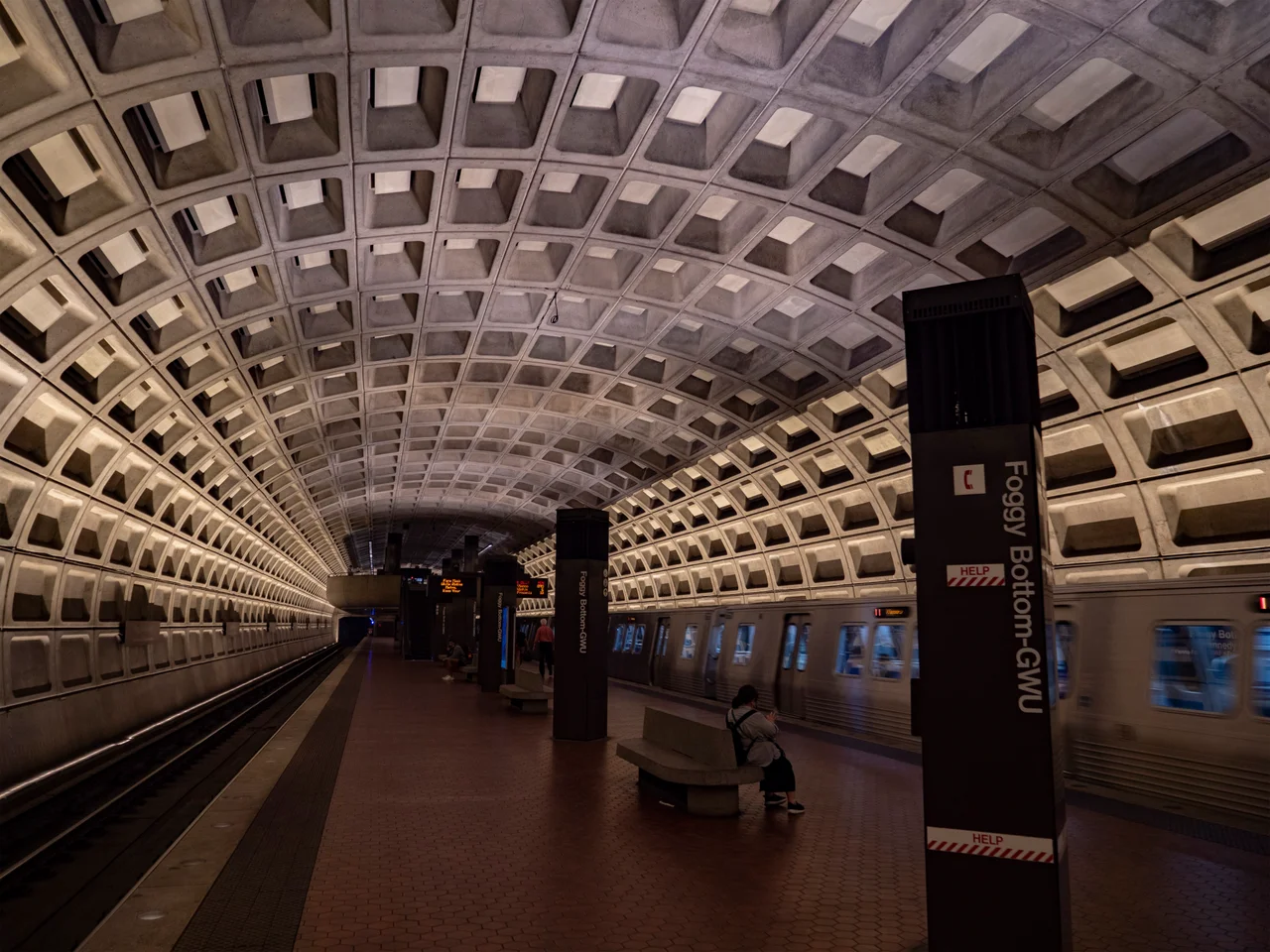

Foggy Bottom
The fog was real. The low ground between the White House and the Potomac sits only a few feet above the river, and in the days before the riverbank was hardened, before the swamps were drained, before the gas works and the breweries closed, the air at the eastern end of Pennsylvania Avenue carried a constant mix of river mist and industrial smoke. Reporters at the State Department headquarters that moved into the Harry S. Truman Building in 1947 started calling the agency Foggy Bottom as a joke, and the joke stuck. American foreign policy is still made under that name. The neighborhood itself was named for the same fog two centuries before any State Department arrived.
Hamburgh and Funkstown
Before it was Foggy Bottom, it was Hamburgh. A German settler named Jacob Funk bought 130 acres at the confluence of Rock Creek and the Potomac in 1763 and subdivided them as a town. The official name on the plat was Hamburgh. Everyone called it Funkstown after its founder. German Lutheran settlers had moved here from Pennsylvania looking for cheaper land, and Funk set aside a plot for a German-speaking congregation in 1768. That congregation became Concordia German Evangelical Church, founded in 1833 at 1920 G Street NW, and survives today as United Church, the oldest continuously active religious community in Foggy Bottom. When Washington was incorporated in 1791, Hamburgh was absorbed into the new federal city. The German place names disappeared from the maps. The community persisted in the rowhouses for another century.
The Industrial Riverside
In 1856 the Washington Gas Light Company built the West Station Works, a coal-gas plant, at 26th and G Streets NW on the riverbank. Coal barges unloaded directly from the Potomac. The plant attracted unskilled laborers, who moved into the alleys behind the rowhouses. The Christian Heurich Brewing Company opened nearby in 1872 and grew into one of the largest breweries in the city; its most successful products, Senate and Old Georgetown, were sold across the mid-Atlantic. By 1860 the unskilled population in Foggy Bottom had jumped from nine percent to forty-two percent. The neighborhood became one of the densest and poorest in Washington. Working-class Irish, Germans, and African Americans lived in close quarters in the alley dwellings, often without indoor plumbing. A four-block historic district preserved today on the National Register protects the surviving rowhouses and alleys from the period between 1870 and 1915.
The Moons of Mars
Just up the hill, on what was then called Potomac Hill, the United States Naval Observatory operated from 1844 to 1893. On the nights of August 11 and August 17, 1877, the American astronomer Asaph Hall sat at the Observatory's 26-inch refractor and discovered, on successive evenings, the two small moons of Mars. He named them Phobos and Deimos, the Greek words for fear and dread, after the sons of Ares who attended their father in battle. The moons are tiny, irregular, captured asteroids about twenty-two and twelve kilometers across, and they orbit Mars closer than any other major planetary moons orbit their primaries. They were the last moons in the solar system to be discovered with the naked eye through a telescope. By 1893, the lights and the fog of growing Washington had made the Foggy Bottom observatory site impractical, and the Naval Observatory moved up to its present location on Massachusetts Avenue. The original building still stands at 23rd and E Streets, now part of the State Department complex.
Watergate and the Kennedy Center
The West Station Works was torn down in 1948 to make way for the Watergate complex, the riverfront mixed-use development of luxury apartments, offices, and a hotel that opened between 1965 and 1971. On the night of June 17, 1972, five burglars hired by the Committee to Re-Elect the President were arrested inside the Democratic National Committee headquarters on the sixth floor of the Watergate Office Building. Two years and two months later, on August 9, 1974, Richard Nixon resigned the presidency, the first American president to do so. Just south of the Watergate, on the same patch of former industrial land, the Christian Heurich brewery buildings were demolished in 1961 and 1962 to make room for the John F. Kennedy Center for the Performing Arts, designed by Edward Durell Stone and dedicated in 1971. The Kennedy Center is home to the National Symphony Orchestra, the Washington National Opera, and a year-round program of theater, dance, and music.
A University Town
George Washington University, founded in 1821 as Columbian College, moved its main campus to Foggy Bottom in 1912 and now occupies forty-two acres at the center of the neighborhood. The university's presence transformed Foggy Bottom from a working-class riverside community into a college neighborhood with apartment buildings and academic offices instead of breweries and alleys. The State Department moved into the Harry S. Truman Building in 1947, the Federal Reserve and the World Bank and the International Monetary Fund all opened headquarters in the southern and western sections, and what had been a quiet immigrant enclave became one of the most concentrated centers of American economic and diplomatic power. The fog is mostly gone today. The river is contained behind hardened banks. The breweries closed by 1956. But the rowhouses in the historic district still stand, four blocks of small Victorian homes that remember when the air smelled of coal gas and the alleys held the people who powered the city.
From the Air
Foggy Bottom centers at 38.8993 degrees north, 77.0501 degrees west, in northwest Washington between the White House and the Potomac. Best viewed at 1,500 to 2,500 feet AGL with the Kennedy Center, Watergate, and Lincoln Memorial in the same frame. Reagan National (KDCA) is four nautical miles south. The site sits inside the P-56 prohibited area; viewing is from authorized riverside approaches.
Nearby Stories
- Gunston Hall 1.1 km away
- 2023 Baltimore Shooting 4.9 km away
- Battle of Middleburg 6.6 km away
- Crownsville Hospital Center 10 km away
- Battle of Loudoun Heights 13 km away
- First Battle of Rappahannock Station 20 km away
- Howard County, Maryland 21 km away
- Harriet Tubman Underground Railroad 50 km away