
Foreign Correspondents' Club (Hong Kong)
In 1943, with Japanese forces pressing against Chinese lines, a group of journalists gathered in Chongqing and founded a club. They had no permanent address, no guarantee of survival, and no way of knowing that their institution would outlast the war, outlast the colonial era, and one day occupy a handsome dairy depot in the heart of Hong Kong — still arguing, still reporting, still pushing back against those who would rather the press say nothing at all.
From a Wartime City to a Colonial Building
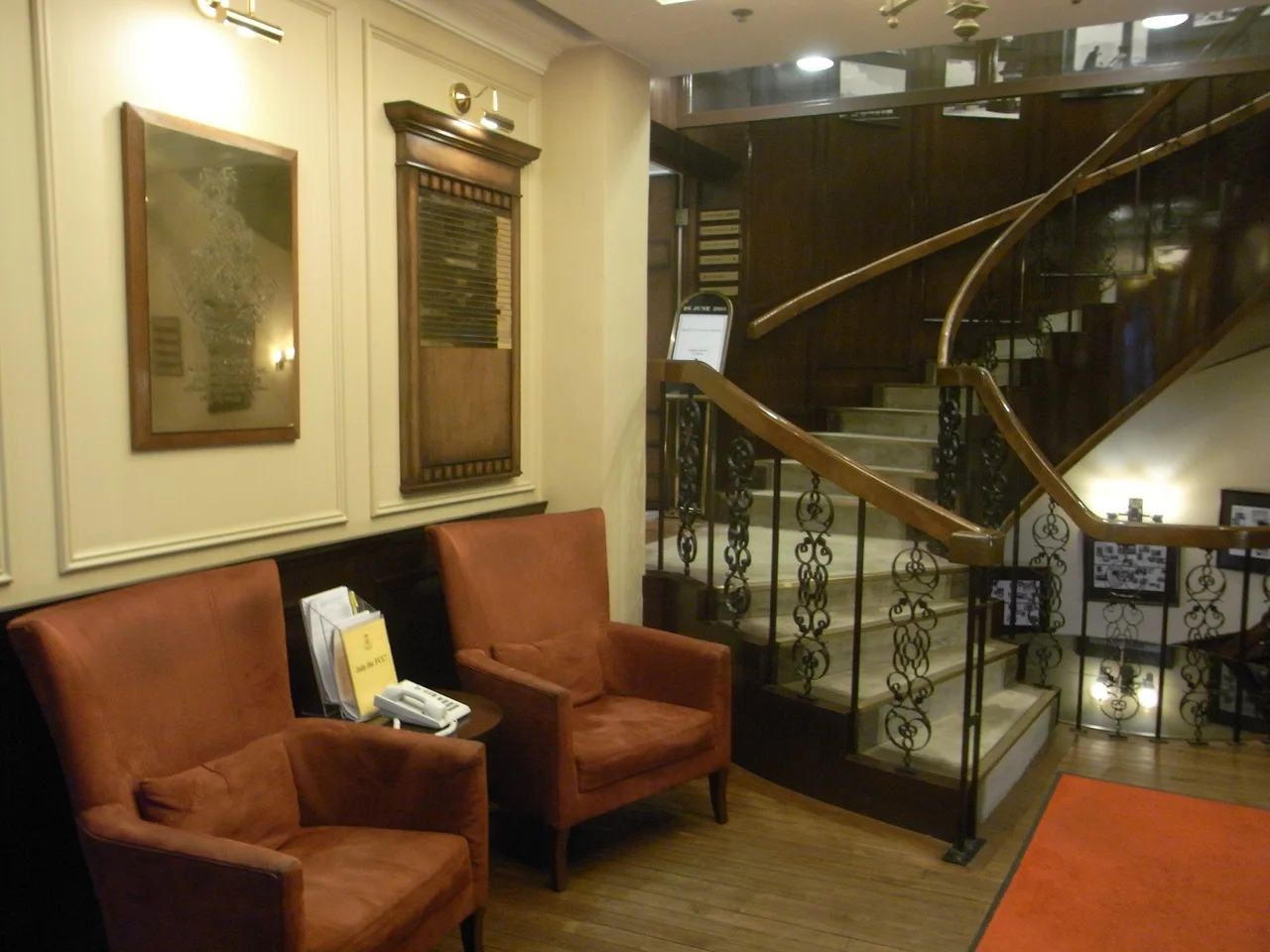
The Foreign Correspondents' Club moved through several addresses in its early Hong Kong years before settling, in 1982, into the North Block of the Old Dairy Farm Depot on Ice House Street in Central. The building is one of the few surviving colonial structures in the district — a low, solid thing surrounded by towers of glass. The FCC shares the depot with the Hong Kong Fringe Club, and together the two institutions occupy a kind of cultural beachhead against the relentless commercial redevelopment that has erased much of colonial Hong Kong.
The depot's Main Bar is the club's heart. Reporters file stories here, diplomats whisper here, and the occasional celebrity passes through. When prominent figures visit Hong Kong — heads of government, captains of industry, artists with something to say — many choose the FCC's speaker lunches as their platform, understanding that the audience inside the room is merely the first audience, and that the press corps seated there will carry the message everywhere else.
A Club of 2,400, Most of Them Not Journalists
The FCC's around 2,400 members span five categories: Correspondent, Journalist, Associate, Corporate, and Diplomatic. The majority — roughly 1,600 — hold Associate memberships, meaning the club is less a press room than a gathering place for the expatriate and professional community that gravitates toward it. You can join as an associate, though the waiting list can stretch from several months to several years.
The Chief Executive of Hong Kong was once a member, but no holder of that office since Donald Tsang has accepted the invitation. Whether this reflects political calculation or mutual indifference is a matter of interpretation — though in Hong Kong, where interpretation is politics, the absence has been noticed.
Bert's Bar and the Rooms Below
Go downstairs and you find Bert's Bar, named for the late Bert Okuley, a former FCC president, distinguished foreign correspondent, and jazz pianist. Live jazz plays here several nights a week, often with the house band led by Musical Director Allen Youngblood. The basement also holds a Work Room — broadband-connected, practical, built for journalists under deadline — and a small but functional health club with a sauna and steam room.
John le Carré used the club as a setting in his 1977 novel *The Honourable Schoolboy*. Wayne Wang's 1997 film *Chinese Box* features the Main Bar. The place has become something of a recurring character in Hong Kong's fiction: a room where things are said off the record, and occasionally not off the record enough.
The 2018 Confrontation
On 14 August 2018, the FCC hosted a lunch talk by Andy Chan, a pro-independence activist. Beijing had tried to prevent the event. The club declined to cancel it, citing freedom of speech. The response was swift and concrete: Victor Mallet, the FCC's vice-president who had chaired the talk, was denied a visa renewal by the Hong Kong government. He was forced to leave Hong Kong and lost his bureau posting as a result; the Financial Times condemned the decision but Mallet remained with the paper.
Four years later, the government inserted a national security clause into the club's lease, requiring the FCC to 'safeguard national security.' The wording was deliberately broad. The club has continued to operate, its future somewhere between cautious and uncertain, its history of speaking freely now part of what it is defending.
What Remains
The building at 2 Lower Albert Road still stands, its colonial masonry indifferent to the decades passing around it. The Main Bar still serves drinks to reporters and diplomats and the curious. Bert's Bar still hosts jazz. The speaker lunches still attract figures who want their words to travel.
What the FCC represents — a space where journalists can work, gather, and press the powerful with questions — has grown harder to maintain in Hong Kong. The club has not resolved this tension. It continues, which is itself a kind of statement.
From the Air
The Foreign Correspondents' Club sits at approximately 22.2804°N, 114.1560°E in the Central district on Hong Kong Island. From the air, the cluster of colonial low-rise buildings at the top of Ice House Street is visible below the glass towers of the financial district. Kai Tak Airport (VHHX) was the historic approach, swooping low over Kowloon Bay; today Hong Kong International Airport (VHHH) is on Lantau Island, about 34 km to the west. Approach from the east at 3,000 feet and the density of Central resolves from a general glitter into the green hill of Government Hill and the white speck of St. John's Cathedral — just below which the FCC building sits.
Nearby Stories
- Lok Ma Chau Loop 2.3 km away
- Portas do Cerco 2.3 km away
- Kweilin Incident 17 km away
- Wanshan Archipelago Campaign 34 km away
- Nanxiong Formation 115 km away
- Battle of Nanpeng Island 148 km away
- Heyuan 169 km away
- Cape Maobitou 632 km away