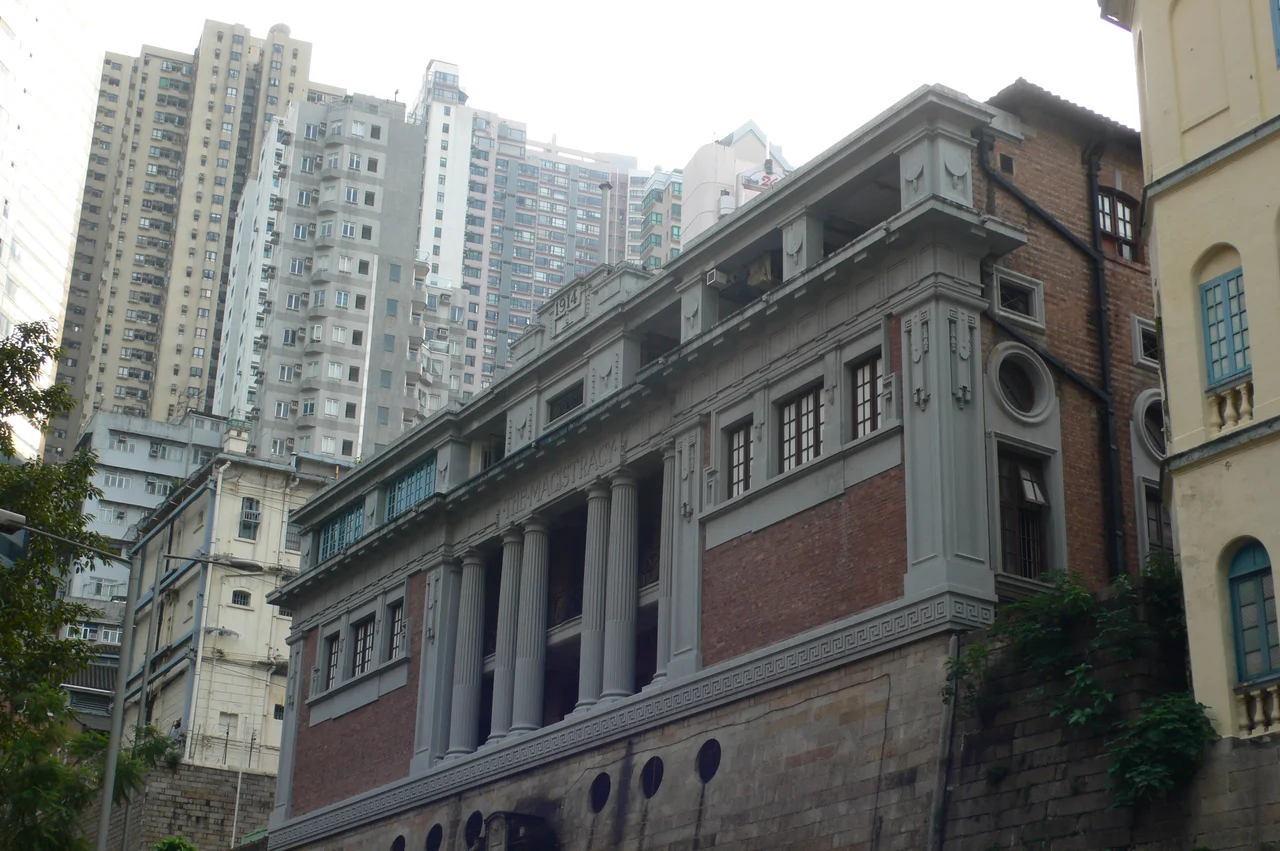

Former Central Magistracy
For more than a century, people came to 1 Arbuthnot Road in Central for one of two reasons: to face a magistrate, or to work for one. The building that received them — granite-walled, pillared, severe — was designed to communicate the weight of colonial authority. Today it communicates something else: that authority passes, buildings remain, and what was once a place of judgment has become a place for art.
A Site With a Longer Memory
The former Central Magistracy was constructed between 1913 and 1914, but the ground beneath it was already seasoned with institutional purpose. The first Hong Kong Magistracy occupied this site, with a structure probably erected around 1847. That earlier building was demolished to make way for the present one — a transition that delayed construction because the new design required an extensive basement, an engineering challenge on a steep hillside in a subtropical city.
The steepness is still there. The building sits on Arbuthnot Road, one of the narrow, sharply rising lanes that connect Central's commercial flatland to the Mid-Levels above. It is not a convenient address. The Greek Revival facade — imposing columns, classical proportions — faces a road too tight for the building to assert itself properly. You have to step back to see it, and the road doesn't really give you the room.
Granite, Columns, and the Weight of Purpose
The architecture is formally described as Greek Revival, a style that colonial administrators favored for civic buildings because its associations — ancient democracy, rational order, the rule of law — could be read as legitimating. The facade's pillars and the massive granite retaining walls were built to project permanence. They succeeded. The building survived a century of Hong Kong's accelerated redevelopment largely because no one could agree on a use for it after the courts left.
The Central Magistracy closed in 1979. For the following years it served various administrative functions for organizations affiliated with the Royal Hong Kong Police Force (RHKPF), which had its headquarters nearby. The building sat in legal and bureaucratic limbo — too significant to demolish, too old-fashioned for easy repurposing — until the broader vision for the Tai Kwun site gave it a context.
Three Monuments, One Complex
Tai Kwun — the Cantonese name meaning 'big station' — is a heritage and arts complex that brings together three declared monuments: the former Central Police Station, the former Central Magistracy, and Victoria Prison. Together they form a single walled compound on a ledge above Central, a physical record of how colonial Hong Kong administered justice and confined those it judged.
The complex opened to the public in 2018 after a major conservation and adaptive reuse project. The Magistracy building now hosts arts and cultural programming, its courtrooms and corridors repurposed for exhibitions and performances. The transformation is deliberate. The same rooms where magistrates once handed down sentences are now used for things that could not have been predicted when the building was designed: film screenings, gallery shows, community events.
The Legacy of the Compound
Walking through Tai Kwun, you move between spaces that were designed to separate people — police from public, prisoner from free — and find them unified. The compound's high walls, built to contain, now frame an open courtyard where visitors sit in what was once the parade ground. It's a kind of architectural irony that Hong Kong has, in recent years, become good at: taking the physical apparatus of control and converting it into something people actually want to visit.
The former Central Magistracy is part of that story, its Greek Revival columns now framing gallery doors rather than courtroom entrances. Whether that's redemption or simply repurposing is a question the building doesn't answer. It was built to enforce; it was closed; it was preserved; it endures.
From the Air
The former Central Magistracy sits at approximately 22.2811°N, 114.1545°E on the slope of Government Hill in Central, Hong Kong Island. The Tai Kwun compound is visible from low-altitude approaches as a walled enclave of grey stone immediately uphill from the glass towers of Central. Hong Kong International Airport (VHHH) is on Lantau Island, about 34 km to the west-southwest. The distinctive ridgeline above Central — with Government House and the botanical gardens visible on the slope — makes this section of the city easy to identify from the air at 2,000 to 3,000 feet on approach from the south.
Nearby Stories
- Lok Ma Chau Loop 2.3 km away
- Portas do Cerco 2.3 km away
- Kweilin Incident 17 km away
- Wanshan Archipelago Campaign 34 km away
- Nanxiong Formation 115 km away
- Battle of Nanpeng Island 148 km away
- Heyuan 169 km away
- Cape Maobitou 632 km away