.jpg)
Former French Mission Building
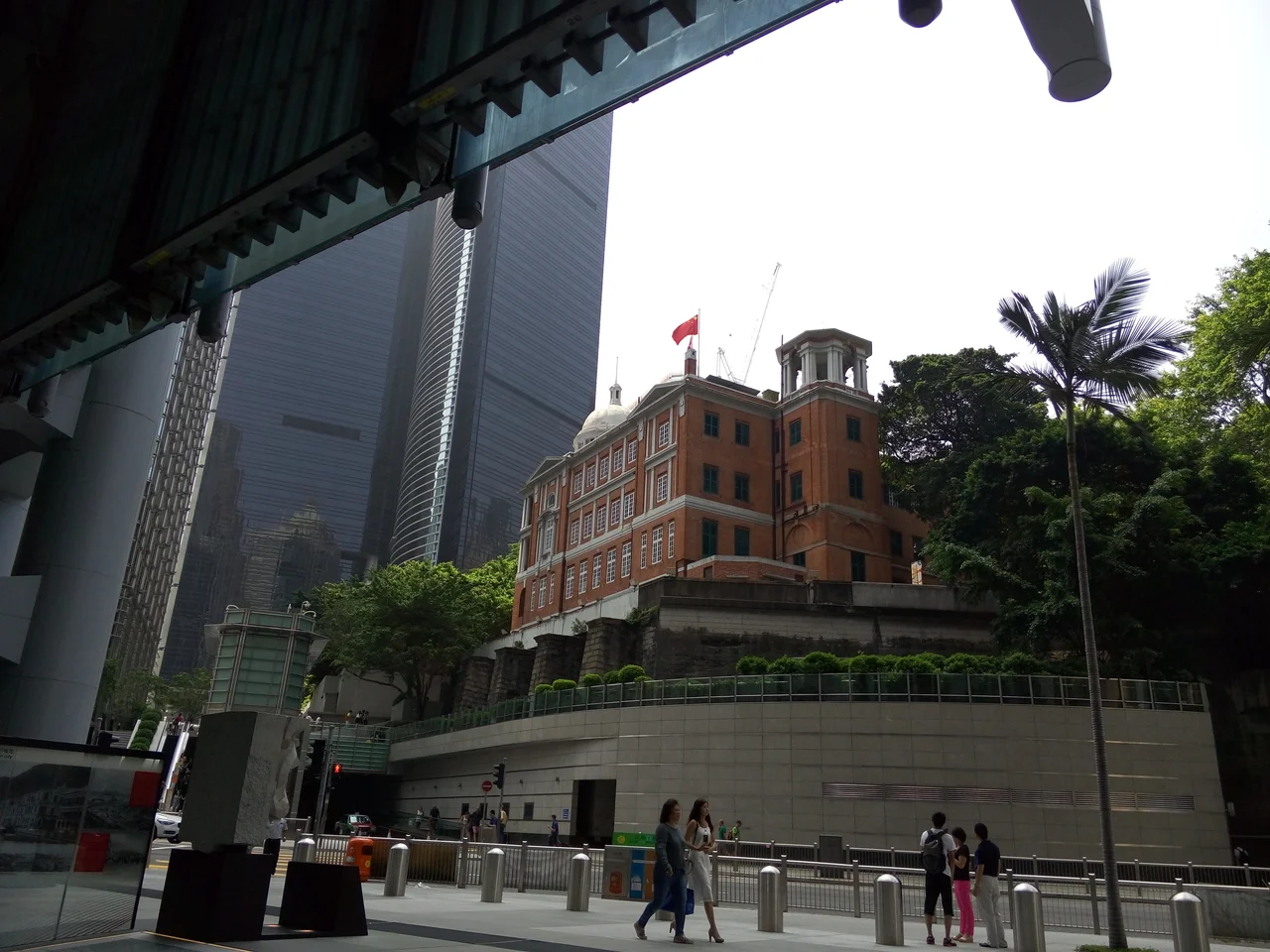
The building at 1 Battery Path on Government Hill has never been able to make up its mind — or rather, others have kept making up its mind for it. Since 1842 it has housed American merchants, a Russian consulate, a bank, a Catholic mission, a school, multiple courts, and a government press office. Each tenant left, was replaced, and the building absorbed the change. By the time it was declared a monument in 1989, it had already outlasted every one of its purposes.
Johnston House and the Trading Firm That Failed
The original structure on this site dates to 1842 — just a year after Britain established its foothold in Hong Kong. Known then as Johnston House, it was a mansion that sat on Government Hill at a height that communicated status, if not permanence. Among its early occupants were the tai-pans of Augustine Heard and Company, an American trading firm that, like many such enterprises, found the China trade more complicated than anticipated. The firm went bankrupt in 1876.
Before and around that failure, the building had other tenants. HSBC used it at some point. The Russian Consulate occupied it during the 1870s, an early signal that the building on the hill would always attract occupants with outsized ambitions. The Hong Kong government leased the building from 1879, beginning a long relationship between this address and official power.
The French Mission and the Chapel on the Hill
In 1915, the Paris Foreign Missions Society acquired the building and commissioned a major renovation. The architects were Leigh & Orange, a Hong Kong firm that shaped much of the colony's built environment. The work was substantial enough that contemporaries described it as an 'extensive rebuilding.' When it reopened in 1917, the structure was three storeys of granite and red brick in Neo-Classical style, with a chapel topped by a cupola added to the north-west corner.
The red brick facing was new, giving the building the warm, reddish tone it still carries today. The chapel's cupola is visible from below, rising just above the building's roofline as a modest ecclesiastical gesture. After serving as a mission for several decades, the Paris Foreign Missions Society eventually departed, and the building moved on again.
Courtrooms and Government Offices
The building's post-mission decades were a relay race of institutional tenancy. The Education Department took it over. Then came the Victoria District Court, occupying it from 1965 to 1980. The Supreme Court followed from 1980 to 1983. Government Information Services moved in starting from 1987.
Each of these functions took advantage of the same quality the building has always offered: dignity. It sits on a podium on Government Hill, elevated above the commercial activity of Central, with St. John's Cathedral visible nearby. The position announces importance. The building looks like a place where decisions are made. Hong Kong's courts understood this and used it accordingly.
The Court of Final Appeal, 1997–2015
The most significant chapter in the building's institutional life began on 1 July 1997, the day sovereignty over Hong Kong transferred from Britain to China. On that same day, the Court of Final Appeal — Hong Kong's highest court — took up residence in the Former French Mission Building. The timing was not incidental. Establishing the court in a declared monument, in a building with colonial-era presence, was a statement about continuity: that the common law tradition would persist under the new arrangement.
The court remained until 6 September 2015, when it moved to the Old Supreme Court Building nearby. During those eighteen years, the French Mission Building served as the venue for Hong Kong's most consequential legal decisions. The building was declared a monument on 14 September 1989 — before the handover, before the court arrived — a designation that protected its physical fabric whatever else might change.
After the Court
Since 2015, the building has been renovated as part of Hong Kong's Legal Hub — a complex it shares with the adjacent Justice Place. Law-related organisations, local and international, moved in when renovation works completed in mid-2020. The granite walls and red brick facade have outlasted every previous tenant; the cupola still catches the light above Battery Path, and St. John's Cathedral still stands visible from the building's upper levels, as it has since both structures were here. The building has found its latest purpose in the same world it has always occupied: law, authority, and the institutions that need a credible address.
From the Air
The Former French Mission Building sits at approximately 22.2794°N, 114.1597°E on Government Hill in Central, Hong Kong Island. The red brick facade and domed cupola are visible from low-altitude overflights of Central, particularly when approaching from Victoria Harbour to the north. The building stands on a natural rise above the commercial district, with the green of Government House gardens visible uphill. Hong Kong International Airport (VHHH) is on Lantau Island, approximately 34 km to the west. On clear days at 2,000 feet approaching from the south, the layered architecture of Central — colonial stone below, glass towers above — is strikingly clear.
Nearby Stories
- Lok Ma Chau Loop 2.3 km away
- Portas do Cerco 2.3 km away
- Kweilin Incident 17 km away
- Wanshan Archipelago Campaign 34 km away
- Nanxiong Formation 115 km away
- Battle of Nanpeng Island 148 km away
- Heyuan 169 km away
- Cape Maobitou 632 km away