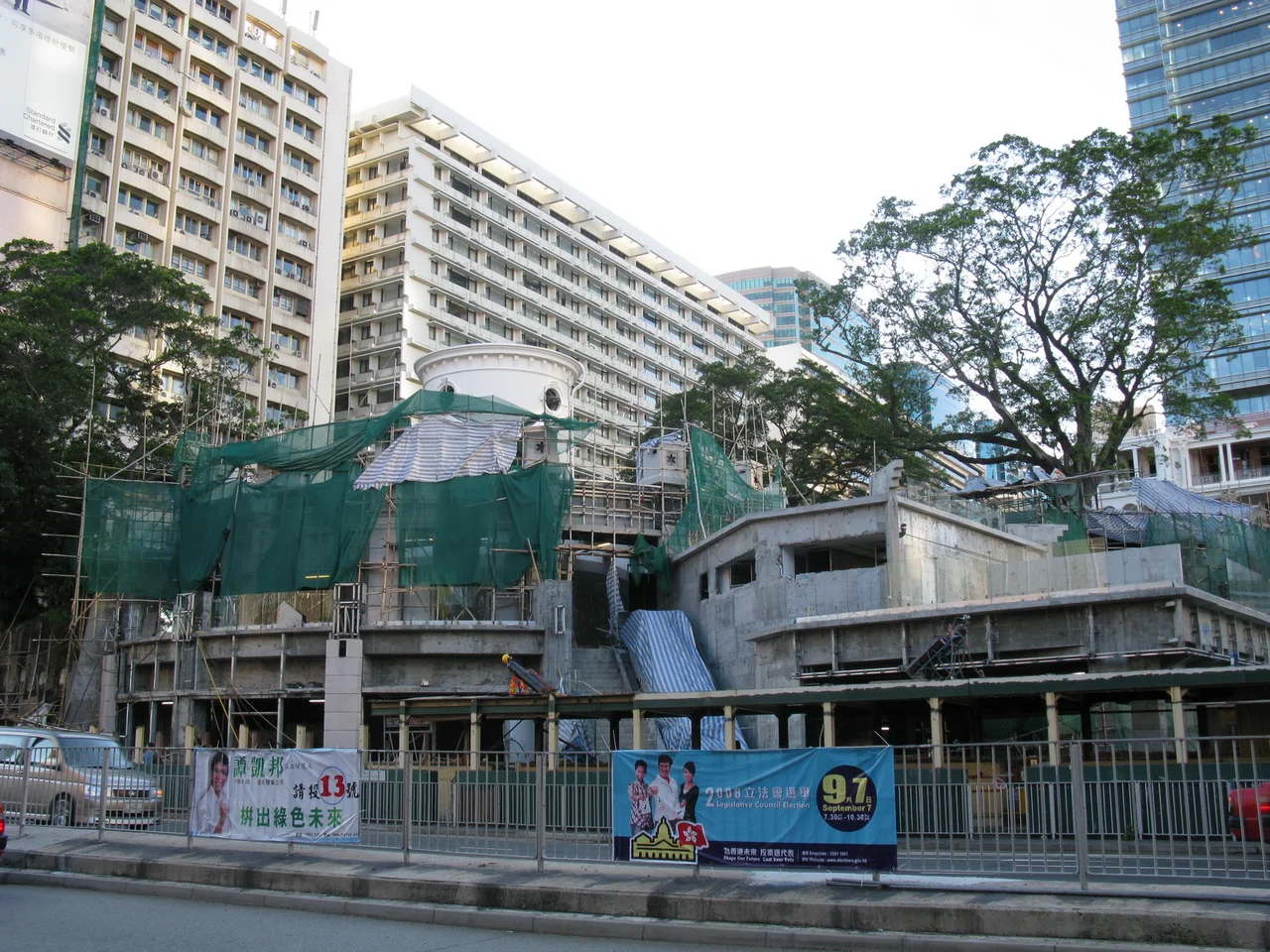

Former Marine Police Headquarters
Every morning, for decades, a ball was hoisted to the top of the Signal Tower at the Marine Police Headquarters. At precisely 1 PM it dropped, and every ship in Victoria Harbour set its chronometer accordingly. Without accurate time, navigation failed; without navigation, trade failed; without trade, Hong Kong had no reason to exist. The time ball was a small mechanism doing an enormous job, and the compound around it — completed in 1884, sitting above the Tsim Sha Tsui waterfront — was built to the same logic: modest in appearance, essential in function.
The Water Police and the Harbour They Watched
They were called the Water Police before the name changed to the Marine Police, and the name change matters less than what they did. From 1884 until 1996, this compound was their headquarters — the place from which officers watched the harbour, intercepted smugglers, responded to distress calls, and maintained order over one of the world's busiest waterways. At peak, Victoria Harbour handled thousands of vessels. The police who watched it needed a base at the water's edge, and this is where they built it.
The compound is one of the four oldest surviving government buildings in Hong Kong, a distinction it earned simply by remaining when almost everything else was torn down. Hong Kong has demolished its past with unusual efficiency; what survives does so through some combination of luck, designation, and institutional inertia. The Marine Police Headquarters survived all three.
The Time Ball Tower
The Signal Tower — also called the Time Ball Tower or Round House — is the compound's most distinctive structure. Every morning a ball was raised; at 1 PM it fell. Ships in the harbour observed the drop and corrected their chronometers. The system was standard for major ports in the 19th century, a way of distributing accurate time before radio.
Its use diminished in 1907 when the time ball apparatus was moved to Signal Hill in Kowloon, and the tower's primary purpose ended. But the structure itself remained, a round Victorian tower that now stands among the compound's other buildings as a remnant of a very specific problem that technology has long since solved. It is one of those objects whose function has become entirely historical while its form remains entirely present.
Vacancy, Then Competition
The Marine Police moved to Sai Wan Ho in 1996, leaving the compound vacant. In 2002, the Hong Kong Government announced a competitive tender for an adaptive reuse concept — acknowledging that the site needed a new purpose but that its historical significance meant the purpose had to fit the building rather than the other way around.
Six proposals were submitted. In May 2003 the government announced that Flying Snow Limited, a subsidiary of Cheung Kong Holdings, had won a 50-year land grant. The conditions were specific: certain furnishings and features were required to be preserved and restored. It was the first private sector-led preservation project in Hong Kong, a model that the government would later use for other heritage sites.
1881 Heritage: Stables and Suites
The resulting development opened in 2009 under the name 1881 Heritage. The original Marine Police Headquarters — Main Building, Stable Block, and Signal Tower — was joined by the nearby Old Kowloon Fire Station (completed 1920) and its Accommodation Block (completed 1922), creating a campus of colonial-era buildings around an open courtyard.
The Main Building was renamed Hullett House to honour Richmond William Hullett, and its ten suites were given Hong Kong-themed names and decors: South Bay (Art Deco), Deep Water Bay (Pop Art), Ma Wan (Imperial China), Tai O (Regal chinoiserie), Silvermine (all-white, described as a honeymoon suite). In 2019, FWD Group leased the hotel and relaunched it as House 1881, renovating the suites and adding five new dining concepts. The Stable Block, immediately north of the Main Building, became a restaurant. The Signal Tower still stands above the courtyard, no longer dropping balls for ships, but visible for what it was.
A Compound in Fiction
The compound appeared in Hong Kong's fiction before it appeared in Hong Kong's heritage listings. Ernest K. Gann's novel *Soldier of Fortune*, published in 1954, used the Water Police Headquarters as a setting. The house-author Nick Carter's 1966 novel *Dragon Flame* referenced it as well. These mentions are small things, but they confirm that the compound had, even in its working years, accumulated enough visual character to anchor a scene. It looked like history before it had quite finished being operational.
From the Air
The Former Marine Police Headquarters — now 1881 Heritage — sits at approximately 22.2955°N, 114.1700°E on the Tsim Sha Tsui waterfront in Kowloon, directly south of Nathan Road and facing Victoria Harbour. From the air, the compound is visible as a low Victorian cluster of buildings immediately beside the harbour, set against the density of Tsim Sha Tsui behind it. The Clock Tower of the Former Kowloon-Canton Railway Terminus is visible nearby to the east. Hong Kong International Airport (VHHH) is on Lantau Island, about 30 km to the west. Approaching from the harbour at 1,500 feet, the contrast between the colonial compound and the surrounding commercial towers is stark.
Nearby Stories
- Lok Ma Chau Loop 2.3 km away
- Portas do Cerco 2.3 km away
- Kweilin Incident 17 km away
- Wanshan Archipelago Campaign 34 km away
- Nanxiong Formation 115 km away
- Battle of Nanpeng Island 148 km away
- Heyuan 169 km away
- Cape Maobitou 632 km away