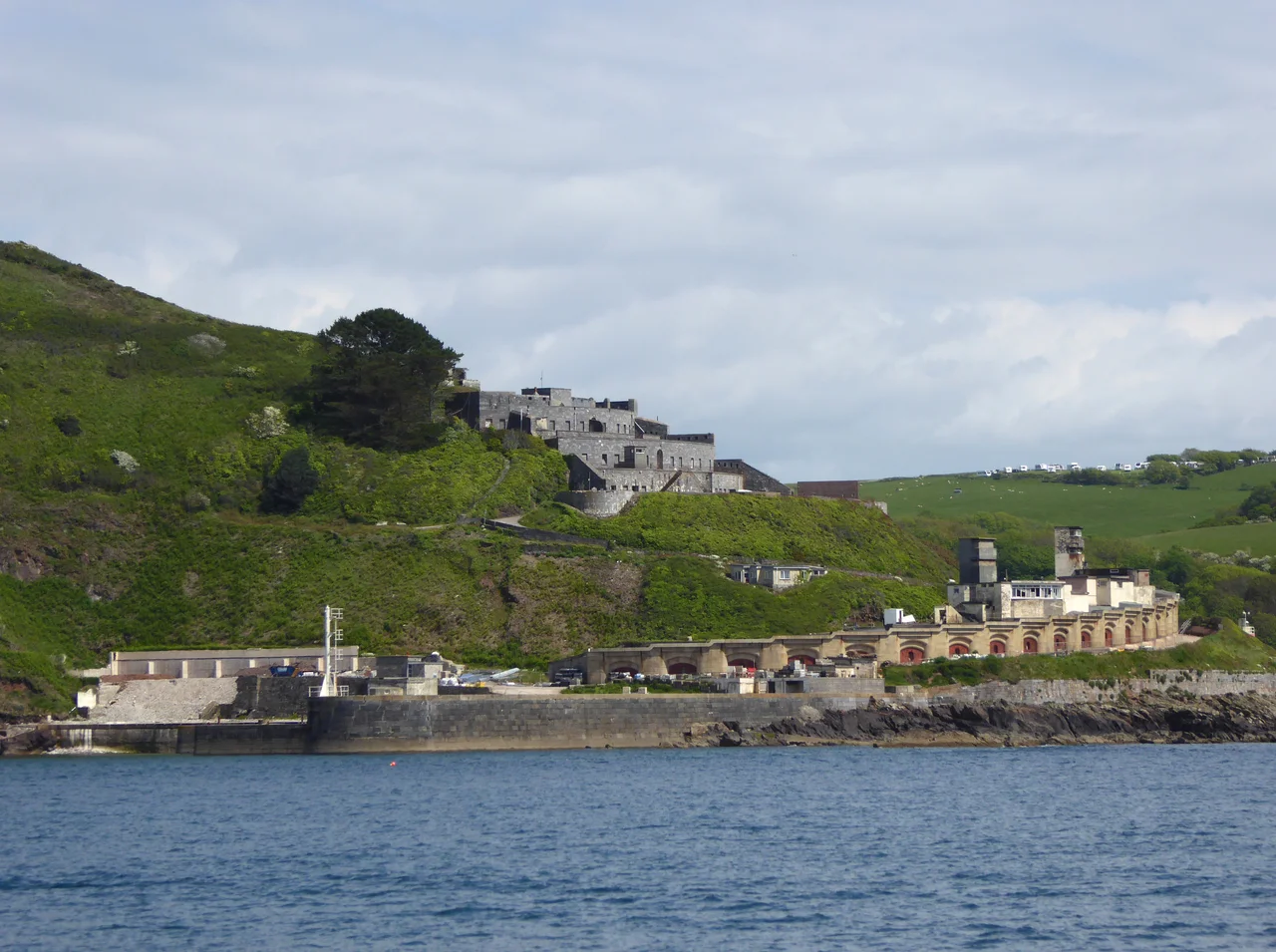

Fort Bovisand
Before there was a fort at Bovisand, there was a water stop. In 1816, with sailing warships anchored in Plymouth Sound and needing fresh water, a stone jetty and slip were built so that ship's boats could pull in and fill their casks from a nearby reservoir. It was a small piece of infrastructure for a vast naval operation. Forty-five years later, the same headland would be hewn out of granite into something far less ordinary: twenty-three armoured casemates arranged in an arc, each housing a rifled muzzle-loading gun, all of them pointing at the narrows where any French squadron foolish enough to try the Sound would have to pass.
An Arc of Granite
The Royal Commission on the Defence of the United Kingdom reported in 1860 with a stark assessment: Britain's naval bases were vulnerable to French steam-powered ironclads, and the country needed a new generation of forts. Work on Fort Bovisand began in 1861. The original design called for two storeys of casemates like nearby Fort Picklecombe, but during construction the plans were altered to a single tier of twenty-three granite casemates with armoured shields. Major Whitworth Porter designed it; the contractor was George Baker and Company, the same firm that would later go bankrupt while finishing Crownhill Fort. The fort initially mounted twenty-two 9-inch rifled muzzle-loaders and one 10-inch RML, with accommodation for 180 men. Beneath the gunfloor ran deep tunnels for ammunition, dug into the cliff to keep the magazines safe from enemy fire. The fort was completed in 1869.
The Long Obsolescence
Naval gun design moved faster than fort construction. By the early 1900s the original armament was already obsolete and was removed. Six 12-pounder quick-firing guns went in to chase the new threat: fast torpedo boats. By 1942 two twin 6-pounders had replaced four of the 12-pounders, specifically to engage the German E-boats raiding the Channel. A three-storey observation tower went up alongside to direct their fire, and a Bofors 40mm anti-aircraft gun was installed the following year. When coast artillery was dissolved across Britain in 1956, the Ministry of Defence abandoned the fort. It sat empty for fourteen years, waiting for someone to find a new use for it.
Britain's Diving School
That use arrived in 1970 with a lease and a vision: turn the abandoned fort into the country's national commercial diving school. The casemates that had once held smoke-belching muzzle-loaders became classrooms and equipment stores. The deep underground magazines made surprisingly useful workshops. The Fort Bovisand Underwater Centre trained divers for the North Sea oil industry and the merchant navy. The upper fort, above the coastal path, served as an outdoor activity centre for schools from the mid-1970s through the early 1990s, with the old magazine converted to bunkhouses, kitchen and dining area, and the cottage doing duty as toilet block and staff quarters. By 2000 the main leaseholder had liquidated, and in December that year Plymouth Ocean Projects went into receivership too. The diving era ended.
Greg Dyke, the BBC, and a New Chapter
In 2004 the site was bought from the Public Receiver by Powder Creek Ltd, a company majority-owned by Greg Dyke, the former Director-General of the BBC who had resigned earlier that year after the Hutton Report. Discovery Divers moved in by late 2004. The Fort Bovisand Trust was formed in 2011 to pursue heritage attraction plans, and in 2013 won a development grant from the Heritage Lottery Fund to take the proposals forward. The bid for a full delivery grant lost out to the Concorde Museum at Filton. Plans shifted to a mixed scheme of residential units alongside catering and commercial spaces. Cliff stabilisation works went on in 2020, and the first stage of the new development began in early 2021. Two centuries after that first stone jetty was built for warship watering parties, the granite casemates still face out over the Sound, watching for ships that no longer come.
From the Air
Fort Bovisand sits at 50.34 degrees north, 4.13 degrees west, on the eastern headland at the entrance to Plymouth Sound, opposite the eastern end of the Plymouth Breakwater. From the air the fort appears as a long arc of stone built into the cliff face above Bovisand harbour, with the Breakwater visible as a pale line stretching across the Sound mouth to the south-west. Plymouth (EGHD) is 4 nm to the north-west; Exeter (EGTE) 38 nm to the north-east. Best viewed at 1,500-2,500 feet on a clear day, ideally an hour after sunrise when the granite casemates catch full eastern light.
Nearby Stories
- Davidstow Circuit 3.7 km away
- Golden Hind 3.9 km away
- Powderham Castle 4.4 km away
- Fowey Lifeboat Station 5.1 km away
- Okehampton Castle 12 km away
- Battle of Plymouth (1652) 19 km away
- Goonhilly Satellite Earth Station 44 km away
- German Submarine U-672 73 km away