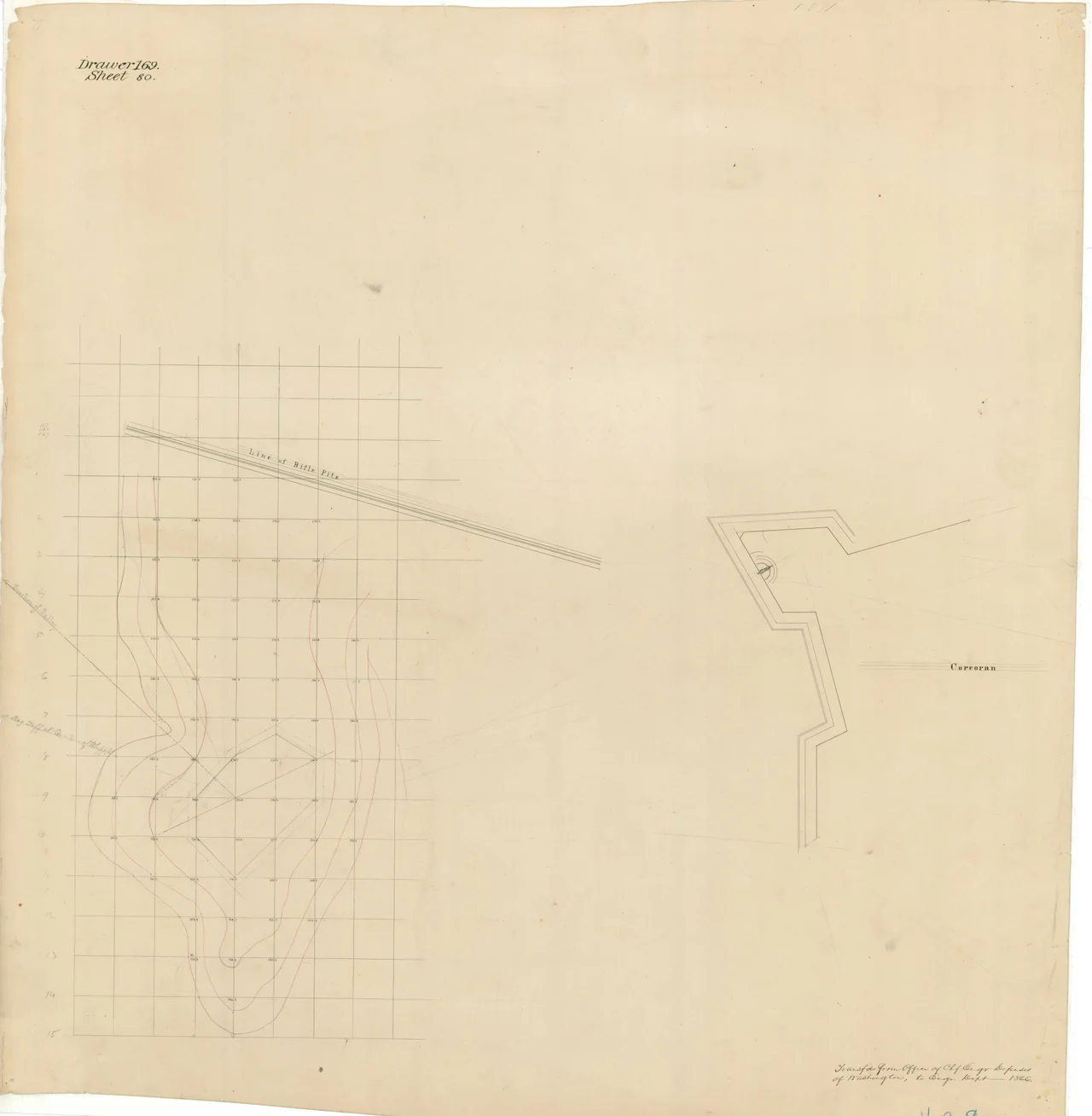

Fort Corcoran
Father Thomas Mooney was the chaplain of the 69th New York Volunteer Regiment, the Fighting Irish, and on a summer morning in 1861 he stood beside the freshly emplaced cannons of Fort Corcoran and baptized them. The men of the regiment, most of them Irish-born or first-generation, watched him bless the iron the way he might bless a child. The cannons received names, sprinklings of water, and brief prayers for their use. New York's archbishop, John Hughes, took a dim view of the sacrilegious action when news reached him and recalled Father Mooney to New York. The cannons remained at the fort. The Irish Brigade went on to fight at Bull Run, Antietam, Fredericksburg, and Gettysburg. The fort, perched above the Potomac at the southern end of the Aqueduct Bridge, watched the war from a safe distance until 1866, when it was finally torn down.
Built in a Day
The morning after Virginia voted to secede on May 23, 1861, Union troops crossed the Potomac before dawn and occupied Arlington Heights. Over thirteen thousand soldiers marched into northern Virginia on May 24, accompanied by a long train of wagons filled with shovels, wheelbarrows, and timber. By sunrise the army had broken ground on the first two forts of what would eventually become the defenses of Washington: Fort Runyon at the southern end of the Long Bridge, and Fort Corcoran at the southern end of the Aqueduct Bridge. The 69th New York Volunteer Regiment provided much of the labor at Fort Corcoran and the fort took the name of their colonel, Michael Corcoran, an Irish-born nationalist who had emigrated to New York and risen through the New York militia. The fort sat on high ground commanding the Aqueduct Bridge, Mason's Island (today's Theodore Roosevelt Island), and the Virginia approaches to Washington.
The Confederate Army Did Not Quite Come
Fort Corcoran was an outpost without a defensive ring at first. For seven weeks, Union engineer John Barnard could focus only on Corcoran and Runyon because no other defensive works existed on the Virginia side. When the rest of the army marched south to fight First Bull Run on July 21, the engineers went too. The disaster at Bull Run threw all of this into reverse. On the night of July 23, two days after the defeat, President Lincoln and Secretary of State William Seward visited the fort to try to revive morale. The fort served as a rallying point for battered artillery units retreating from Manassas. An informal report on July 29 showed the fort packed with twenty-three guns, more than twice its design, and over two hundred artillerymen, far above its planned garrison. William Tecumseh Sherman, then commanding a brigade in Daniel Tyler's division, camped near the fort with his shaken regiments and began the painful work of rebuilding their discipline.
The Balloon Corps
What made Fort Corcoran more than just another earthwork was its role as the launching site for the Union Army Balloon Corps. The scientist and aeronaut Thaddeus S. C. Lowe demonstrated balloon reconnaissance to President Lincoln in June 1861 by ascending from the Mall and telegraphing observations back to the ground via a wire that hung from the basket. The Army hired him, and by autumn Lowe was operating a small fleet of gas balloons from Fort Corcoran and other sites around Washington. The hydrogen was generated on the spot from portable equipment. Observers in the baskets used spyglasses to map Confederate positions across the river and reported by telegraph. The Balloon Corps was the first organized military aviation unit in American history. It operated until 1863, when interservice politics and budget disputes shut it down. Fort Corcoran served as one of its principal bases throughout the program's brief life.
The Telegraph Hub
By the second year of the war, Fort Corcoran had become a communications hub as much as a fortification. A July 1863 report on military telegraph operations counted six lines running from Fort Corcoran to the War Department in Washington, five lines to Fort Ethan Allen, two to Alexandria, and one each to two observation points southwest of the fort. By Appomattox, more than thirty miles of telegraph wire converged on the fort. A December 1862 study by a War Department commission recommended building additional defensive works on the ridge above Fort Corcoran and adding bombproof shelters to the existing structure, both of which were done in 1863 and 1864. The fort that had been hastily thrown up on a single day in May 1861 had become one of the largest and most heavily wired forts in the Washington system, with twelve seacoast howitzers, twenty-four-pounder barbette guns, and field artillery.
Nothing Left Above Ground
Confederate forces never seriously threatened Fort Corcoran. Mosby's Rangers occasionally probed the Virginia defenses, and Jubal Early's 1864 raid stayed well to the north along the Maryland side. The fort was decommissioned in 1865 and dismantled in 1866. The timber was salvaged. The earthworks were leveled. Within a generation the ground had passed back into private ownership and become part of the growing town of Rosslyn. Today the fort site lies under Wilson Boulevard in Arlington County, surrounded by office towers and condominium buildings. An Arlington County historical marker stands at the corner where the parapets once were. Colonel Michael Corcoran, the namesake, was captured at First Bull Run, held for over a year in Confederate prisons, exchanged in 1862, promoted to brigadier general, and died in December 1863 after a fall from his horse outside Fairfax Court House. He was thirty-six.
From the Air
The Fort Corcoran site is at 38.8970 degrees north, 77.0747 degrees west, in modern Rosslyn at the foot of the Key Bridge (the modern successor to the Aqueduct Bridge). Best viewed at 1,500 to 2,500 feet AGL with Theodore Roosevelt Island immediately south and Georgetown across the Potomac. Reagan National (KDCA) is three nautical miles south. The site sits adjacent to the P-56 prohibited area and inside the Washington Class B veil; overflight requires ATC coordination.
Nearby Stories
- Gunston Hall 1.1 km away
- 2023 Baltimore Shooting 4.9 km away
- Battle of Middleburg 6.6 km away
- Crownsville Hospital Center 10 km away
- Battle of Loudoun Heights 13 km away
- First Battle of Rappahannock Station 20 km away
- Howard County, Maryland 21 km away
- Harriet Tubman Underground Railroad 50 km away