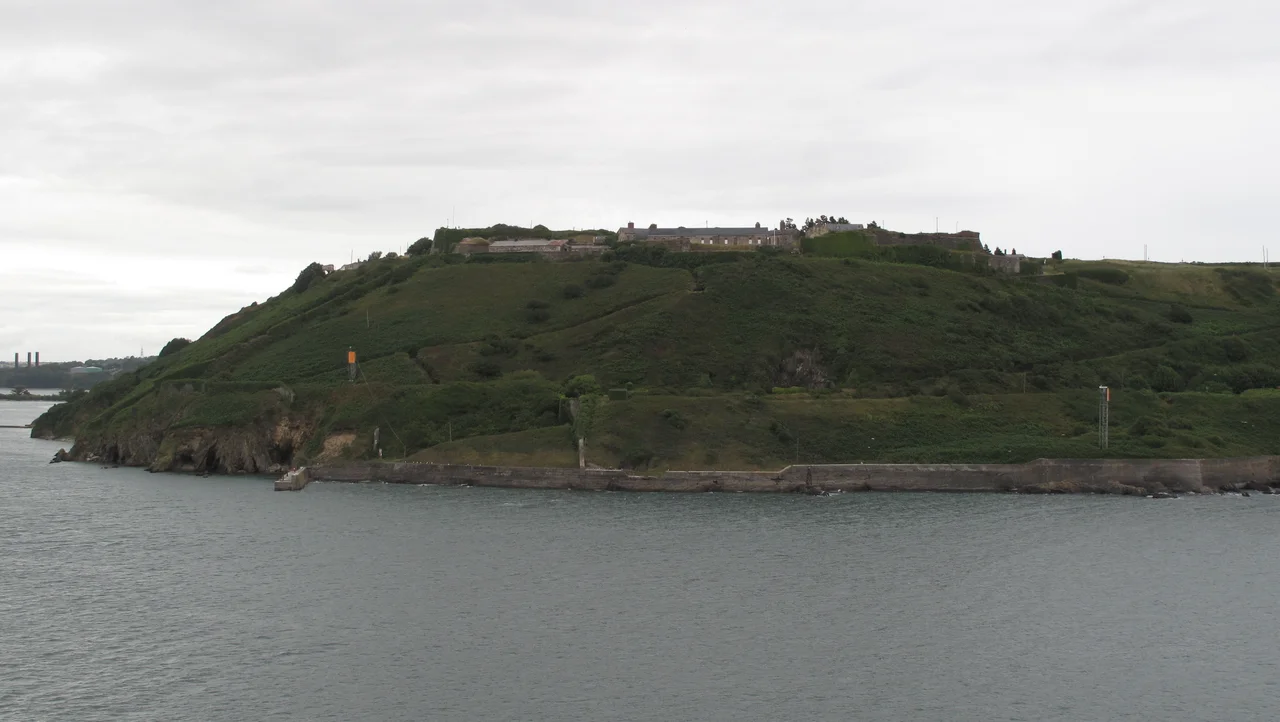

Fort Davis
Stand on the cliff above Whitegate and you are looking at four centuries of harbour defence stacked on top of each other. Underneath the modern Irish Army training site lie the brick-vaulted casemates of a Palmerston Fort, built in the 1860s with the new technology of concrete. Underneath that are the foundations of 'King John's Fort,' the Williamite-era defences that fell to the Duke of Marlborough in 1690. And underneath those again is 'Prince Rupert's Tower,' built before 1607 for Charles I's nephew - the wild Royalist cavalry general - long before Charles himself was born. The fort that now has the name Davis has worn at least three other names. The walls have been in continuous use for over four hundred years.
Why Whitegate
Look at a chart of Cork Harbour and the answer is obvious. The harbour mouth is a narrow gap roughly 800 metres wide, between Whitegate Point on the east and Crosshaven on the west. Anything heading for the world's second-largest natural harbour - which Cork Harbour is - has to pass through that gap. A gun on the high ground at Whitegate, paired with a gun across the water at Crosshaven, makes the entrance untenable for any enemy fleet. The first fortification went up before 1607 and was named for Prince Rupert of the Rhine, the Royalist cavalry general who would later become a key figure in the English Civil War. By the time of the Williamite War in 1689, additional works had been added and the place was being called 'King John's Fort,' for the medieval English king. Together with Fort Camden across the water, it fell to William of Orange's forces under the Duke of Marlborough in the lead-up to the Siege of Cork in 1690.
French Prisoners in the Tunnels
The next major round of construction came from the 1790s onward, prompted by the wars with revolutionary and Napoleonic France. Some of the tunnels and casemates from this period would be used between 1803 and 1815 to hold French prisoners of war - Napoleon's veterans dragged across the sea to wait out the war in the dark stonework of an Irish hill. By the mid-19th century the place had been renamed Fort Carlisle, for Frederick Howard, 5th Earl of Carlisle, a former Lord Lieutenant of Ireland. In the 1850s a Royal Commission reconsidered the strategic importance of the harbour and proposed major upgrades. In the 1860s, Fort Carlisle was redeveloped along the lines of other 'Palmerston Forts' - the chain of late-Victorian fortifications named for Prime Minister Lord Palmerston. Concrete, then a relatively new construction material in military engineering, was used extensively. At peak, the fort mounted upwards of 20 guns.
The Western Approaches
During the First World War (1914 to 1918), Cork Harbour became one of the most important Allied naval bases for protecting the Western Approaches - the shipping lanes inbound to British and Irish ports from North America. Fort Carlisle, working with Fort Camden across the harbour entrance, kept guns trained on any vessel approaching. Royal Garrison Artillery Coastal Defence units lived on the site. The graves in the small military cemetery here date from this era and from the Irish War of Independence (1919 to 1921), though the fort itself saw no significant action in the latter conflict. After the Anglo-Irish Treaty in 1921, the harbour defences became one of the Treaty Ports - three deepwater facilities the Royal Navy retained on Irish soil, until 1938.
Renamed for a Young Irelander
The handover came in July 1938. Fort Carlisle - along with Fort Camden across the harbour, Fort Westmoreland on Spike Island, and the Berehaven and Lough Swilly bases elsewhere - was transferred to Irish control. The new state immediately renamed the forts for nationalist heroes who had often been imprisoned or executed by the British. Fort Carlisle became Fort Davis, for Thomas Davis - the chief organiser of the Young Ireland movement in the 1840s, the man who wrote 'A Nation Once Again' and who died at 30 of scarlet fever. Spike's Fort Westmoreland became Fort Mitchel, for John Mitchel. Fort Camden became Fort Meagher, for Thomas Francis Meagher. Three forts named for three Young Irelanders, all chosen deliberately to overwrite a century of British naming. The fort itself was unchanged - the same gun pits, the same casemates, the same brick vaults still bombproof - but the man named on the gate had become a republican rather than a viceroy.
Quiet Use, Closed Gates
Through the mid-20th century the Coastal Defence Artillery was merged into other regiments of the Irish Army. Fort Davis became primarily a training site - exercise ground, ceremonial gun salute location, ammunition store. The Department of Defence still owns the 74-acre site. There is no public access, though the Buildings of Ireland inventory lists the historic structures and the National Inventory of Architectural Heritage records the rare survival of a complete 19th-century Palmerston Fort. In November 2015 the Army discovered an unmapped tunnel inside the fort, prompting an Irish Examiner video report - a small reminder that even after four centuries, this hill still has secrets the soldiers haven't found.
From the Air
Fort Davis sits at 51.816 degrees N, 8.261 degrees W on the eastern headland of the entrance to Cork Harbour, near the village of Whitegate. From the air it appears as a distinctive star-shaped earthwork on the cliff edge, paired with Camden Fort Meagher visible directly across the harbour mouth at Crosshaven about 1 km west. Roche's Point Lighthouse is 2 km south on the same headland. Best viewed from 1,500 to 4,000 feet on a coastal track from Kinsale toward Cork Harbour. Cork Airport (EICK) lies 16 km northwest. The fort itself is closed to the public; the impressive geometry is only really visible from the air or by sea.
Nearby Stories
- Walter Siepmann 6.3 km away
- Gaeltacht na nDéise 11 km away
- Fermoy 12 km away
- Canovee 14 km away
- Rathcoole Ambush 16 km away
- SS Folia (1907) 20 km away
- Cloghan Castle, Lough Hyne 35 km away
- SM U-27 91 km away