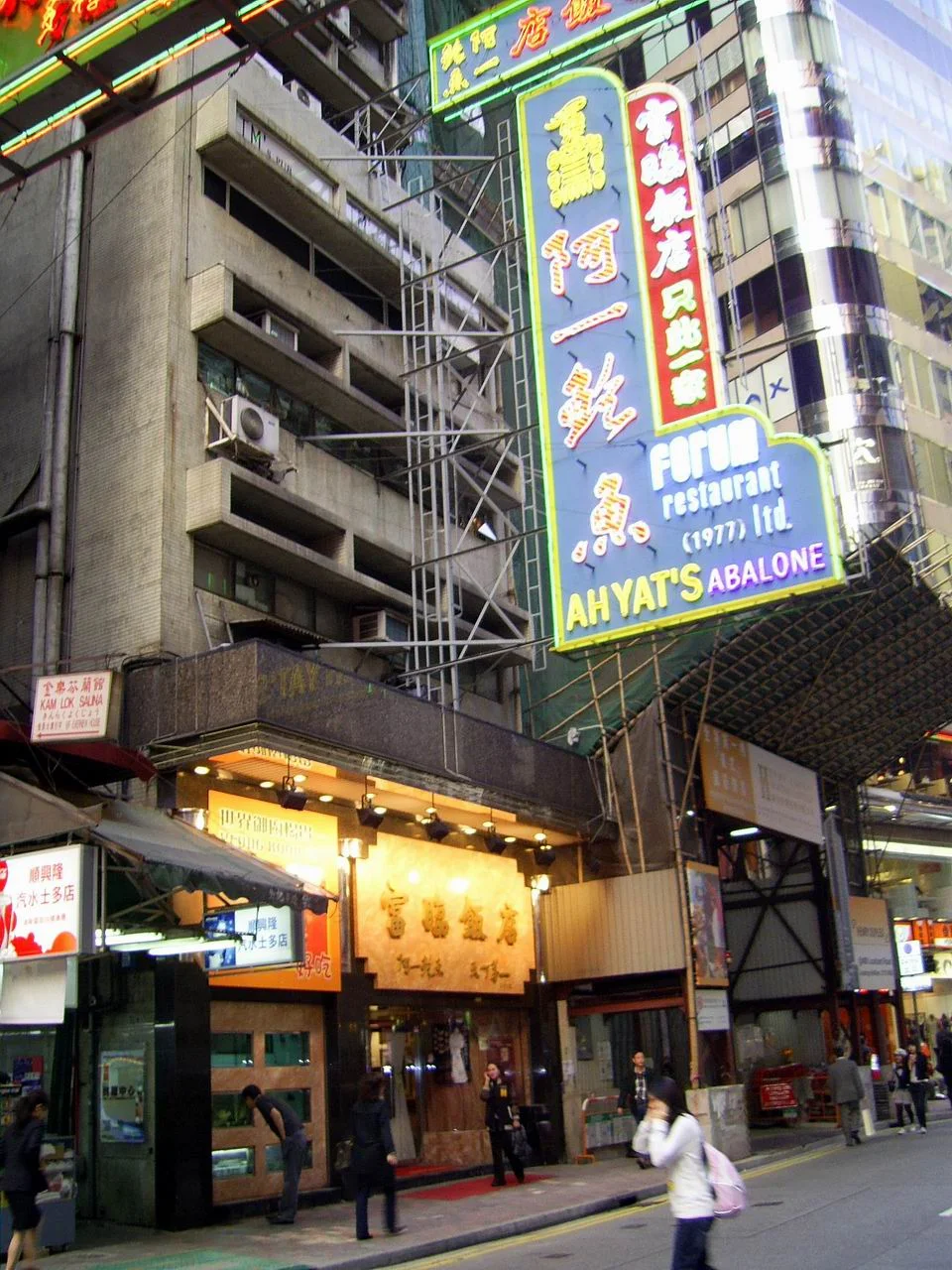

Forum Restaurant
Yeung Koon-yat described abalone this way: 'it was the food of kings, of businessmen, of intellectuals... it's good quality and healthy.' He wasn't selling the idea. He had already bet his restaurant on it. In the early 1970s, with partners leaving one by one and the Forum Restaurant struggling to survive, Yeung decided that mastering a single dish would be the difference between staying open and closing. He chose abalone. The decision would take him to Deng Xiaoping's table and, eventually, to three Michelin stars.
A Restaurant That Almost Didn't Make It
Yeung Koon-yat first opened the Forum in 1974 with business partners, though the restaurant was not officially registered until 1977. The early years were hard. The partners left, one by one, until Yeung was the sole owner. The menu was ordinary — comfort food, the kind served at hundreds of other Cantonese restaurants. Nothing made the Forum stand out.
Yeung's response to this situation was unusual. Rather than broaden the menu or cut prices, he narrowed his focus to a single ingredient: abalone. He studied the shellfish obsessively, learning preparation techniques from Japanese practitioners who had centuries of expertise with the dried variety. He soaked and dried whole pieces for a day, rehydrating Japanese dried abalone sourced from northern Japan, experimenting with heat — charcoal at first, then gas — until the texture and flavor met his standard. It took years. It paid off.
The Dinner for Deng Xiaoping
Word of Yeung's abalone spread through the circles that could afford it — businessmen, government officials, the Hong Kong elite. Positive reviews accumulated. Then, in 1984, Yeung served abalone to Deng Xiaoping. The occasion elevated the dish from local delicacy to something with a different kind of prestige. The politician, according to the account that has passed into Forum lore, said it was the best abalone he had ever eaten.
The story did what good culinary stories do: it traveled. The Forum became a destination for people who wanted to eat the same dish that had been served to one of the most powerful figures in 20th-century China. Yeung had found his signature, and it had found him an audience that extended well beyond Causeway Bay.
Michelin and the Third Star
The Michelin Guide launched its Hong Kong and Macau edition in 2009. In the inaugural edition, the Forum received one star. Recognition built from there: the second star came in 2018, the third in 2020. Three Michelin stars is the guide's highest designation — a rating that, in practice, makes a restaurant a global destination and drives reservations from diners who plan international itineraries around specific meals.
Yeung's signature dish, Ah Yat's abalone (named using his nickname), is the Forum's centerpiece. The preparation has not fundamentally changed since Yeung developed it: Japanese dried abalone from northern Japan, rehydrated over a full day, slow-cooked by a method that Yeung refined over decades. The technique is simple to describe and difficult to execute. That gap is where the three stars live.
Lockhart Road to Sino Plaza
For years the Forum operated at 485 Lockhart Road in Causeway Bay. In January 2014 it moved to the first floor of nearby Sino Plaza, at 255–257 Gloucester Road, after its previous site was rented to Tsui Wah Restaurant for HK$1.22 million per month — a 70% increase over what the Forum had been paying, and a sum that made staying impractical.
The same year brought a trademark dispute: the Forum sued Fulum Group in April 2014, arguing that their chain's name infringed on the Forum's because the two names sound similar and are written with the same Chinese characters. By July 2014, a coexistence agreement had been reached. The matter illustrated how tightly Yeung had tied the Forum's identity to its name — and how seriously he took anything that might dilute it.
Yeung Koon-yat
Yeung Koon-yat died on 31 July 2023 at the age of 90, following an undisclosed illness. The Forum announced his death on social media. He had built a restaurant that began with almost nothing — struggling finances, departing partners, no clear identity — and turned a single ingredient into a career, a reputation, and eventually a culinary legacy recognized by the world's most authoritative restaurant guide.
The story of the Forum is inseparable from the story of its founder: the decision to specialize, the years of study, the patience required to perfect something genuinely difficult. Abalone is not a forgiving ingredient. It demands time, technique, and a cook who refuses to settle for close enough. Yeung was that cook for fifty years.
From the Air
Forum Restaurant is located at approximately 22.2813°N, 114.1820°E in Causeway Bay on Hong Kong Island, inside Sino Plaza at 255–257 Gloucester Road. From the air, Causeway Bay is the dense commercial district east of the financial centre, bordering Victoria Harbour's northern shore. The neon density of this neighbourhood and the oval of the Happy Valley Racecourse nearby — visible even from altitude — help orient the area. Hong Kong International Airport (VHHH) is on Lantau Island, approximately 30 km to the west. At 2,000 feet on approach from the east over Tseung Kwan O, the Hong Kong Island skyline is spread below, with Causeway Bay identifiable by its harbour-front commercial towers.
Nearby Stories
- Lok Ma Chau Loop 2.3 km away
- Portas do Cerco 2.3 km away
- Kweilin Incident 17 km away
- Wanshan Archipelago Campaign 34 km away
- Nanxiong Formation 115 km away
- Battle of Nanpeng Island 148 km away
- Heyuan 169 km away
- Cape Maobitou 632 km away