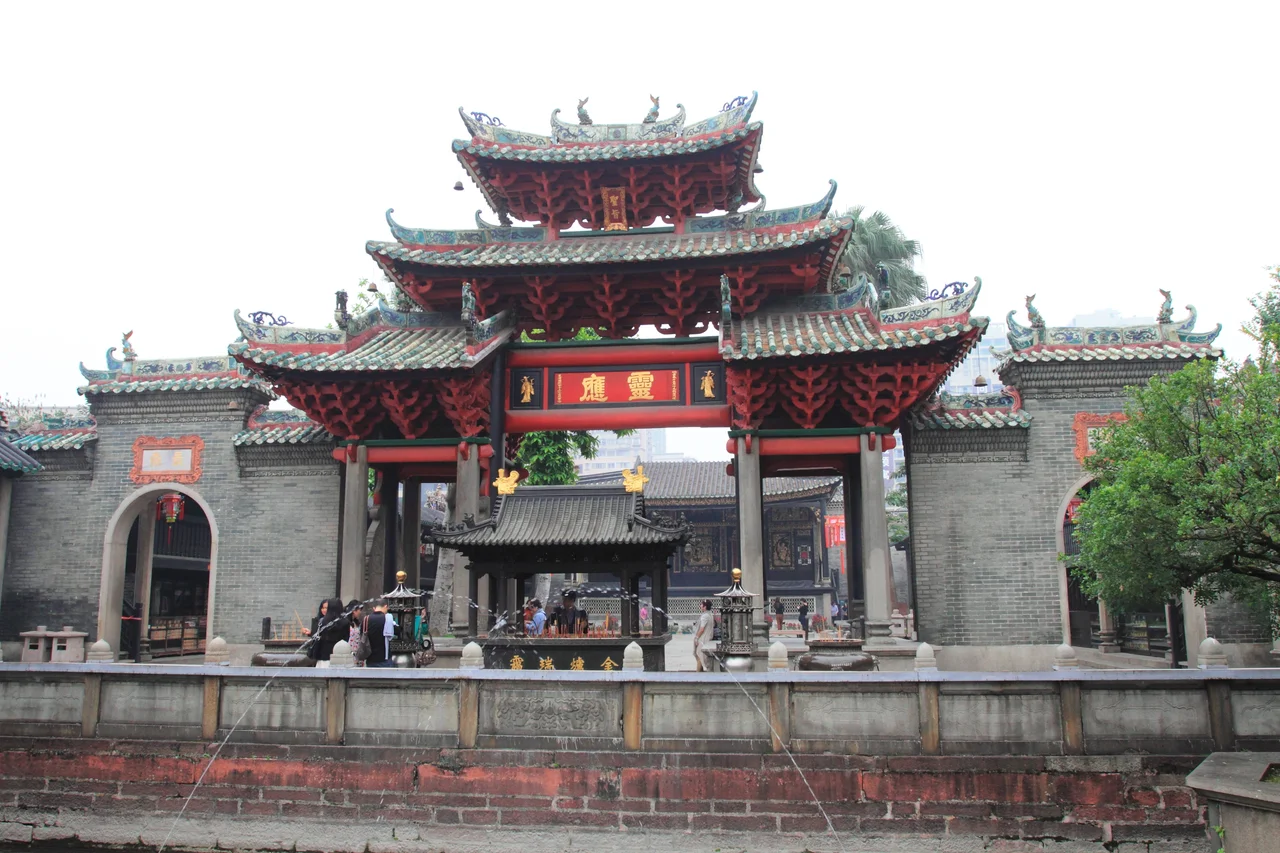

Foshan Ancestral Temple
The god inside this temple commands water. Xuanwu — the Dark Warrior, the Northern Emperor — is a Daoist deity whose dominion over rivers, rain, and flood made particular sense in a city built on the Pearl River Delta, where the land and water have never fully sorted out their boundary. The Foshan Ancestral Temple, known in Cantonese as Zumiao, was first raised in his honor during the Yuanfeng Era of the Song dynasty, between 1078 and 1085. It was destroyed at the end of the Yuan Dynasty. Rebuilt in 1372, in the fifth year of the Ming's Hongwu Era, it has stood on this 25,000-square-meter plot ever since — through the collapse of dynasties, the founding of the People's Republic, and a conversion into a municipal museum that somehow made it more visited rather than less.
The Northern God in a Southern City
Xuanwu is depicted in Chinese iconography as a warrior entwined with a serpent and a tortoise — ancient symbols of strength and longevity. His association with water made him a logical patron for Foshan, a city whose history is inseparable from the Pearl River's tributaries and the delta they formed. Cantonese culture adapted Xuanwu into Beidi, the "Northern God," a figure believed to hold power over Guangdong's waters and capable of averting floods.
The temple built in his honor became one of the region's most important religious sites. By the Ming and Qing dynasties, Foshan had grown into one of the "Four Great Towns of China," a major center of trade and manufacture, and the Ancestral Temple stood at the heart of the city's civic and spiritual life. It was not merely a place of worship. It was where the community gathered for festivals, where civic identity was expressed, and where the relationship between the human city and the watery world around it was negotiated through ritual.
Nine Hundred Years of Architecture
The temple complex that survives today reflects centuries of rebuilding, expansion, and careful maintenance. The core structure was rebuilt in 1372 and designated a key cultural relic protected by China's State Council. The Confucius Temple within the compound was constructed in 1911, adding a second tradition to the site's spiritual layering and opening to visitors in 1981. Together they create an unusual compound where Daoist, Confucian, and community cultural elements occupy the same 25,000 square meters.
The architectural quality is what stops visitors mid-step. Ornate ceramic roof decorations — a specialty of nearby Shiwan — crown the temple's ridgelines in colorful, narrative friezes. Carved woodwork fills the interior with dragons, scholars, and mythological scenes. The scale is intimate enough that details reward close attention, yet the complex is large enough that individual courtyards have their own atmosphere. After 1949, the temple was converted into the Foshan Municipal Museum, a transformation that preserved the buildings while opening them to a broader public.
Halls for Heroes
Two halls added to the complex in the early 21st century pull the site into more recent history. The Huang Feihong Memorial Hall commemorates the martial artist and folk hero born in the Foshan area, whose story has been depicted in over 100 films. Ip Man Hall honors the Wing Chun grandmaster from Foshan who would go on to teach Bruce Lee. Together they represent something that the original temple architects could not have planned: that this city would become synonymous with a particular style of Chinese martial arts, and that its gods and its fighters would end up sharing the same compound.
The juxtaposition is less strange than it sounds. Wong Fei-hung and Ip Man were both products of a Lingnan culture that the Ancestral Temple helped shape — a culture where physical discipline, folk religion, communal loyalty, and artistic tradition were not separate categories but interwoven aspects of the same social fabric.
A Living Temple Calendar
The Ancestral Temple is not a frozen artifact. Its calendar of events runs year-round, drawing over a million visitors annually. The Spring Blessing Ceremony and the Temple Fair mark seasonal transitions. Community Drinking Rituals and Mid-Autumn Festival celebrations bring neighborhoods together. The Preschool Children Enlightening Ceremony — a tradition in which young children perform their first act of writing under ceremonial guidance — connects the youngest residents to the site's long association with learning and aspiration.
Lion dance performances, Cantonese opera, and Foshan martial arts demonstrations fill the courtyards with sound and movement that the 11th-century architects might recognize in spirit if not in exact form. The god of water presides over all of it, as he has for nearly a thousand years. The city floods sometimes. The festivals continue regardless.
From the Air
The Foshan Ancestral Temple (Zumiao) sits at approximately 23.032°N, 113.108°E in the Chancheng District of central Foshan. The site is roughly 20 kilometers west of central Guangzhou and part of the dense Pearl River Delta urban fabric that connects the two cities. The nearest major airport is Guangzhou Baiyun International (ZGGG), approximately 25–30 kilometers to the northeast. At altitude, the Pearl River tributaries provide useful geographic reference — Foshan's urban core sits in the triangle of waterways west of Guangzhou. The temple complex is not distinguishable from cruising altitude but its Zumiao Road address places it in the historic center of Chancheng District, surrounded by older low-rise urban development. Best visibility in autumn and winter; summer haze common across the Pearl River Delta.
Nearby Stories
- Humen 7.6 km away
- Birds' Paradise 11 km away
- South China Mall 19 km away
- Qingyuan Maglev Tourist Line 22 km away
- Heyuan 123 km away
- Battle of Nanpeng Island 148 km away
- Temple of the Five Lords 410 km away
- Lugu Lake 1268 km away