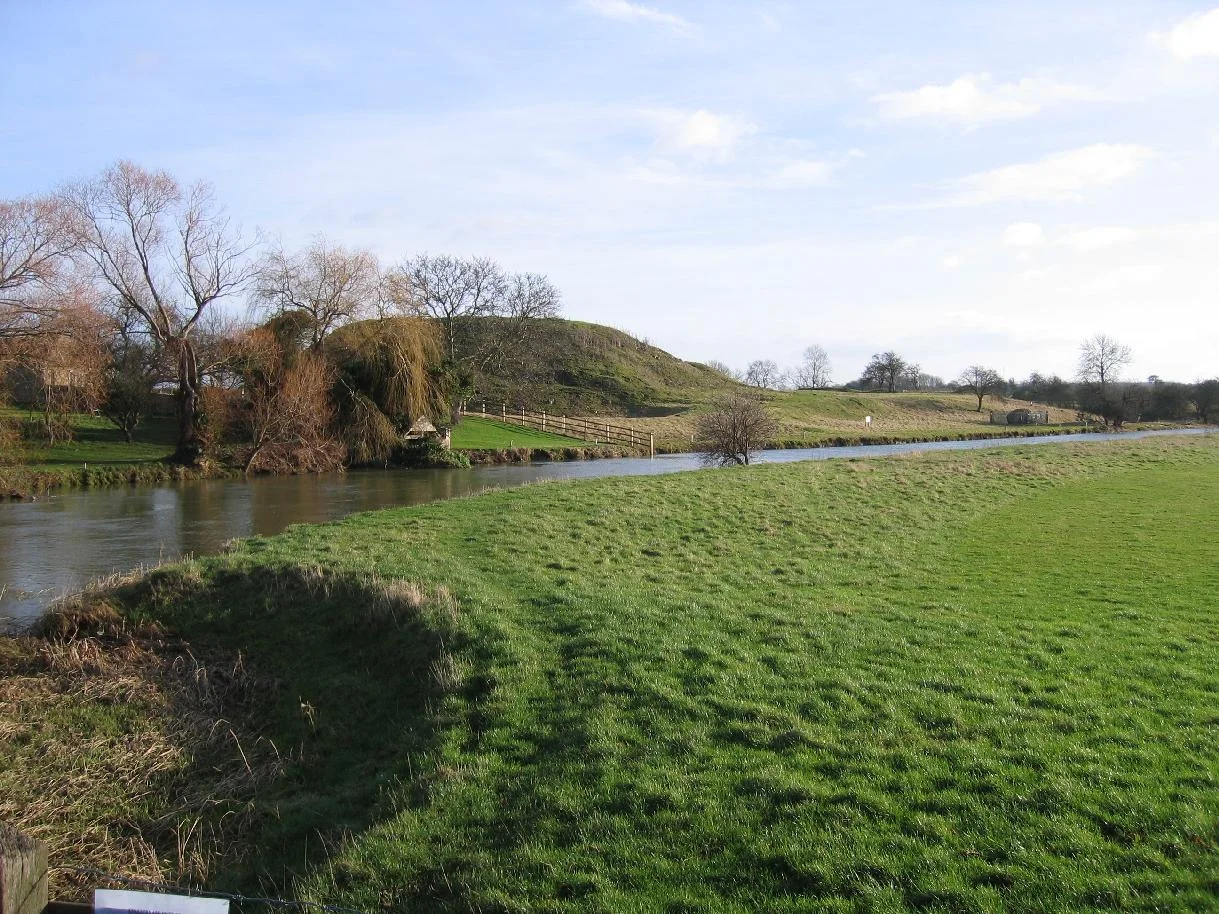

Fotheringhay Castle
There is a grass mound by the River Nene, and that is most of what is left. The castle that stood here was the size and weight of a small town, and inside its great hall on the morning of 8 February 1587 the executioner needed three blows of the axe to kill Mary, Queen of Scots. By 1635, less than fifty years later, the place had been reduced to ruin and most of its stone carted away for use elsewhere. What survives is the motte: seventy metres across at the base, thirty metres across the flat top, seven metres above the water meadow. Stand on it on a still morning and the absence has a shape.
Scottish Princes and Norman Earth
Fotheringhay was raised around 1100 by Simon de Senlis, Earl of Northampton, on the northern bank of the Nene. The site he chose was Norman in form, motte-and-bailey, with a polygonal stone keep on top of an earthen mound and a moat fed from the river. Through his widow's remarriage in 1113, the castle passed to Prince David of Scotland, later King David I, and for a century the Scottish royal house owned this small piece of Northamptonshire. King John seized it in the early thirteenth century during his quarrels with the barons; in 1219 William Marshal finally surrendered it to Henry III after stubbornly holding on past every order. By 1221 it was in royal hands, where, with intervals, it remained. Edward III gave it eventually to his fourth surviving son, Edmund of Langley, founder of the House of York, and from that grant onwards Fotheringhay became something different: a Yorkist place.
The Yorkist Cradle
Richard, Duke of York, made Fotheringhay one of his principal residences. His wife Cecily Neville bore him sons here, and on 2 October 1452 the youngest of them, Richard, was born in the castle. He grew up to be the king who has been argued over more bitterly than any other English monarch, the one who lost his crown and his life at Bosworth Field. He had two older brothers who became kings before him: Edward IV, who fathered the Princes in the Tower, and George, Duke of Clarence. Cecily, who outlived almost all of them, entertained guests at Fotheringhay long after her husband's death in battle in 1460. Elizabeth Woodville, Edward IV's queen, stayed at the castle in 1469. Elizabeth of York, Edward's daughter and later Henry VII's queen, kept her horses here and once paid a man a shilling to mark her colts. The accounts of a small castle keep small details.
Mary's Last Winter
She had been a prisoner for eighteen years before they brought her here, moved between Sheffield Castle, Sheffield Manor and other holdings of her keeper the Earl of Shrewsbury. Mary Stuart, Queen of Scots since infancy, queen consort of France for a year and a half, claimant to the English throne through her grandmother Margaret Tudor, was Elizabeth I's cousin and her most dangerous problem. Walsingham's intelligencers caught her endorsing the Babington Plot in the summer of 1586. She was moved to Fotheringhay in September, tried in the Great Hall on 5 and 6 October, and convicted of treason. Elizabeth, who had been her cousin's reluctant jailer for half a lifetime, took more than two months to sign the death warrant. Mary was told the sentence the day before it was carried out. She spent the evening writing letters, including a long one to her brother-in-law Henri III of France, distributing her possessions and praying. The next morning she walked down to the hall in a black gown, removed it to reveal a deep red kirtle, the colour of Catholic martyrdom, and laid her head on the block. The first blow struck the back of her head. The second severed most of her neck. The third finished the work. Her small terrier, hidden under her skirts, was found afterwards hiding by the body and would not leave. She was forty-four.
The Erasure
It is sometimes said that James I had Fotheringhay demolished out of grief for his mother. The truth seems to be more ordinary. The castle had been falling into disrepair through the later Elizabethan years; by 1635 it was reported a ruin and was taken down soon afterwards, its dressed stone sold for re-use in barns, in inns, in Northamptonshire walls. A staircase said to be the one Mary descended on her last morning ended up at the Talbot Hotel in Oundle, where it is still pointed out. The site today is open to the public during daylight hours. There is a stone with a plaque, a thistle planted by visitors, the motte, the river. Donizetti set three scenes of his 1835 opera Maria Stuarda here. Sandy Denny wrote a song about Mary's imprisonment in 1969 and called her band, when she left Fairport Convention, Fotheringay. The castle is gone. The argument goes on.
From the Air
Fotheringhay Castle's earthworks lie at 52.5243 degrees north, 0.4362 degrees west, on the north bank of the River Nene about four miles north-east of Oundle. From 2,000 to 3,000 feet AGL in clear weather the motte and bailey ditches read clearly against the water meadows; the Perpendicular tower of the Church of St Mary and All Saints in the village is the more obvious landmark from altitude. Nearest airports: Sywell (EGBK) about 24 nm south-west, RAF Wittering (EGXT) 7 nm north-east. Class G airspace; respect the Wittering MATZ.
Nearby Stories
- Selwyn College, Cambridge 7.2 km away
- John Bunyan Museum 9 km away
- Canons Ashby House 9.4 km away
- Woolsthorpe-by-Colsterworth 11 km away
- Loughborough 11 km away
- Wigston 13 km away
- RAF Witchford 19 km away
- King's Lynn Minster 27 km away