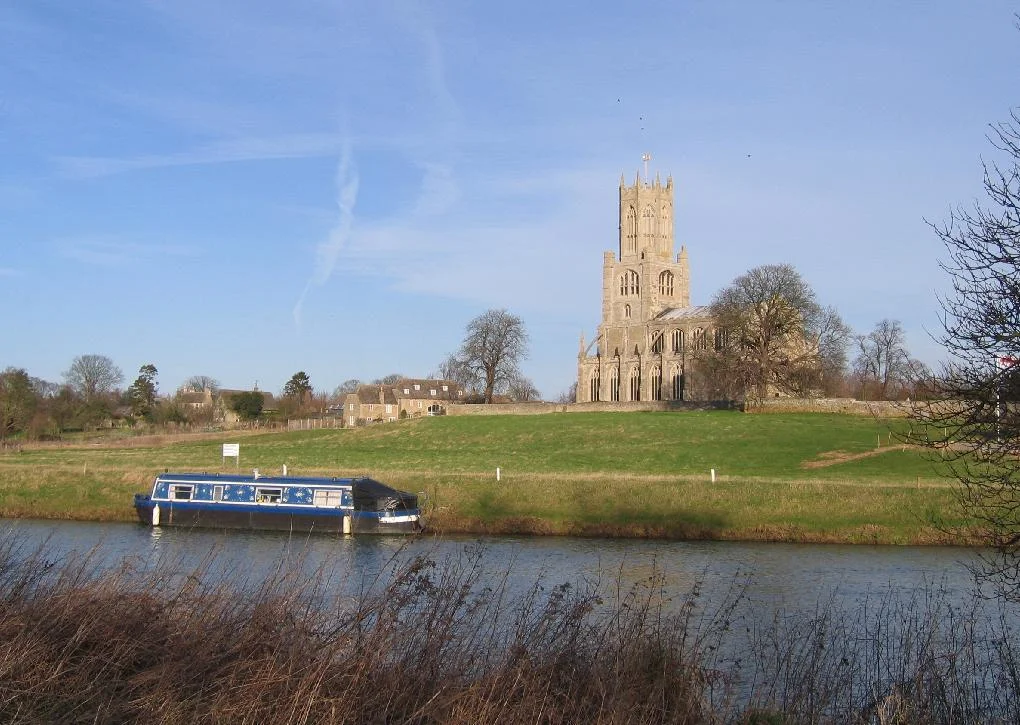

Fotheringhay
The Richard III Society lays white roses on the altar of St Mary and All Saints every 2 October, his birthday. Otherwise Fotheringhay is a village of around a hundred and twenty people, a few stone houses, the Nene gliding by between water meadows, and a church tower that looks impossibly large for what is left around it. The historian John Nicholls put it best in 1821: 'Fotheringhay has been distinguished beyond any other place in Britain, except the Capital, by the aggravated misfortunes of Royalty.' The misfortunes are buried in the chancel. The village walks past them on the way to the pub.
Fodering Inclosure
The name is older than the castle. The first written mention is from 1060, six years before the Conquest, and the Domesday Book of 1086 records it as Fodringeia, which the antiquary John Leland later glossed as 'Fodering inclosure': the part of the forest set aside for hay. There were thirty-six households here at the time of the survey, a mill and an annual value of eleven pounds. The village had a grammar school by the time of Edward VI, formed as a continuation of the medieval collegiate church next door. A notable thirteenth-century resident named Walter de Foderingey went on to become the first principal of Balliol College, Oxford, in 1282; you do not expect a Northamptonshire river village to have founding Oxford fellows in its parish records, and yet.
The Falcon and the Fetterlock
Edward III gave the manor to his fourth surviving son, Edmund of Langley, in the fourteenth century. Edmund's badge was a falcon enclosed by a fetterlock, the rolled iron shackle used to hobble a horse, which the heralds explained as a Yorkist claim to the throne not yet released. From him descended the entire House of York. Richard III was born in the castle in 1452. His father Richard, 3rd Duke of York, was killed at the Battle of Wakefield in 1460 along with his second son Edmund, Earl of Rutland; in 1476 their bodies were brought to Fotheringhay and re-interred at the church in a slow funeral procession that became one of the great state ceremonials of the Wars of the Roses. Duke Richard's widow Cecily Neville, who had outlasted both her husband and most of her sons, was eventually buried in the same tomb. Across the chancel lies Edward of Norwich, 2nd Duke of York, killed at Agincourt in 1415 and brought home a year later. The choir of the old church was destroyed at the Reformation; Elizabeth I, who had reason to think kindly of her Yorkist great-grandparents, ordered the smashed tombs replaced. The two pyramidal monuments she commissioned still flank the altar.
The Octagonal Lantern
Edward III began the present church around 1411 as the parish nave of a collegiate foundation, and work on what we see today was finished about 1430; a wider parish church in matching Perpendicular style was added at the west end from 1434 onwards. The college and chancel were demolished at the Reformation, but the parish church survived. What it has, and what makes it instantly recognisable from miles across the Nene valley, is a square stone tower topped by an octagonal lantern, a rare and beautiful piece of fifteenth-century engineering that lets light into the body of the church and announces a Yorkist patronage that did not survive into the next century. Inside is a fifteenth-century painted pulpit, donated by Edward IV, decorated with the suns-in-splendour of his personal badge.
After the Royalty
The lordship of the village passed through many hands after the castle came down. From the Earl of Newport it went to the 1st Marquess of Halifax, then to his son, then to the Earl of Nottingham, then by sale to Hewer Edgeley Hewer, heir of William Hewer who had served as Samuel Pepys's manservant before becoming his protégé at the Admiralty. So the Pepys connection comes here too, sideways, through the diarist's old assistant. Hewer died childless in 1728; in 1797 Pepys's great-great-nephew sold the estate to the Blackbornes. Eventually the lordship reached the Belsey family. The Nene Way long-distance footpath now runs through the village, past the motte where the castle stood, past the church where the dukes lie, past cottages whose roofs settle gently in the rain. The Talbot Hotel up the road in Oundle is built of Fotheringhay Castle stone, and the staircase Mary was led down to her death is said to be there too. The village itself goes on being a village.
From the Air
Fotheringhay village sits at 52.5292 degrees north, 0.4463 degrees west, on the north bank of the River Nene, four miles north-east of Oundle. From 2,000 feet AGL the octagonal lantern of St Mary and All Saints rises distinctly above the village; the green motte of the vanished castle is immediately east of the church across the water meadow. Nearest airports: Sywell (EGBK) 24 nm south-west, RAF Wittering (EGXT) 7 nm north-east. Class G airspace; the Wittering MATZ lies just to the north.
Nearby Stories
- Selwyn College, Cambridge 7.2 km away
- John Bunyan Museum 9 km away
- Canons Ashby House 9.4 km away
- Woolsthorpe-by-Colsterworth 11 km away
- Loughborough 11 km away
- Wigston 13 km away
- RAF Witchford 19 km away
- King's Lynn Minster 27 km away