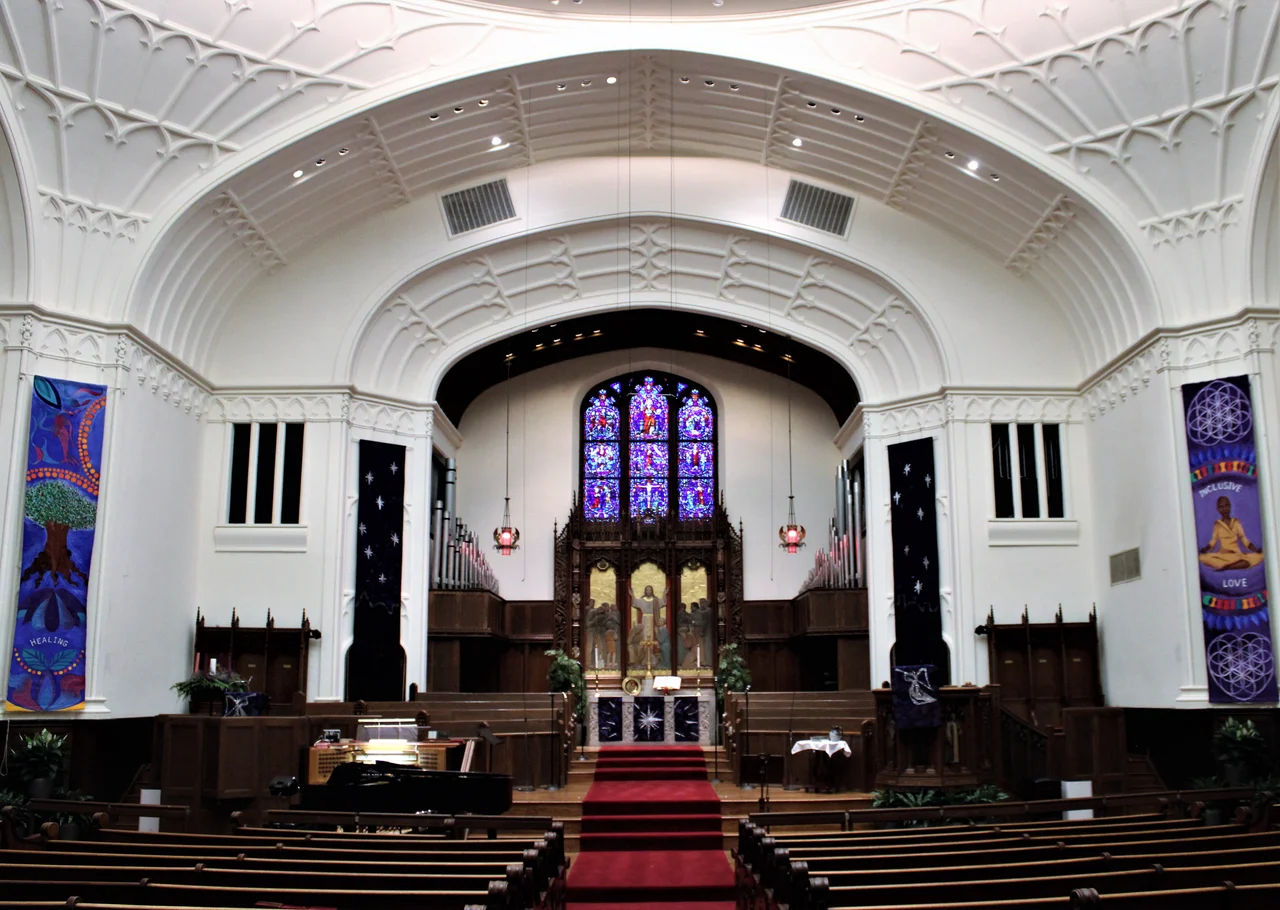

Foundry United Methodist Church
Henry Foxall watched from a hill in Georgetown as the British Army marched on Washington in August 1814. He owned the Columbia Foundry, the largest cannon-foundry in the federal city, which made it a strategic target. The British had already burned the Capitol and the White House. The foundry was next. Then the weather changed. A heavy thunderstorm rolled in off the Potomac and the British column, fearing flooded approaches and impassable powder, turned away from the foundry and marched back toward Maryland. Foxall, a devout Methodist, took the storm as divine intervention. He vowed to build a church in gratitude. He kept the vow. The church he founded in 1814 still stands, on different ground than the original, with a different building, but with the same name: Foundry.
The Ironmaster's Vow
Henry Foxall was an English immigrant, an associate of Francis Asbury, the founder of American Methodism, and a lay preacher himself in addition to running the Columbia Foundry. After the thunderstorm of 1814 spared his foundry, he donated land and funds at 14th and G Streets NW for a simple brick church. The congregation was organized in 1814 with Stephen G. Roszel as its first preacher in 1815. The name Foundry Chapel was first used in 1816. The congregation became an independent charge of the Methodist Episcopal Church in 1817. Foxall went on to serve as mayor of Georgetown. He never gave up his Methodist preaching, and the name Foundry has stuck to the church through two relocations and two centuries.
Lincoln at the Pew
On January 18, 1863, President Abraham Lincoln attended a service at Foundry just after he had signed the Emancipation Proclamation. The visiting preacher was Bishop Matthew Simpson, an Indiana Methodist who was raising money for missionary work and who would later deliver the eulogy at Lincoln's funeral. Simpson, in the middle of his sermon, proposed that Lincoln be made a life director of the Methodist Missionary Society. The congregation took up an immediate collection. Lincoln, who attended a Presbyterian church in Washington but who was deeply respected across denominational lines for his religious seriousness, accepted the designation. The handwritten certificate naming him a life director of the society survives in the Library of Congress.
Christmas with Churchill
The current Foundry building at 1500 16th Street NW opened on February 28, 1904, after the original congregation merged with the Fifteenth Street Methodist Church and built a larger structure on land between Dupont Circle and downtown. The congregation's most famous wartime moment came on December 25, 1941, eighteen days after Pearl Harbor. Winston Churchill had crossed the Atlantic by battleship for what would become known as the Arcadia Conference, the first wartime strategy meeting between the United States and the United Kingdom. President Franklin Roosevelt brought him to Foundry on Christmas morning for a special interfaith service. The two leaders sat together in the front pew. The sermon was preached by Frederick Brown Harris, Foundry's pastor from 1924 to 1955 and the longest-serving Chaplain of the United States Senate in history. Newsreel cameras filmed the service. The image of the two Allied leaders worshipping together while their countries were at war was carried around the world.
The Clintons and the Welcome
In 1993, Foundry welcomed Bill and Hillary Clinton as members. The Clintons attended services about half the weekends they were in Washington during the eight years of the presidency, walking in through the side entrance with Secret Service protection. The senior minister at the time was J. Philip Wogaman, a former dean of Wesley Theological Seminary. Foundry under Wogaman and his successors became known as one of the most theologically progressive United Methodist congregations in the country. In 2010 the congregation voted overwhelmingly to allow same-sex marriages, placing it in direct conflict with the United Methodist Church's national prohibition. The vote was an early step in a long denominational reckoning that eventually split the UMC in 2024. In 2014, Ginger E. Gaines-Cirelli became the first woman to serve as senior pastor of Foundry. She continues to lead the congregation.
Pipes and Voices
Foundry's music program is one of the most active among Washington congregations. The 55-voice Foundry Choir was selected to lead the opening communion service of the 1984 United Methodist General Conference, which marked the bicentennial of Methodism in America. The church organ, a Casavant Freres instrument with 3,364 pipes and 60 ranks, was installed during the 1984 renovation. A committee led by organist Eileen Guenther supervised its design and voicing, with particular attention to French Classical and Romantic literature. Guenther gave the inaugural recital in February 1985. The pipes ring up to the vaulted ceiling above pews that have held a president celebrating freedom, two world-war leaders sharing Christmas, and a congregation that, two centuries after a thunderstorm spared an ironmaster, is still trying to figure out what its faith means.
From the Air
Foundry United Methodist Church is at 38.9111 degrees north, 77.0364 degrees west, at 1500 16th Street NW in the Logan Circle / Dupont area of northwest Washington. Best viewed at 1,500 to 2,500 feet AGL with 16th Street running south to the White House clearly visible. Reagan National (KDCA) is five nautical miles south. The site sits inside the P-56 prohibited area; viewing is from authorized riverside approaches.
Nearby Stories
- Gunston Hall 1.1 km away
- 2023 Baltimore Shooting 4.9 km away
- Battle of Middleburg 6.6 km away
- Crownsville Hospital Center 10 km away
- Battle of Loudoun Heights 13 km away
- First Battle of Rappahannock Station 20 km away
- Howard County, Maryland 21 km away
- Harriet Tubman Underground Railroad 50 km away