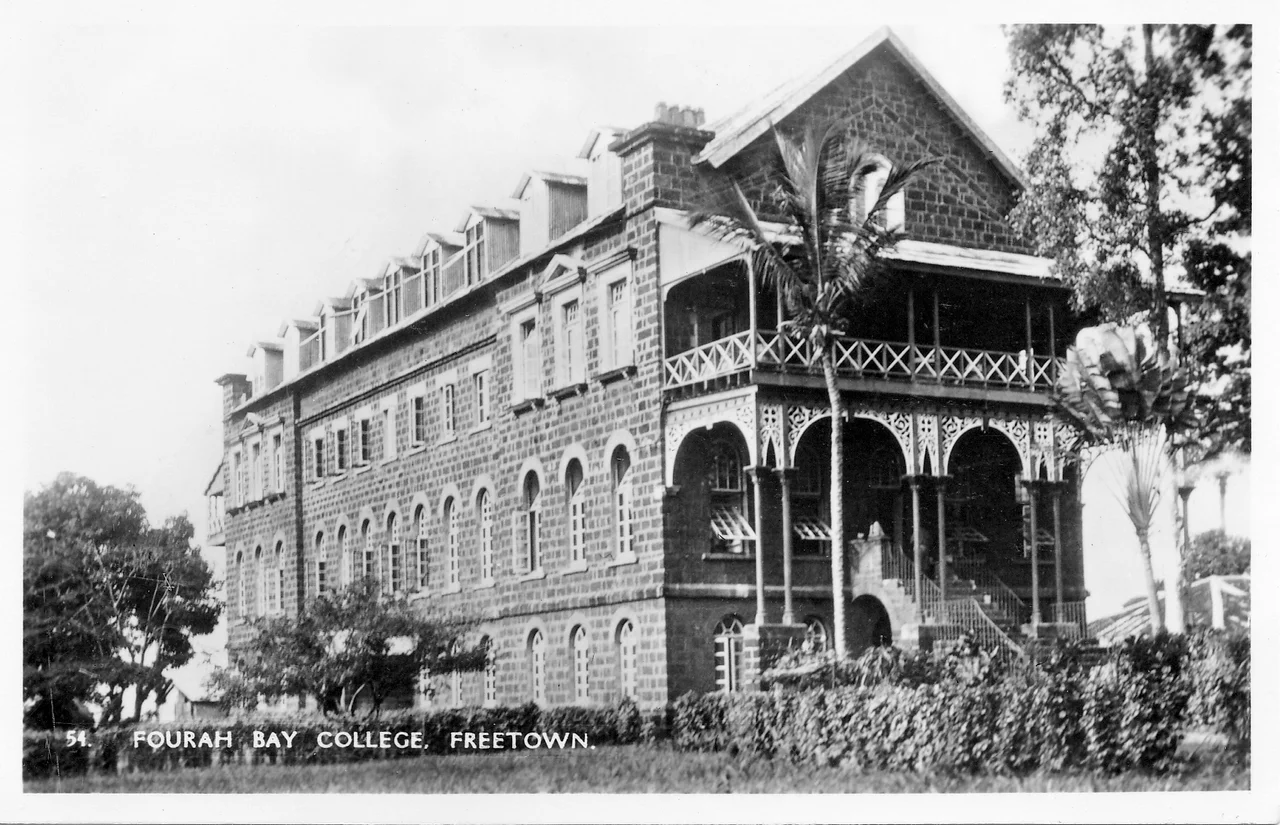

Fourah Bay College
Its first student had once been a captive. Samuel Ajayi Crowther was a Yoruba boy of about twelve when slavers seized him in the 1820s and sold him to a Portuguese ship — a ship that a British anti-slavery patrol intercepted, landing him as a freed man in Freetown. A few years later, in 1827, he enrolled as the very first student at a new Anglican school on a hill above the harbor. That school became Fourah Bay College, the oldest Western-style university in sub-Saharan Africa, and Crowther became its most famous early son: a linguist, a translator, and the first African Anglican bishop. The institution began as he did — improbable, and pointed toward something larger.
A School on the Hill
Fourah Bay College was established in February 1827 by the Church Missionary Society. It opened as a missionary school in a Freetown that was itself unusual: a colony founded as a home for freed and recaptured Africans, including thousands liberated from intercepted slave ships. The college grew quickly into a magnet for ambitious students from across British West Africa. Nigerians, Ghanaians, Ivorians and many others came to study theology and education here, joining the local Sierra Leone Creole community. In time it was the first Western-style university in the whole of West Africa — and a rare place, in the nineteenth century, where Africans could pursue a university-level education on their own continent.
The Athens of West Africa
So many fine schools clustered in and around Freetown that the city earned a striking nickname: the "Athens of West Africa." Fourah Bay sat at the center of that reputation. Its early principals included Edward Jones, an African-American missionary from South Carolina who became the institution's first Black principal and supervised construction of the original college building, begun in 1845 when Governor William Fergusson laid its foundation stone. From 1876 the college was formally affiliated with Durham University in England, allowing its students to earn recognized degrees — a connection that lasted until 1967. For nearly a century, Fourah Bay was where West Africa came to be educated.
Who Walked These Halls
The roll of alumni reads like a who's who of West African public life. Sir Samuel Lewis became the first mayor of Freetown and the first West African knighted. Africanus Horton, surgeon and scientist, argued for African self-government a full century before independence arrived. Christian Frederick Cole became the first Black graduate of Oxford and the first African barrister in the English courts. Lati Hyde-Forster broke ground as the first woman to graduate from the college. Presidents, chief justices, bishops, poets and the lyricist of Sierra Leone's national anthem all passed through. Yvonne Aki-Sawyerr, the current mayor of Freetown, studied here too. Few institutions anywhere can claim such a concentration of a region's leadership.
The Old Building's Long Decline
That original college building — the stone landmark begun in 1845 — had a turbulent afterlife. It stayed in use until the Second World War, when the college relocated outside Freetown for safety. Afterward the building served as the headquarters of the Sierra Leone Government Railway and later as a magistrate's court. It was proclaimed a National Monument in 1955, fell out of use by 1990, and was gutted by fire in 1999. Today its weathered façade stands as both a relic and a symbol — a reminder of how much history this hillside has held, and how fragile heritage can be.
Still Teaching
The college did not stop at theology. Over the decades it expanded into faculties of arts, law, engineering, the sciences, social sciences and accounting, and added institutes including a notable Institute of African Studies, established in 1964 to study the continent on its own terms. Now a constituent college of the University of Sierra Leone, perched in the Mount Aureol neighborhood with the city and harbor spread below, Fourah Bay continues to educate new generations. Nearly two centuries after a freed captive named Crowther became its first student, the institution remains what it has always been: a place where West Africa comes to learn.
From the Air
Fourah Bay College sits at 8.49°N, 13.21°W on Mount Aureol, in the hills above central Freetown on the Sierra Leone peninsula. The nearest airport is Freetown–Lungi International (GFLL), across the estuary about 13 miles to the north. From the air the campus occupies a green ridge overlooking the city and one of West Africa's finest natural harbors. Approach from the Atlantic side for a clear view of the peninsula mountains rising behind Freetown; clearest in the December–April dry season.
Nearby Stories
- Tombo, Sierra Leone 11 km away
- Mabilafu 50 km away
- Makeni 68 km away
- Îles de Los 75 km away
- Bonthe 83 km away
- Sandervalia National Museum 98 km away
- Loos Islands 106 km away
- Rocas Atoll 2605 km away