
Fringe Club
Every room in the Fringe Club has a previous life. The jazz bar was once a dairy shop selling milk and ice cream, its 1913 tiled floor still underfoot. The black-box theatre stored fur coats in cold darkness. The cafe was an ice-processing warehouse, its original white tiles intact on every wall. In 1984, when Benny Chia and his collaborators took over this abandoned Victorian depot on Lower Albert Road in Central, they were not just rescuing a building — they were transmuting something ordinary and commercial into something the city urgently needed: a home for art that didn't fit anywhere else.
Blood and Bandages on Lower Albert Road
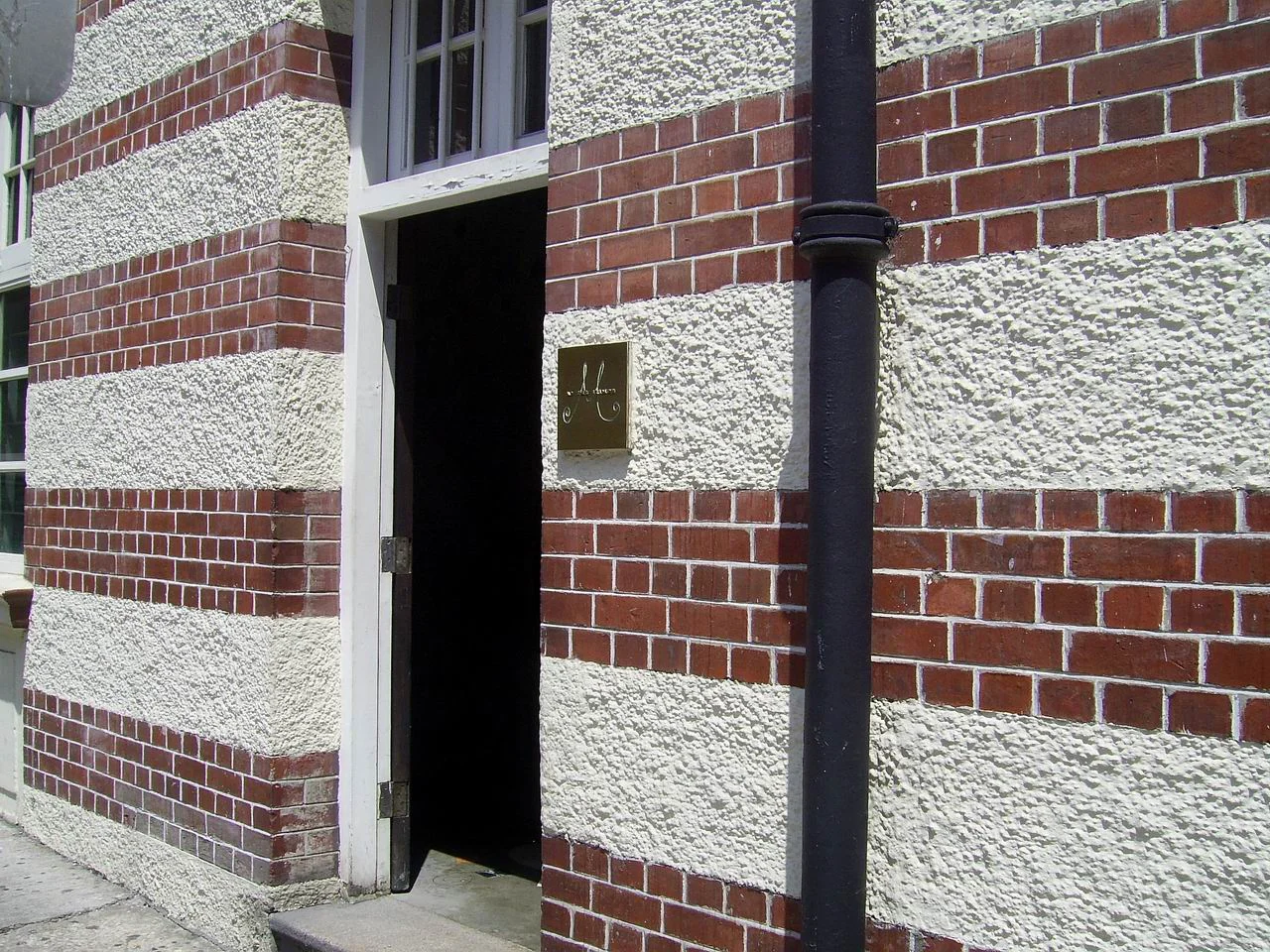
The building that houses the Fringe Club is easy to spot on Lower Albert Road. Its facade is described — affectionately — as "blood and bandages" brickwork: alternating bands of red brick and pale stucco that give it the look of a Victorian confection dropped into one of Hong Kong's most expensive neighbourhoods. Dairy Farm International built it around 1892 as a cold-storage warehouse, a practical structure serving a practical purpose. Over the following decades it expanded to include a dairy shop, a meat-smoking room, a winter-clothes storage vault, and residency for the general manager. By the 1970s the company had moved on, and the building sat empty — a Grade I heritage building waiting for someone to notice it.
The Organisation That Refused to Charge Rent
What makes the Fringe Club genuinely unusual is not just its building — it is its founding principle. Founded as a not-for-profit organisation, its mission from the beginning has been to provide rent-free contemporary arts space for exhibitions and performances. In a city where commercial rents rank among the highest on Earth, that commitment is radical. The organisation supports itself through food and beverage revenue, ticket sales, membership fees, advertising, and donations, with backing from the Hong Kong Arts Development Council. In 2001, it won a Hong Kong Government Heritage Award for its use of the historic building — recognition that conservation and living culture are not necessarily in conflict.
What the Ice Vault Became
Walk through the Fringe Club today and the building's former life surfaces in every corner. The Fringe Vault, where blocks of ice, dairy products, and cold meats were once stored, is now a cafe where those original white-tiled walls have been preserved rather than painted over. The Fringe Underground Theatre — formerly the warehouse where ice blocks were processed and cold meat prepared — has become a space for experimental performance and creative risk-taking, its industrial bones still present beneath the stage lighting. The Jockey Club Studio Theatre, a black-box venue, was once dry storage for fur coats. The Fringe Dairy, the only jazz and cabaret venue in Hong Kong, still has its French windows with wooden shutters, its overhead fans, its tiled floor from 1913. Converted, not erased.
The Artists the City Forgot to Accommodate
The Fringe Club's enduring purpose is less about the building than about who it serves. Emergent artists, experimental theatre makers, musicians working outside the mainstream — these are the people the Club was designed to support. It promotes Hong Kong artists internationally through cultural exchange and overseas touring, and provides gallery space for local and international contemporary work. The Anita Chan Lai-ling Gallery, converted from the old depot's garage, shows work that the larger institutional galleries often pass over. The Colette Artbar, named for the artist and actress Colette Koo, focuses on photography and painting. In a city that has sometimes been accused of valuing commerce over culture, the Fringe Club has spent four decades proving the accusation incomplete.
The Taipan's Fireplace
One room at the Fringe Club carries a different kind of history. What is now NOVE, a Chinese restaurant, was once the office and private residence of the Taipan — the senior executive of the Dairy Farm operation. The fireplace is still there, its chimney still connecting to the rooftop. It is a small, concrete reminder that this building once housed the hierarchy as well as the machinery of a colonial-era enterprise. The Fringe Club did not demolish any of it. Instead, it let the layers accumulate: dairy depot, company headquarters, arts centre. The fireplace stays. The art changes around it.
From the Air
The Fringe Club sits at 22.2802°N, 114.1557°E in Central, Hong Kong, at the base of the Mid-Levels on Lower Albert Road. Flying into Hong Kong International Airport (VHHH), approach from the west over Lantau Island and descend toward Victoria Harbour. At 3,000 feet, the dense grid of Central's skyscrapers becomes visible; the Fringe Club is tucked just below the green hillside where the Mid-Levels Escalator begins. The building's Victorian brickwork stands out against the glass towers on either side. Nearby landmarks include the Bank of China Tower, the former Central Police Station, and St. John's Cathedral.
Nearby Stories
- Lok Ma Chau Loop 2.3 km away
- Portas do Cerco 2.3 km away
- Kweilin Incident 17 km away
- Wanshan Archipelago Campaign 34 km away
- Nanxiong Formation 115 km away
- Battle of Nanpeng Island 148 km away
- Heyuan 169 km away
- Cape Maobitou 632 km away