_at_the_Archaeological_Museum_of_Kerameikos_on_27_June_2018.jpg)
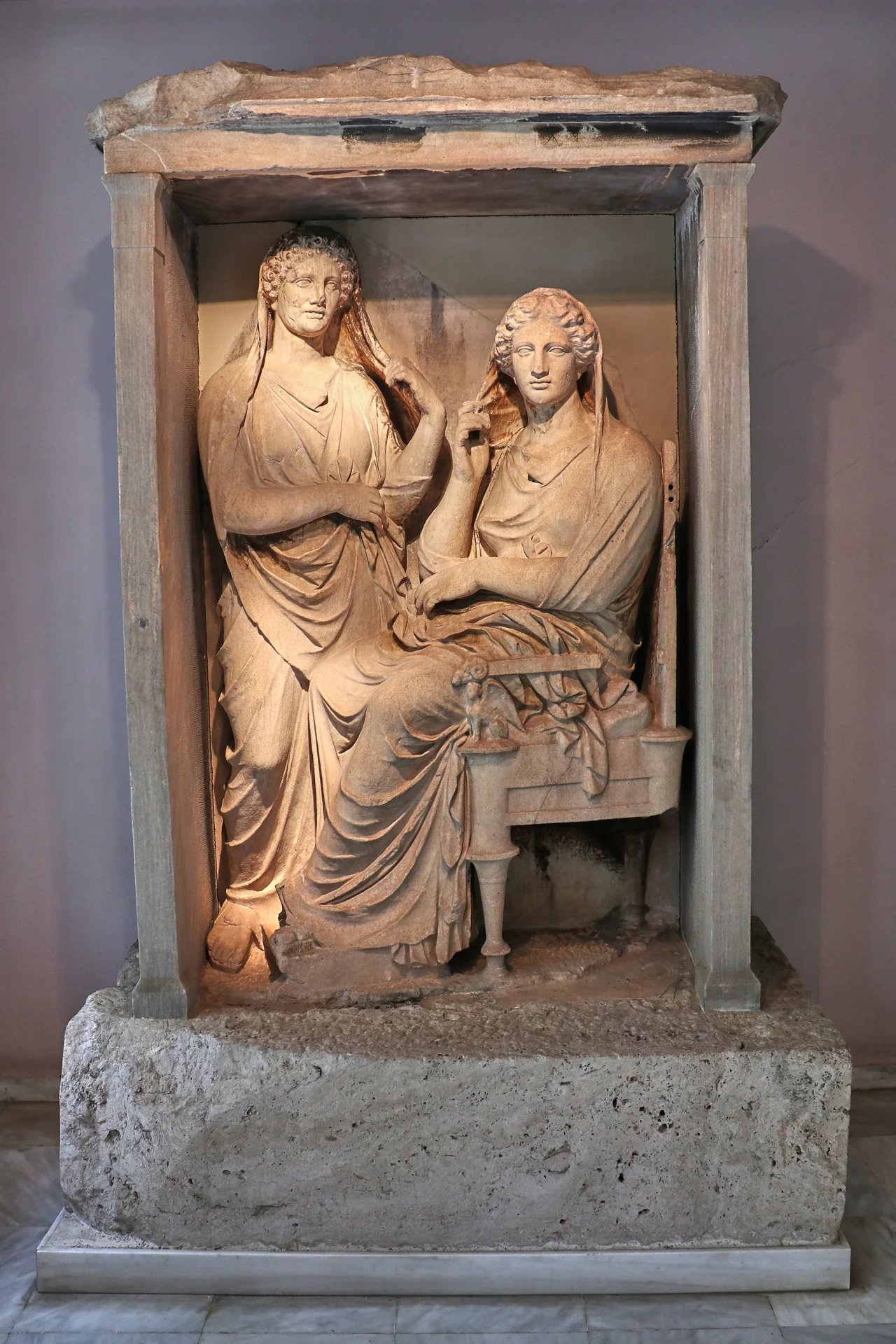
Funerary Naiskos of Demetria and Pamphile
Pamphile sits. Demetria stands beside her, a hand drawn up to the cloth covering her head. They are sisters, carved from a single block of white marble, and they look out at you with the flat, unreadable calm of people who are no longer here. One of them has been dead for decades. The other has only just joined her. In the Kerameikos cemetery, on the northwestern edge of ancient Athens, this small marble temple held the place where two women were finally laid side by side.
Two Sisters, Two Deaths
The naiskos, a word meaning "little temple," was carved around 320 BC, shortly after Pamphile died. She is the seated woman, the one most recently lost. Beside her stands Demetria, her sister, who had died at least two decades earlier. The sculptor reunited them in stone across the gap of years that separated their deaths. Both wear long folding chitons and the himation drawn over the head, the gesture of mourning and of the dead. Their hair is dressed in elaborate tresses, in the fashion of Athenian women of the fourth century BC. Pamphile's left leg pushes slightly forward beneath the cloth, a small motion the marble holds forever. The armrest of her chair ends in a ram's head supported by a siren, the kind of richly worked throne that grieving Athenian families chose for their daughters and wives.
The Stele That Came Before
There is a second monument from the same tomb, older and more tender. It was made for Demetria when she died, long before her sister. On that earlier stele the roles are reversed: Demetria sits, and the living Pamphile stands beside her. The two clasp hands in a gesture the Greeks called dexiosis, the handshake of farewell, the moment the dead let go of the living. It is a goodbye frozen mid-grip. On the later naiskos that handshake is gone. There is no one left to say goodbye to. Both sisters are dead now, and the sculptor gave them only stillness, two figures gazing out together, past mourning, past parting. The older stele itself is now kept in the National Archaeological Museum, but its heads were broken off long ago and are not preserved.
The Last of Their Kind
By the late fourth century BC, Athenian women had begun to appear in grave reliefs on their own, no longer needing a husband or father beside them to matter. Demetria and Pamphile are among them. But their monument belongs to the end of an era. In 317 BC, the governor Demetrius of Phalerum, a philosopher trained in Aristotle's school, passed a sumptuary law restricting the lavishness of tombs. Overnight, the great carved steles that had crowded the Kerameikos for generations stopped. The series of figurative funerary monuments simply ended. The naiskos of Demetria and Pamphile is one of the very last of its kind, a final flourish of private grief before the state decided that mourning, too, could be too extravagant.
What Survives
The original marble rests today in the Kerameikos Archaeological Museum under inventory number P687, just steps from where it once stood. On the ancient site itself, in the cemetery beside the museum, a plaster cast marks the spot, so that visitors walking the old burial road can still see the sisters where their family meant them to be seen. The monument was unearthed during excavations in the late nineteenth century, more than two thousand years after Pamphile's death. Whatever else has been lost of these two women, their names endure, carved into stone by people who loved them and wanted them remembered together.
From the Air
The Kerameikos lies at approximately 37.978 N, 23.717 E, just northwest of the Acropolis in central Athens. The site is a green archaeological clearing amid the dense city grid, near the Thissio and Kerameikos neighborhoods. The nearest airport is Athens International (Eleftherios Venizelos), ICAO LGAV, about 30 km to the east-southeast. From the air, the Acropolis and its limestone rock are the dominant landmark; the Kerameikos sits just beyond the ancient city walls to its northwest. Clear Mediterranean light makes the compact green of the excavation easy to pick out against the surrounding rooftops.
Nearby Stories
- Great Sand Beach 5 km away
- Battle of Delium 7.7 km away
- Tower of Aliartos 9 km away
- HMHS Britannic 10 km away
- Saronic Gulf 15 km away
- Sousaki Volcano 17 km away
- Sanctuary of Apollo Maleatas 24 km away
- Skyros 66 km away