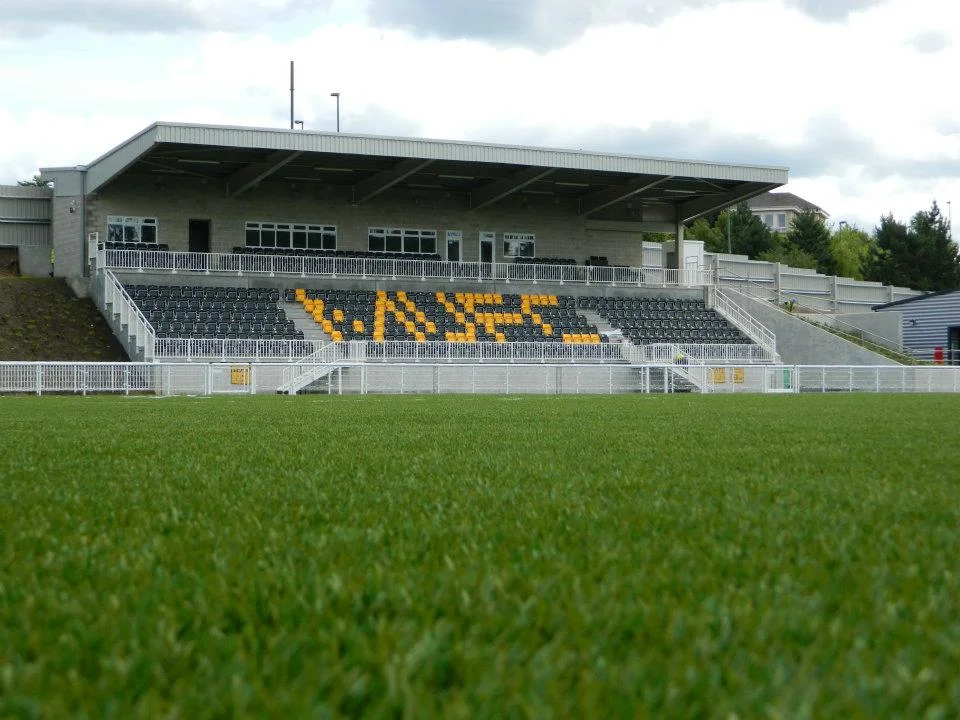

Gallagher Stadium
A colony of great crested newts almost stopped it. So did legal disputes, a turned-down £1.2 million grant from the Football Foundation, and twenty-four years of homelessness for a football club that had effectively died and been reborn. When Maidstone United finally walked out onto a pitch they could call their own on 14 July 2012, they were stepping not onto grass but onto a deep-pile carpet of artificial fibres - and that choice alone made Gallagher Stadium one of the most quietly radical grounds in English football.
A Club That Had to Reinvent Itself
The original Maidstone United had been a Football League club, and in 1988 they sold their stadium and moved into Dartford's ground in a move that destroyed them. The reformed club, born in 1992, started over in the Kent County League Division 4 - English football's most humble basement. Their home games were played at their predecessor's old training pitch off London Road. As they climbed the pyramid, they ground-shared first with Sittingbourne, then with Ashford, the way nomadic teams do when the legal documents and the bank balance won't agree on a permanent home. The preferred site at James Whatman Way, named for the paper-maker whose firm invented wove paper in Maidstone in the 1740s, sat empty and overgrown. The lease wasn't signed with the Ministry of Defence, the former owners, until March 2006, fourteen years after the new club's birth.
The 3G Gamble
When construction finally began in September 2011, Maidstone made the unprecedented decision to skip grass entirely. They became the first English club to build a stadium with third-generation artificial turf. The reasoning was practical: no more match postponements from waterlogging or frost, plus the pitch could be hired out for community use, generating between £120,000 and £150,000 in annual profit. Former Brighton manager Gus Poyet, after seeing his side play on it, called the surface "magnificent" and "perfection." West Ham legend Tony Cottee played a charity game there and pronounced 3G "a great idea" for non-league clubs. The Football Association eventually agreed - by the 2014-15 season, 3G pitches were permitted in every round of the FA Cup. That ruling brought BT Sport cameras to Gallagher Stadium for a First Round Replay against Stevenage, which Maidstone won 2-1, advancing to the second round on a surface that English football had once dismissed.
Naming the House
On 2 January 2012, with construction still underway, the Gallagher Group - the building, civil engineering, and quarrying firm that served as main contractor on the build - signed a five-year deal worth £150,000 for the naming rights. Before that, the ground was simply James Whatman Way, after the road. The stands grew in stages: a Main Stand on the east with 750 seats, press boxes, and executive lounges; a steep North Stand covering 1,768 standing supporters; and a shallower South Stand for 500 more. The west side remained undeveloped hard standing. Four pylons at the corners hold the floodlights. The first competitive match, against Walton & Hersham in August 2012, ended in a 5-4 defeat - the kind of opening fitting for a club that had spent two decades doing things the hard way.
The Newt Years and the Comeback
The story behind those statistics is one of repeated near-failure. Planning permission was finally granted in 2004, but only after legal challenges, and only once the colony of great crested newts living on the site had been properly accommodated under environmental law. Even with permission, the lease still took two more years to sign. A £1.2 million grant bid was rejected in 2008. The club nearly went under. A change of ownership in October 2010 changed the trajectory. A dedicated company called Maidstone United Ground Ltd was formed, £1 million was raised by summer 2011, and the freehold was bought outright from the MoD. Construction began that September. The 3G pitch went down between 30 April and 2 May 2012. The stadium was complete by 13 July. The next day, Brighton & Hove Albion visited for the opening friendly. Brighton won 5-0, with Craig Mackail-Smith scoring the first goal ever struck at Gallagher Stadium. None of the Maidstone fans seemed to mind.
By the River Medway
The ground sits on a former Royal Engineers drilling site beside the River Medway, off the A229 that links central Maidstone to the M20 motorway. Maidstone East railway station is a ten-minute walk away. The Main Stand was expanded in 2015 - adding 308 seats, lifting capacity over 3,030 - and a permanent North Stand was built in 2016 once Maidstone reached the National League, the top tier of non-league football. By May 2022, a crowd of 4,175 saw Maidstone host Hampton & Richmond, setting the stadium attendance record. The capacity today stands at 4,200, of which 792 are seated. Not enormous numbers in Premier League terms. But for a club that twenty years earlier had been playing on a training pitch borrowed from its dead predecessor, every seat is a small victory.
From the Air
Located at 51.28 north, 0.52 east, on the eastern edge of central Maidstone beside the River Medway. The stadium sits just north of the A229 dual carriageway. The closest major airport is London Gatwick (EGKK), roughly 25 nautical miles to the west; Manston (EGMH) is 30 nm to the east. Visible from cruising altitude as a compact four-stand ground with corner floodlight pylons.
Nearby Stories
- Blackwall Tunnel 0.2 km away
- London Gateway 2.6 km away
- Canterbury Castle 4.2 km away
- Battle Abbey 7.4 km away
- Plymouth Brethren 9.9 km away
- The Carrington Event: The Solar Storm That Could Happen Again 12 km away
- Clacton Pier 32 km away
- 2008 Channel Tunnel fire 42 km away