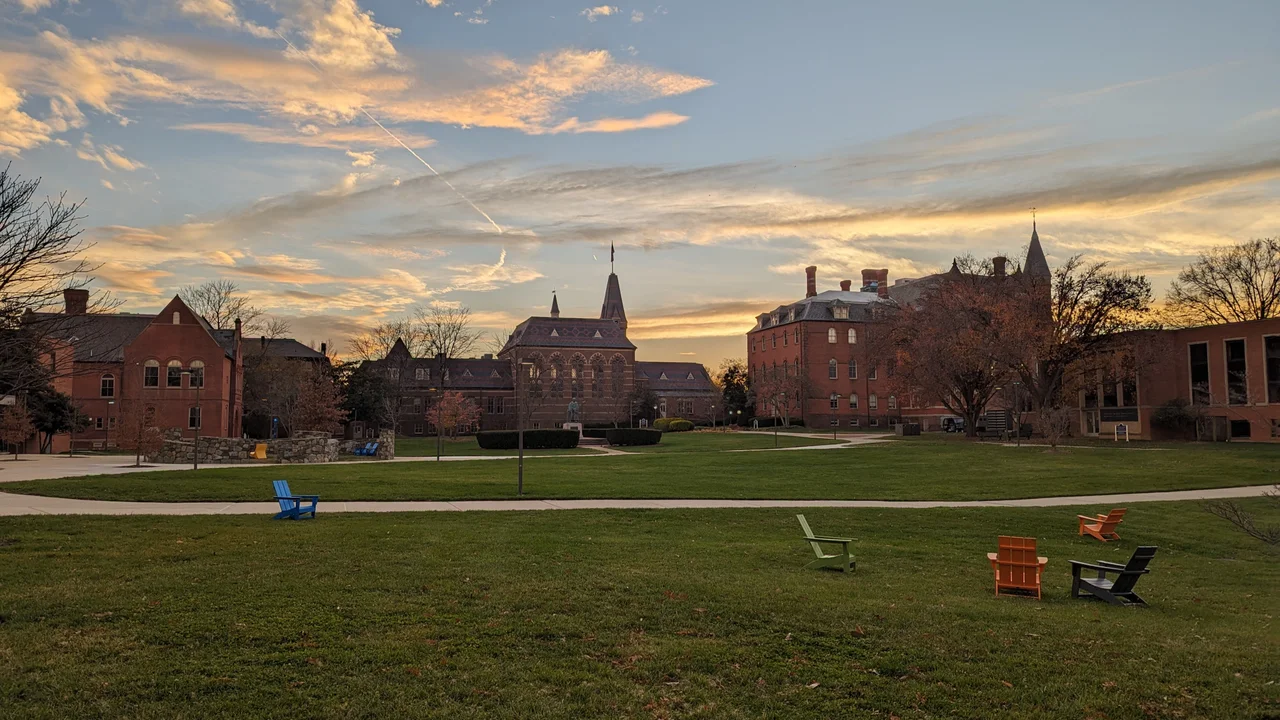

Gallaudet University
In the spring of 1988 the students at Gallaudet University locked the campus gates. Their demand was simple: a deaf president for the only university in the world that taught its classes in American Sign Language. The board of trustees had just chosen a hearing candidate over two deaf finalists, and the students had had enough. The week of protest that followed, known as Deaf President Now, became one of the most successful civil rights actions in American higher education history. The board reversed itself. Within seven days I. King Jordan, a deaf professor and Gallaudet alumnus, was named the university's first deaf president. The protests are taught in classes across the country today. The school they happened at is taught much less, mainly because most hearing Americans do not know it exists.
Lincoln Signs the Charter
Gallaudet University was founded in 1864 as a grammar school for deaf and blind children. Its origins trace back to philanthropist Amos Kendall, who had donated two acres of his farm in northeast Washington in 1857 for a school for deaf and blind children. The school operated as the Columbia Institution for the Deaf and Dumb under Kendall's protege Edward Miner Gallaudet, son of Thomas Hopkins Gallaudet (the famous educator who had brought sign-language pedagogy from Paris to the United States in 1817). In 1864, Edward Miner Gallaudet persuaded Congress to authorize his school to grant college degrees, and on April 8, 1864, Abraham Lincoln signed the charter, making the college part of the institution. It was the first college for the advanced education of deaf students in the world. Lincoln's signature on the charter is still on display on campus.
The Visual Campus
The 99-acre campus in northeast Washington was designed deliberately for a visual culture. Buildings are arranged so that students walking outdoors can see each other and converse from a distance using ASL. Doors are wider than standard to accommodate two-handed signers walking together. Glass walls and open sight lines are everywhere. The newest building on campus, the James Lee Sorenson Language and Communication Center, was designed in 2008 with what architects now call DeafSpace principles, which Gallaudet itself has codified and exports to architecture programs around the world. The visual quality of campus life can be hard for hearing visitors to register. Students notice each other across hundreds of feet of lawn and have conversations the way other students would across a coffee shop table. Doors do not slam. Bells do not ring. Visual fire alarms, flashing lights instead of bells, are used in every building. The acoustic dimension of conventional campus design simply does not exist here.
Deaf President Now
By 1988 Gallaudet had existed for one hundred and twenty-four years. It had never had a deaf president. The board of trustees announced on March 6 that it had chosen Elisabeth Zinser, a hearing administrator from North Carolina, over two deaf finalists. The chairwoman of the board, Jane Bassett Spilman, reportedly told the assembled students that deaf people were not yet ready to function in the hearing world. The students closed the gates with the help of buses they parked across the entrances. They issued four demands: a deaf president, the resignation of Spilman, a 51 percent deaf majority on the board, and no reprisals against student protesters. Within a week, all four demands were met. I. King Jordan, the dean of the College of Arts and Sciences, became president on March 13, 1988. Deaf President Now is now used as a case study in nonviolent direct action across American universities. The gates the students closed are marked on campus today with bronze plaques.
Two Languages
Gallaudet is officially bilingual. American Sign Language and written English are the languages of instruction. Hearing students are admitted in small numbers to the graduate school, and a handful to the undergraduate program. Classes can include simultaneous voicing for hearing students, but the default is signed. The Clerc Center, named for Laurent Clerc, the deaf French teacher who came to America in 1816 with Thomas Hopkins Gallaudet and helped found American education for the deaf, operates two model schools on campus from preschool through high school. The university's library holds the largest collection of materials on deafness and deaf culture in the world. In 2025 the executive cabinet, including the president, chief of staff, and most cabinet officers, were deaf. The leadership team is structured to reflect the student body it serves.
After 1988
The university has faced internal challenges since Deaf President Now. A 2006 controversy over the appointment of Jane K. Fernandes as Jordan's successor sparked another student protest, called Unity for Gallaudet, that resulted in Fernandes's withdrawal before she took office. The school has navigated questions about cochlear implants, about the changing definition of deafness, and about its relationship to the larger deaf community. Enrollment has fluctuated. Federal funding for the university (which receives a substantial annual appropriation as part of its 1864 charter) has been periodically contested. Through it all the school has continued to operate as the only college in the world where everyone signs. Roberta Cordano, appointed in 2016, was the first deaf woman to lead the university.
From the Air
Gallaudet University is at 38.9065 degrees north, 76.9961 degrees west, on Florida Avenue NE in northeast Washington, just east of the Union Station / NoMa neighborhood. Best viewed at 1,500 to 2,500 feet AGL with the Capitol clearly visible to the southwest. Reagan National (KDCA) is four nautical miles south. The site sits just outside the P-56 prohibited area but inside the Washington Class B veil; overflight requires ATC coordination.
Nearby Stories
- Gunston Hall 1.1 km away
- 2023 Baltimore Shooting 4.9 km away
- Battle of Middleburg 6.6 km away
- Crownsville Hospital Center 10 km away
- Battle of Loudoun Heights 13 km away
- First Battle of Rappahannock Station 20 km away
- Howard County, Maryland 21 km away
- Harriet Tubman Underground Railroad 50 km away