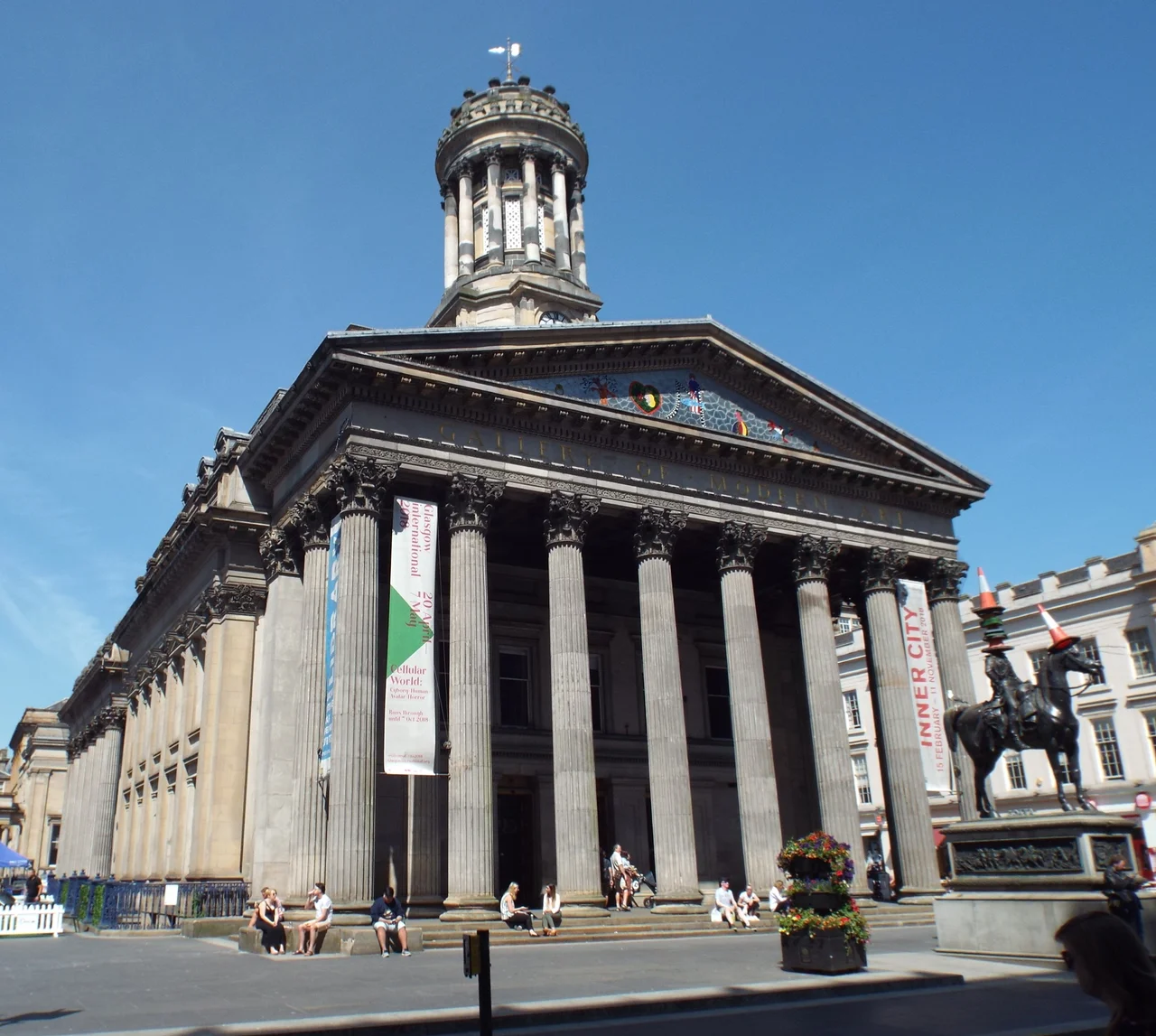

Gallery of Modern Art, Glasgow
The traffic cone is the point. Outside the Gallery of Modern Art on Royal Exchange Square, a Victorian equestrian statue of the Duke of Wellington has carried a striped orange cone on his head, on and off, for decades. Authorities have removed it. Glaswegians have replaced it. The council once estimated the back-and-forth cost ten thousand pounds a year and proposed raising the plinth to make it harder to climb. The proposal was scrapped after a public outcry, with thousands signing a petition to keep the cone. The cone has been painted gold for Olympic gold medals, replaced with an EU flag on Brexit Day, and crowned with a saltire during the Independence Referendum. It is, by most accounts, the most photographed object in Scotland.
A House Built on Tobacco
The grand neoclassical building behind the statue did not start out as a gallery. It was built in 1778 as a townhouse for William Cunninghame of Lainshaw, one of the Glasgow Tobacco Lords whose enormous fortunes came from a transatlantic trade powered by the labour of enslaved people in the Americas. Cunninghame and his peers grew wealthy on a system that traded human lives for leaf, and the elegant Georgian frontage on Queen Street is one of the most visible traces of that wealth in the modern city. The honest reckoning of where the money came from is now part of GoMA's own programming. The building has worn many uses since: the Royal Bank of Scotland bought it in 1817, and by the late 1820s it had been remodelled into the Royal Exchange, with the Corinthian portico and cupola added by the Glasgow architect David Hamilton between 1827 and 1832.
From Library to Gallery
Glasgow District Libraries purchased the building in 1949 for £105,000, and in 1954 moved Stirling's Library into the great hall, a room one survey of the period described as 'magnificent: 110 feet by 60 feet, divided into three parts by a double row of monolithic Corinthian columns and spanned by a richly ornamented arched ceiling thirty feet high.' Special bookcases lined up with the columns; fluorescent strips lit them; over a hundred volumes on pictorial art, three hundred on music, and eight hundred on parenting sat together under that ceiling. The library moved on. The building reopened as the Gallery of Modern Art in 1996, with the central hall converted into the city's principal contemporary art space. Today GoMA shows work by local and international artists, running temporary exhibitions and workshops, and uses its big biannual projects to take on contemporary social questions.
The Duke and His Cone
The equestrian statue of Arthur Wellesley, 1st Duke of Wellington, was sculpted by the Italian artist Carlo Marochetti in 1844. He sits, bronzed and dignified, on a stone plinth in front of the gallery. The first traffic cone is said to have appeared on his head sometime in the 1980s, the work of an anonymous Glaswegian after a night out. The authorities removed it. Another appeared. They removed that one too. Eventually the city seems to have accepted that this was now part of the statue. In June 2010, in the run-up to the opening of the citizenM hotel, the standard orange cone was swapped for a branded glitter version. The cone was painted gold during the 2012 London Olympics, in honour of Team GB's record medal haul and Scotland's share of it. A second gold cone followed for the 2014 Commonwealth Games hosted in Glasgow. On Brexit Day, 31 January 2020, a cone painted as the EU flag appeared. The cone has refused, every time, to stay off.
What the Joke Means
It is tempting to read the cone as just a recurring student prank, but anyone who has spent time in Glasgow knows it is more than that. The cone is a public refusal to take a war monument too seriously. It is also, quietly, an argument: that the city's monuments belong to the city, that humour can be a form of ownership, and that an old bronze duke is improved, not diminished, by an orange hat. When the council proposed in 2013 to double the height of the plinth so the cone could no longer be reached, more than ten thousand people signed a petition against the plan. The council backed down within twenty-four hours. The cone stayed. So did the gallery behind it, full of work by living artists and grappling with present-day questions, all under the watchful, slightly ridiculous gaze of a Duke who has finally been let in on the joke.
From the Air
Located at 55.860 N, 4.252 W in the heart of Glasgow city centre, on Royal Exchange Square just off Queen Street. From altitude the gallery sits in the dense Georgian grid between George Square and Buchanan Street. Glasgow Airport (EGPF) lies 8 nautical miles to the west. The city centre is visible from approach paths into runway 23. A low overflight at 2,000 to 3,000 feet gives a good view of the Merchant City quarter and the green dome of GoMA's cupola amid the surrounding sandstone roofs.
Nearby Stories
- Mauchline 3.6 km away
- Shotts 4.2 km away
- HMS Ulysses (1917) 7.7 km away
- Rothesay Castle 8.8 km away
- Inchcailloch 10 km away
- Strachur 14 km away
- Battle of Dollar 16 km away
- Crawford Castle 16 km away