.jpg)
Galway to Clifden Railway
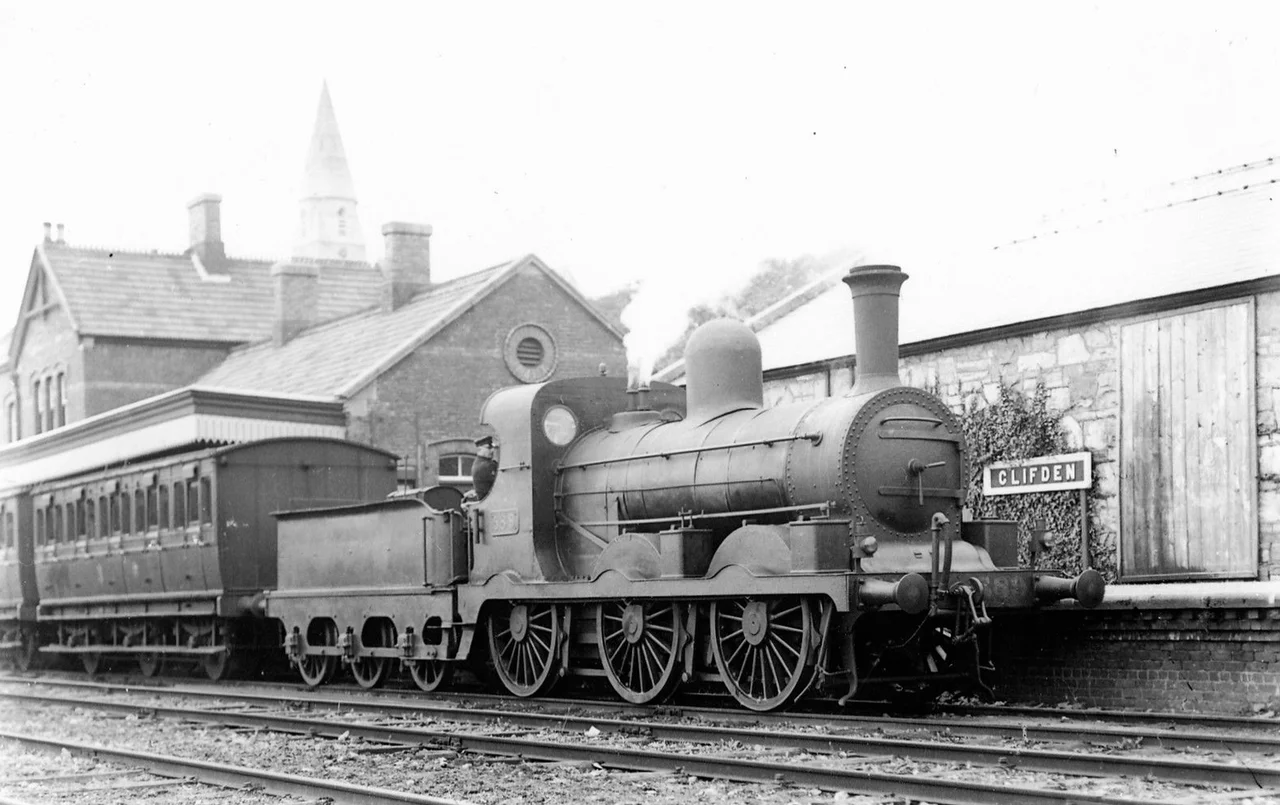
Ten pounds. That was the price the Great Southern Railways accepted from a German scrap metal company in the mid-1930s for the steel bridge that had once carried trains across the River Corrib in the city of Galway. The bridge was the largest structure on the Galway-to-Clifden Railway, a 48.5-mile line through some of Ireland's most spectacular landscape. It had taken five years to build, cost £410,000 in 1890s money (£264,000 of which came from the government as a free gift under the Light Railways Act), employed 1,500 workers at its peak, and carried Edwardian aristocrats in dining cars to their fishing lodges and summer houses in Connemara. By 1935 it was unprofitable. By the time the metal went to Germany, the rails were gone, and the road that became the N59 was being paved over the route the trains had taken.
A Matter of National Importance
Clifden in the 1880s was a town reached mostly by sea. Stagecoaches and wagons crawled the rough roads from Galway, and in bad winters they could not get through at all. The crop failures of that decade pushed Connemara's poor toward famine, and calls grew for a railway as a structural measure, a way of opening the region to wider markets and outside help. The project was described in those terms: a matter of national importance. But for years, no financing could be found. The route to Clifden was uneconomic on any honest reckoning. Then, in 1889, Arthur Balfour's Light Railway Act made state support available for railway projects with little prospect of profit. The Midland Great Western Railway proceeded with two such projects in the west: this Connemara line, and a parallel line from Westport to Achill Sound.
Construction in Hunger
Construction began in the winter of 1890-91, intended as an emergency works programme. Every job seeker was to be taken on. The construction company, run by Charles Braddock, did indeed accept all who applied. Then it failed to pay them. Strikes broke out in Clifden in March 1891, and continued for years as wages arrived late, partly, or not at all the further from Galway the work moved. In July 1892 the MGWR pulled the contract from Braddock and handed it to TH Faulkner, who paid more reliably. By November 1893, 1,500 workers were on the line. Social tensions ran high, often around the illegal sale of alcohol on the construction sites. The route itself was disputed. The 60,000 people of Connemara mostly lived along the coast, and a coastal route from Oughterard would have served them better. An inland route was chosen instead, possibly because the owner of Ballynahinch Castle donated large amounts of land for free. The decision shaped the line's future: shorter, cheaper to build, and through emptier country.
Dining Cars to Clifden
The line opened in two phases. The first section from Galway to Oughterard opened on 1 January 1895, attended by Joseph Tatlow, General Manager of the MGWR, and almost no one else; New Year's Day was reserved for church. On 1 July 1895 the full line to Clifden went into service. Freight traffic disappointed, but passenger traffic exceeded hopes. The wild romantic loneliness of Connemara was already a fashionable summer destination for the aristocracy, and the railway leaned in hard. Starting in 1903, dining-car expresses ran direct from Dublin to Clifden during the summer season. An upscale hotel was built at Recess station, deep in the mountains. Celebrities and aristocrats with fishing lodges in the area lent the place an extra cachet that the company advertised aggressively. Motor cabs developed a forerunner of bus routes from Clifden up to Westport, connecting the two MGWR western branches. For three decades, the line worked.
The End and the Trace
The First World War, the Irish War of Independence, and the Civil War that followed each cut into tourism. During the Civil War the line was damaged badly enough to require a seven-month shutdown. When peace came, road competition was already taking the rest of the traffic. In 1925 the railways of the new Irish Free State were merged into the Great Southern Railways. By the 1930s the deteriorating Connemara track needed a major rebuild, and the modest income could not justify it. On the afternoon of 27 April 1935 the last train left Clifden station, picking up the few remaining wagons at each station along the way. Then came the dismantling and the £10 sale of the bridge. The route still reads in the landscape: 41 bridges and culverts, the Prospect Hill tunnel in Galway, the pillars of the Corrib crossing, sections used as driveways. The Clifden station building survives inside a hotel complex. The locomotive shed is now a museum. The goods shed has been used as a theatre stage and a cinema. The railway is gone, but its track of ninety years has not been erased.
From the Air
The Galway-to-Clifden Railway ran 48.5 miles roughly east-to-west from Galway city (53.27°N, 9.05°W) to Clifden (53.49°N, 10.02°W). The midpoint at Maam Cross (53.46°N, 9.54°W) is the location now associated with the heritage railway revival. From altitude, much of the original track bed can be traced as a faint line through the bog and mountain country, particularly between Maam Cross, Recess, and Ballynahinch. Connemara Airport (EICA) sits near Inverin on the coast about 30 km south of the route; Ireland West Airport (EIKN) is about 90 km northeast. The Twelve Bens dominate the skyline southwest of the line; Mweelrea and the Maamturks rise to the north. Atlantic systems sweep through unpredictably.
Nearby Stories
- Salthill 4.4 km away
- Ardoileán 4.7 km away
- Ross Errilly Friary 5.1 km away
- Westport House 8.8 km away
- Kiltimagh 12 km away
- Inishmore 16 km away
- RMS Carinthia (1925) 32 km away
- Blackrock Island, County Mayo 32 km away