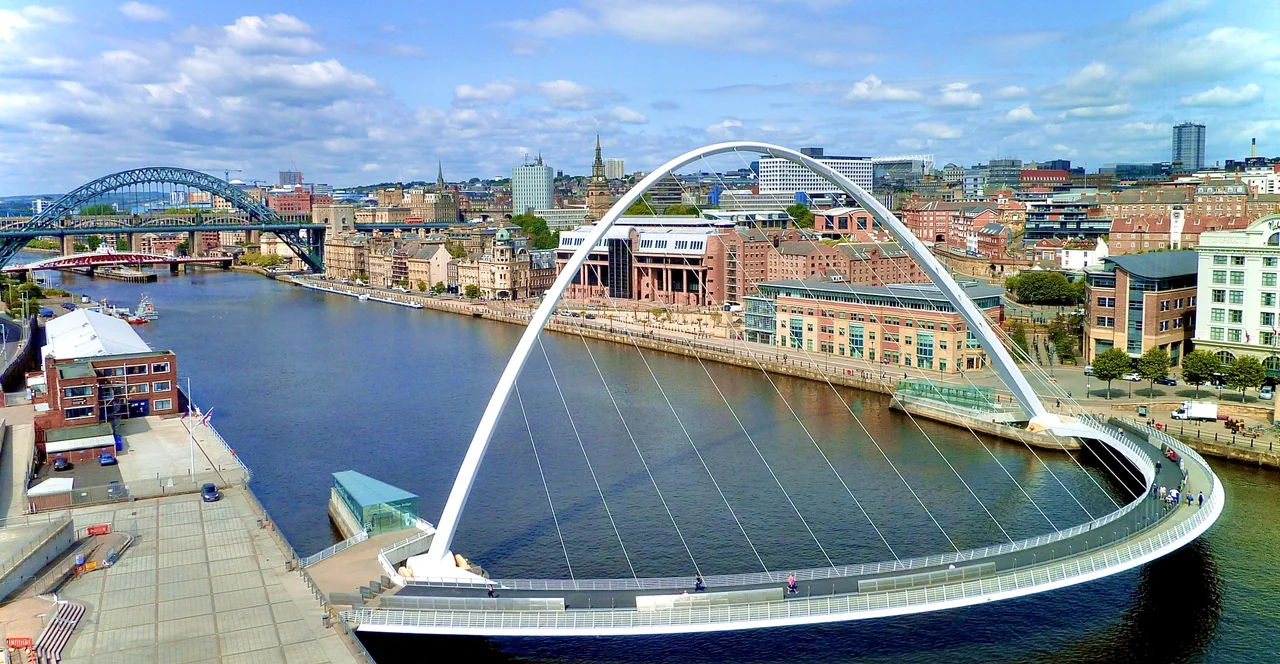

Gateshead Millennium Bridge
It costs around £3.60 to open the world's first tilting bridge. That figure - calculated from the electricity consumed by the hydraulic system over the four minutes it takes to pivot through its full 40-degree arc - is the kind of detail engineers tell with quiet pride. The two steel arches of the Gateshead Millennium Bridge rotate as a single unit. The pedestrian deck lifts. The supporting arch above it leans down. For a few minutes the silhouette resembles an eye slowly closing - or opening, depending on which side of the Tyne you're standing - which is why everyone here calls it the Blinking Eye, or sometimes the Winking Eye. On 28 June 2001, the first tilt happened in front of 36,000 spectators.
A Bridge to Match a Mill
By the mid-1990s, Gateshead Council had decided to convert the Baltic Flour Mills into a contemporary art centre. The Quayside needed a way to bring people across from the Newcastle side without obliging them to walk all the way around via the Tyne Bridge or the Swing Bridge. In 1996, the Council ran a design competition for a new pedestrian-and-cyclist crossing. By July 1997, a final design was being prepared for submission to the Millennium Commission for funding. The name itself caused a feud: Gateshead's preferred 'Baltic Millennium Bridge' was vetoed by Newcastle City Council, which didn't want its rival named on a bridge spanning shared water. Gateshead settled on 'Gateshead Millennium Bridge' in 1998, which Newcastle also disliked. The two councils have only sometimes been friends.
Four Constraints, One Solution
The design had to satisfy four awkward requirements. It needed to sit 4.5 metres above the Tyne at high spring tide when closed. Nothing could be built on the Gateshead Quayside itself. The deck slope could not exceed 1:20 to allow wheelchair access. And it had to let ships pass. WilkinsonEyre's answer was elegant: two steel arches sharing a common axis, one acting as the deck and one as the supporting cable arch above. When river traffic needed to pass, both arches rotated together as a single rigid assembly, lifting the deck out of the way. The 40-degree rotation completes in about four minutes. The system moves at 18 millimetres per second. It is mechanically simple, structurally honest, and, by accident or design, beautiful. The bridge is the twentieth tallest structure in Newcastle - shorter than the neighbouring Tyne Bridge, but no less famous.
Lifted in One Piece
Gateshead-based Harbour & General won the main contract, supported by Ramboll as consulting engineers. Watson Steel prefabricated the structure; Kvaerner Markham designed the hydraulic system. Each component was shot-blasted, painted in Hadrian's Yard 6.5 km upriver, and assembled by welding nine arch sections to nine deck sections, then attaching the cables. On 20 November 2000, the Asian Hercules II - one of the world's largest floating cranes - lifted the entire structure into place as a single 850-tonne piece. The barrier finally lifted to public traffic at 2 pm on 17 September 2001; the first crossers received a commemorative medal from the Council. Queen Elizabeth II formally dedicated the bridge on 7 May 2002 during her Golden Jubilee tour. Her plaque is bolted to the southern abutment. The Stirling Prize that same year went, controversially, to a bridge - some judges argued it wasn't architecture at all. Jim Eyre disagreed.
A Tilt by Request
The bridge tilts for events: The Boat Race of the North, the Cutty Sark Tall Ships' Race, civic celebrations. Most days it stays down. But the Gateshead Council will tilt it for free, at any hour, on seven days' notice - especially if you turn up with a vessel whose mast is no taller than 23.9 metres. The structure has been lit blue for the NHS during the 2020 lockdown, green for social care workers, and many other colours for many other causes. It has appeared in the BBC drama 55 Degrees North, the 2005 film Goal!, and on a first-class postage stamp in 2000. The Royal Mint put it on the one-pound coin in 2007. In 2003 it won the IStructE Supreme Award. In 2005 it took the IABSE Outstanding Structure Award. And for around £3.60 per opening, you can still watch it blink at the Tyne.
From the Air
54.969N, 1.600W. The Gateshead Millennium Bridge spans the River Tyne between Gateshead Quayside (with the Baltic to the south) and Newcastle Quayside (north). The distinctive double-arch eye shape is unmistakable from the air, especially when set against the parallel curves of the older Tyne Bridge immediately to the west. Best viewed at 1,000-3,000 ft AGL. Nearest airport: Newcastle International (EGNT), 5 nm to the northwest.
Nearby Stories
- Cresswell Lifeboat Station 5.2 km away
- Auckland Castle 5.7 km away
- Battle of Otterburn 7.1 km away
- Saltburn Pier 11 km away
- Hadrian's Wall Path 11 km away
- Battle of Stainmore 18 km away
- Saltburn-by-the-Sea 39 km away
- Alexander L. Kielland (Platform) 296 km away