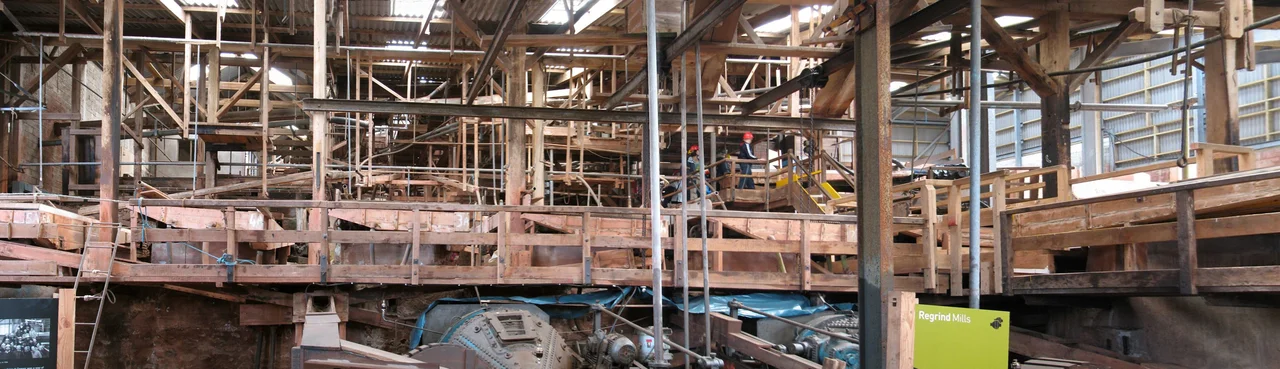

Geevor Tin Mine
The pumps switched off in May 1991. After seventy-nine years of working tin from beneath the Atlantic seabed, after Polish miners and Italian miners and Cornish miners had walked the same dripping galleries shift after shift, Geevor simply stopped. Water rose through the levels at a rate no one had wanted to imagine. Within months, the mine that had defined Pendeen and Trewellard since 1911 was a drowned cathedral of granite, cassiterite, and quartz. The men who knew its tunnels by feel became the last generation of Cornish hard-rock miners. They are also, by accident, the reason Geevor survived as memory.
Mine of the Goats
The name comes from Cornish: an early enterprise here was called Wheal an Giver, "a piece of ground occupied by goats." Tin and copper had been worried out of these cliffs since the late 18th century in small, often desperate workings, and by the 1880s as many as 176 men were pulling ore from the ground at what would eventually become Geevor. The shafts went down through coarse-grained Carboniferous granite into older Devonian killas, a metamorphosed jumble of sedimentary and volcanic rock that the geology textbooks still cite as a perfect contact zone. The cassiterite ran in veins angled northwest to southeast, never more than about one percent of the rock around it. Everything else had to be cut away, broken, hoisted, crushed, and washed. The tin was tiny. The labor was enormous.
The Victory Shaft
Wethered shaft, named for one of the mine's founders, was begun in 1909. By 1919, the workings were marching west toward the cliff edge, and a new shaft was sunk 540 metres to the northwest. They called it Victory, after the First World War's end. It carried the mine forward through every Cornish disaster that followed: the brief shutdown of 1921, the catastrophic tin crisis of 1930 that closed neighboring Levant and most of the rest of the county's mines for good. Geevor held on. After the Second World War, when British miners were scarce and capital scarcer, the mine recruited Polish and Italian men who had survived the chaos of Europe. They brought their families to Pendeen, learned a few words of Cornish English, and went down the Victory shaft alongside men whose grandfathers had been there before them.
Under the Sea
By the 1970s Geevor's sett covered roughly three square miles, including the absorbed workings of Boscaswell Downs, Pendeen Consols, and the old Levant mine. The miners pushed eastward into Levant's drowned undersea galleries, which had stood flooded since 1930. To drain them they first had to plug a hole in the seabed itself, a slow and dangerous task carried out far below the Atlantic. When the dewatering succeeded, the men stepped into chambers that had been sealed for forty years, picking their way past abandoned tools and rotted timber. They were walking through their grandfathers' shift. Above them, hundreds of feet of granite and then the rolling weight of the sea.
The Last Shift
World tin prices collapsed in 1985 and never really recovered. Geevor limped through the late 1980s on subsidies and stubbornness. The closure announcement in 1990 was not unexpected, but it broke the village all the same. Pendeen had been a mining village for the better part of two centuries; now the men of marrying age would have to leave, and many did. Some stayed and turned their hands to building what the mine had become: a museum. Through Cornwall County Council and Pendeen Community Heritage, the 67-acre site was preserved with its winding houses, dressing floors, and underground tour intact. It is the largest preserved tin mining site in Britain, an Anchor Point on the European Route of Industrial Heritage, and part of the Cornwall and West Devon Mining Landscape UNESCO World Heritage Site listed in 2006.
What the Mine Remembers
Walk the Geevor headlands today and you can hear the Atlantic against the cliffs the same way the day shift heard it changing in their lockers. The 19th-century waterwheel still turns. The Cornish stamps still stand. In the dry, where men washed off the red mud at the end of a shift, their clothes hang on numbered hooks, as if they might come back. Some of them, in their seventies and eighties now, do come back, as guides. They walk visitors past the place where a hole in the seabed once had to be plugged. They remember the names of the Polish miners and the Italian miners and the Cornish miners. The mine produced about 50,000 tons of black tin in its working life. What it produced afterward is harder to weigh: a village's memory, kept above ground, on a clifftop where the goats once grazed.
From the Air
Located at 50.1535°N, 5.6772°W on the north coast of Cornwall's Penwith peninsula, between Pendeen and Trewellard. The mine sits directly on the cliff edge above the Atlantic, with its winding-engine houses and stack visible from sea level approaches. Land's End Airport (EGHC) lies 3.5 nm south. The Pendeen Lighthouse stands about 1 nm to the northeast. Recommended viewing altitude 1,500-2,500 ft for the full clifftop spread; visibility is often sharpened by sea spray haze in westerly winds.
Nearby Stories
- Bartholomew Ledges Wreck 1.8 km away
- Carn Brea Castle 4.6 km away
- Battle off Lizard Point 12 km away
- Carnewas and Bedruthan Steps 18 km away
- King Charles's Castle 25 km away
- MV Cita 34 km away
- 1979 Fastnet Race 47 km away
- Trevose Head Lighthouse 55 km away